
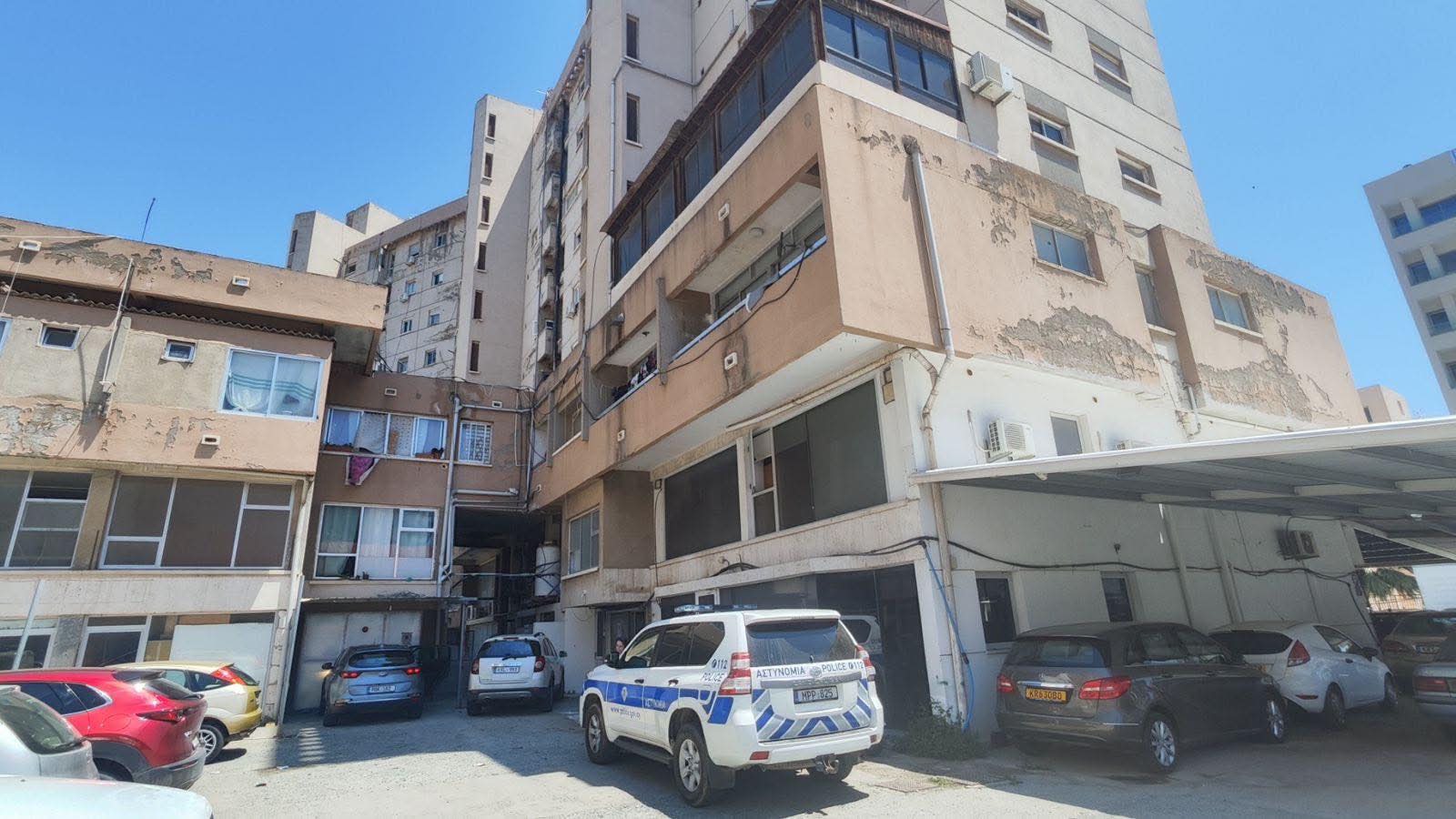
The Larnaca District local government organisation (EOA) is preparing to move ahead with the evacuation of a large apartment complex near Larnaca port if owners fail to address serious structural safety concerns, EOA president Angelos Hadjicharalambous said on Wednesday.
The three-day deadline given to approximately 90 property owners expired on Tuesday, but authorities have decided to give owners an additional two to three days to appoint an engineer and begin taking steps to address the building’s structural safety risks.
“If the owners appoint an engineer and show they are moving towards resolving the problem, they will be given more time,” Hadjicharalambous told the Cyprus News Agency (CNA).
However, he warned that if there is no compliance, the organisation will proceed with evacuation measures and, if necessary, seek a court order to enforce them.
The apartment complex, consisting of five blocks, 79 flats and 10 shops, has been classified as the largest building in Larnaca deemed at risk of collapse.
It came to public attention following a police immigration operation on May 27, during which one foreign national died and two others were injured after jumping from balconies in an attempt to avoid arrest.
According to Hadjicharalambous, notices were served on owners last Friday through door-to-door visits by EOA officials. During these inspections, officials encountered what he described as “appalling living conditions” and widespread illegalities.
“We found flats housing up to 10 people, with extremely poor hygiene conditions throughout the buildings,” he said.
Officials also discovered cases of illegal electricity connections, prompting calls for the involvement of the Electricity Authority of Cyprus (EAC) and the electromechanical services.
Hadjicharalambous said a coordinated response involving several government agencies is needed. Police should investigate illegal residents, the Larnaca municipality should address sanitation and nuisance issues, while the fire service must examine blocked emergency exits and fire safety concerns.
The EOA president also revealed that similar action is expected against other dangerous buildings across the district in the coming days.
Warnings will be sent to the owners of another 30 unsafe structures, 27 of which are occupied apartment buildings.
The organisation inherited responsibility for 563 dangerous buildings from previous authorities, including 359 from the Larnaca District Administration and 104 from Larnaca municipality.
By May 12, 2026, the EOA’s newly modernised register of potentially dangerous buildings contained 889 properties. Of these, 427 are located within Larnaca municipality, while hundreds more are spread across neighbouring municipalities and community clusters.
So far, visual inspections have been assigned for 150 buildings, with reports completed for 100.
The inspections identified 23 occupied and 40 unoccupied buildings within Larnaca municipality as Category C structures – the highest risk classification, indicating a visible danger of collapse.
Four occupied apartment blocks built under the government’s Ktizo housing programme have also been declared dangerous.
Among the 100 buildings inspected, 33 occupied properties were classified as dangerous, including eight in Category A (minor defects), two in Category B (extensive damage without immediate collapse risk), and 23 in Category C.
Of the 64 unoccupied buildings inspected, eight were placed in Category A, 16 in Category B and 40 in Category C. Three buildings have already been demolished or renovated.
Breaking down the figures geographically, Hadjicharalambous said 21 occupied Category C buildings are located in Larnaca municipality, one in Dromolaxia-Meneou and one in Pyla.
Among unoccupied Category C buildings, 20 are located in Larnaca, 12 in Lefkara, five in Dromolaxia-Meneou, one in Aradippou and one in Pyla.
The EOA is continuing to update its records, create a digital archive of dangerous buildings and procure services and equipment, including expert consultants, warning signs and safety fencing.
Authorities are also carrying out ongoing inspections and technical assessments while taking immediate protective measures where required.
Under Cyprus law, owners of dangerous buildings are required to address safety concerns once notified. Failure to comply may result in administrative fines, enforced safety works, evacuation orders or court action, depending on the severity of the risk.





Click here to change your cookie preferences