
What it was like in the Cyprus Mail newsroom
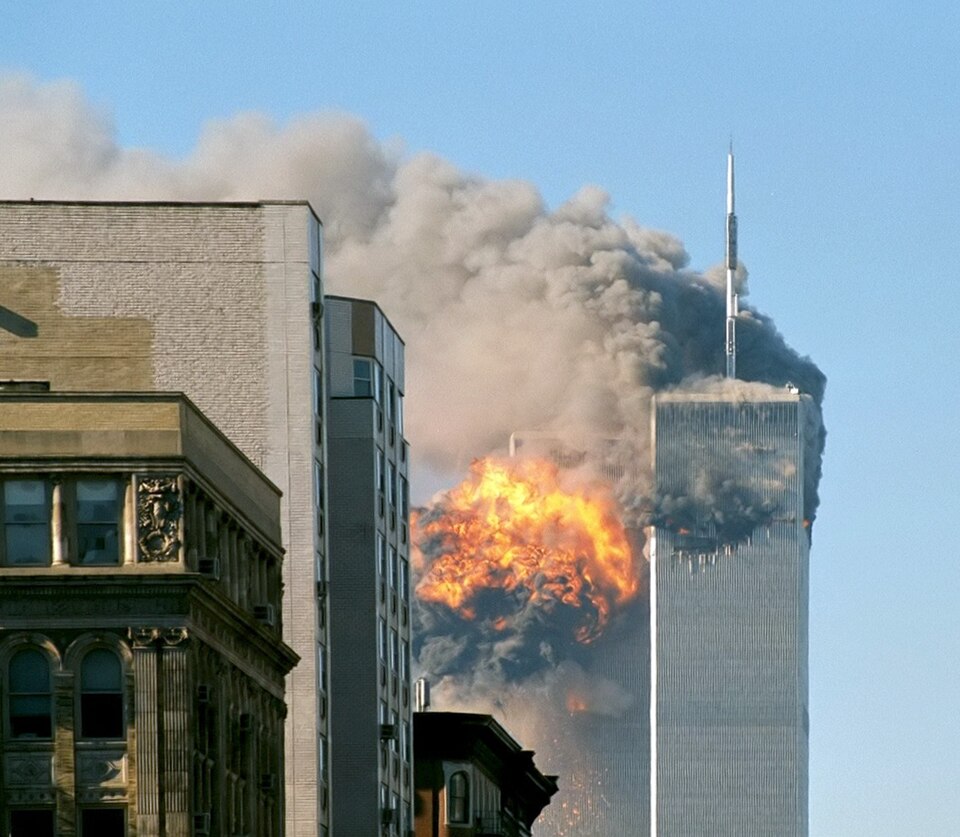
We all remember what we were doing, the day the world changed 25 years ago when the planes hit the Twin Towers in New York on 9/11, 2001. I was in a London department store at the time, stood in front of a television screen watching the second plane hit. Others remember rooms, conversations, phone calls.
For the people working at the Cyprus Mail on September 11, 2001, the attacks were not just the biggest breaking story in decades, they took place in an era with dodgy dial-up internet at best and without smartphones, social media and AI. News websites where they existed were utterly basic. This meant that all the images and news we currently have at our disposal were absent. Journalists were reliant on television screens, telephone calls and news wires.
On the afternoon of September 11 the plans for the next day’s Cyprus Mail newspaper were almost complete.
Jean Christou was the paper’s chief reporter at the time.
“It was a Tuesday, I remember,” she said. “We had an afternoon story meeting and we had decided on the front-page article for the next day.”
It was around 3.50pm in Cyprus when a colleague walked into the newsroom.
“Kosta [the local news editor] came and said, ‘Don’t worry about the front page, a plane has hit the towers.'”
At first, Christou said, they thought it was a small plane.
“We turned on the TV and saw the second plane hit. After that everything was put on hold.”
Twenty-five years later, much of what followed is a blur.
“Sometimes when you are in shock you just remember an image. That second plane was the image for me.”
Katy Turner, who was working on world news in the adjacent room, remembers the story arriving in a very different way.
“We got an urgent message from the Reuters news wire telling us a plane had hit,” she said. Then came another plane, and another piece of information, followed by another.
“We didn’t have the benefit of hindsight. We got one small piece of information and another small piece of information. It wasn’t immediately obvious what was going on.”
She remembers the newsroom speculating about who might be behind the attack and why.
For Turner, one of the moments when the scale of what was happening began to sink in was seeing then US President George W Bush being hurried away from the Florida school he was visiting.
Even the images were different from the torrent people would experience during a breaking story today.
“It was much slower,” she said. “There weren’t lots and lots of different images of people running down the street.”
What readers saw on the morning of September 12 reflected what could be termed as an extraordinary night.
The Cyprus Mail front page was dominated by images of the burning towers under the headline “Terror jets hit US”. Beneath it were all the facts available by the time the newspaper went to print, “Tremendous loss of life feared”, an airliner had slammed into the Pentagon, another had crashed near Pittsburgh and the US suspected Osama bin Laden.
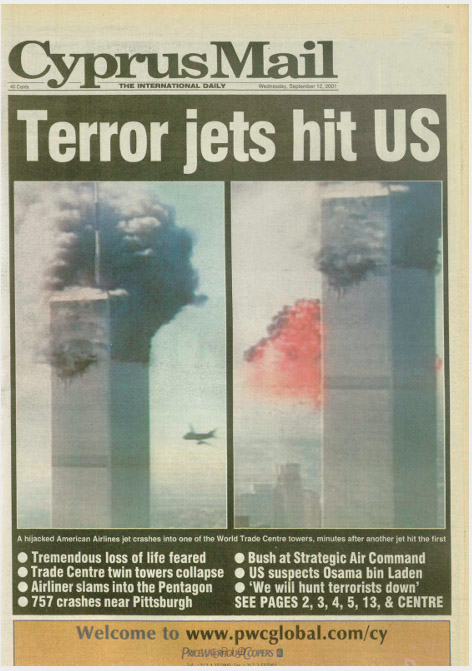
Inside, the paper called it the “Worst attack on US since Pearl Harbor”, while another story asked whether Bin Laden had masterminded the attack. Tony Blair was already describing mass terrorism as “the new world evil”.
However for those pages to get from the newsroom to the readers it was a whole different process to the one we know today. To most it is an almost unrecognisable process.
Toulla, who worked in page setting, had been at home when the attacks happened as her shift began at around 5pm and normally continued until midnight.
When she arrived, the newspaper’s plans had changed.
“The editor told me to phone the printers and ask them what was the latest we could send the newspaper,” she recalled.
The answer was 4am.
“And we stayed until four in the morning.”
The front page that had been planned earlier in the day was gone, as were large parts of the original paper.
“Everything changed,” she said.
There was a lot of pressure and on top of that came a physical production process that belongs to another age of journalism.
The finished pages were output onto film. Toulla remembers going downstairs, where the film had to be processed using developer and fixer in a darkroom.
The films were then rolled up, and then somebody called a taxi to take them to the printing press.
“We had to send the films to the printers by taxi,” she said.
Over the next few days the newspapers taken from the Cyprus Mail archive show how rapidly both the story and the world’s understanding of it changed.
By September 13, “Terror jets hit US” had become “Bush calls it an act of war”.
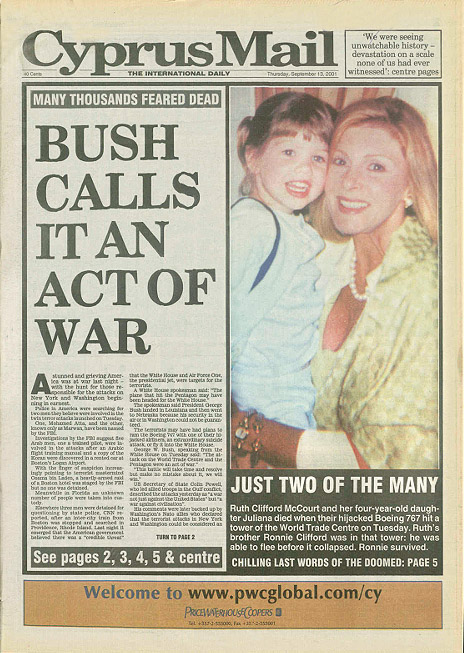
The scale of the human loss was also beginning to acquire names and faces, the front page carried the photograph of Ruth Clifford McCourt and her four-year-old daughter Juliana, who had been aboard Flight 175, along with the news that thousands were feared dead. The final tally would be 2,977.
One headline reported that terror suspects included a trained pilot, another asked how such devastation had been possible, while another focused on Bin Laden.
And Cyprus was no longer simply watching events thousands of kilometres away.
The September 13 edition reported that the US embassy was trying to track down Cypriots in New York, while Cyprus reviewed schedules in the wake of the attacks. President Glafcos Clerides’ planned talks with UN Secretary-General Kofi Annan were called off.
By September 14, the language had shifted again.
“America set to retaliate,” the front page declared.
There was now a much more immediate Cyprus connection, the newspaper reported that a Cypriot steward had been stabbed by the hijackers on Flight 175. Another page described “revulsion on the streets of Nicosia over attacks”, while flights from Cyprus to Israel were resuming.
A day later, the transition from shock to the expectation of war was almost complete.
The September 15 front page read “U.S. mourns and plans its strike”.
Meanwhile then foreign minister Yiannis Kasoulides met with UN Secretary-General Kofi Annan’s special advisor Alvaro De Soto as he was stranded in New York.
However for Katy Turner, September 11 did not end for months.
“There was one story for the next three months,” she said.
What she remembers most is not simply the intensity of that first night but the relentlessness of everything that followed.
“It was continual. Death, destruction, end of the world. No light at the end of any tunnel.”
Cyprus Mail features writer and film critic Theo Panayides experienced September 11 very differently.
He was thousands of kilometres away from the Cyprus Mail newsroom, in Toronto, covering the Toronto International Film Festival for the paper. For three days he had been sitting in cinemas watching films.
On September 11, he came out of one of them, and found people gathered around television screens.
Most of those around him were Americans. The US-Canada border had been closed and many suddenly had the immediate problem of not knowing how or when they would get home.
But what Panayides remembers most clearly was the strange collision between fiction and reality. People have often described the images of September 11 as looking like a film and for him, having spent days inside cinemas, that resemblance felt deeply uncomfortable.
“I remember I didn’t want to watch the footage, because it felt like it was disaster porn,” he said.
“It was too near the bone. We’d been watching movies with these same people for the past three days and this was real and the other ones weren’t, but it looked the same.”
He remembers being the one person in the room who turned away from the television.
There was already a sense that what had happened would lead to war, although few could imagine what that would ultimately mean.
“We assumed it was going to be like bombing al-Qaeda or something,” Panayides said.
“But I don’t think anybody saw the next 25 years coming.”




Click here to change your cookie preferences