
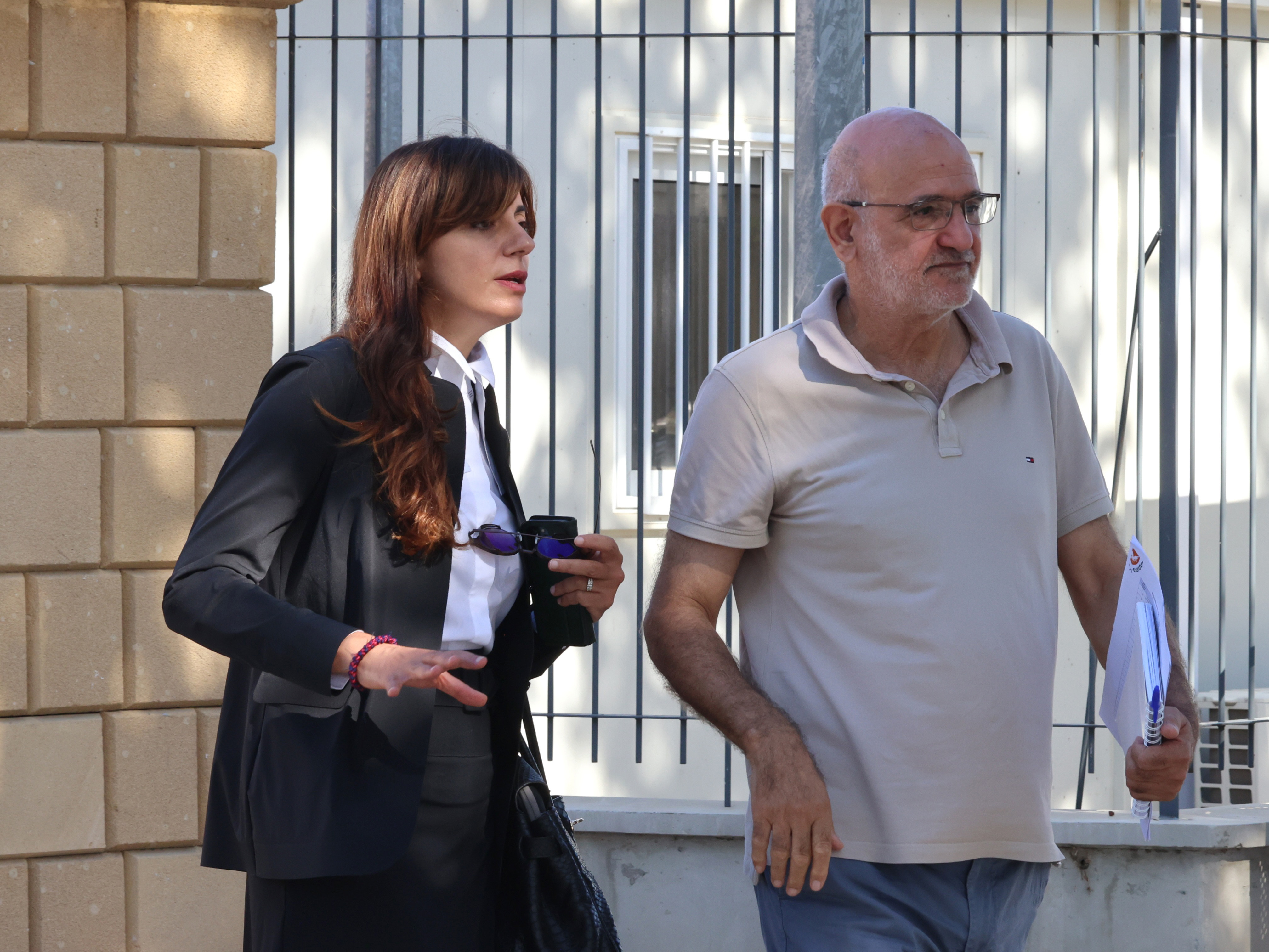
Journalist Makarios Drousiotis and Kyriaki Kyriakou, also known as Sandy, were on Wednesday referred directly to the Nicosia criminal court for trial in connection with the “Sandy” case, which involves a total of 101 charges.
The referral came during the defendants’ first appearance before Nicosia district court.
Prosecutor Alexia Siapani told the court that the Attorney-General’s position was that the charges against the defendants were not suitable to be tried summarily and requested that the case be referred directly to the criminal court.
Lawyers for the first defendant, Leto Cariolou and Alexandros Clerides, argued that the charge sheet did not disclose a case suitable for trial before the criminal court, while reserving the defence’s right to raise the issue before that court.
The district court president said that although the charges could be tried summarily, given the Attorney-General’s position, the two defendants would be referred for direct trial before the Nicosia criminal court on December 15, 2026, at 9am.
Both defendants signed €10,000 bail bonds and were released pending trial.
Retaliatory process
Speaking after Wednesday’s hearing, Drousiotis described his referral to the criminal court as a “retaliatory process”, which he linked to his book Mafia State, while saying he retained full confidence in the Cypriot courts.
Drousiotis argued that, rather than being treated as a protected witness, he was being sent before the criminal court in what he described as an “abusive” process.
“Even if the charges stand, which in our view they do not, this is a case for the district court and not the criminal court,” he said.
He said the issue had been raised during Wednesday’s proceedings, arguing that the judge had indicated the case could be heard by the district court but was required to refer it to the criminal court following the Attorney-General’s request.
Drousiotis said he regarded this as evidence that the referral was retaliatory.
He went on to draw parallels with other people who had approached the Independent Authority Against Corruption, referring to former auditor-general Odysseas Michaelides and former prisons director Anna Aristotelous.
“This is effectively the self-abolition of the Anti-Corruption Authority and a message to anyone who has something to say or submit that, if they do so, they will find themselves in trouble,” he said.
Asked about the eventual outcome of the case, Drousiotis said he had “complete confidence” in the judicial process.
‘I do not feel the Cypriot courts have treated me unfairly’
“I have been through the courts many times because of retaliatory libel cases and I do not feel that the Cypriot courts have treated me unfairly,” he said.
The 101 charges include offences relating to forging documents, circulating forged documents, publishing false news and harassment.
The criminal case was filed by the Legal Service at Nicosia district court on July 24, following its examination of evidence submitted by police.
The case has drawn sustained public attention and relates to allegations made public by Drousiotis in March 2026, which subsequently became the subject of a police investigation.
In the post in question, Drousiotis, then a parliamentary candidate for Volt, made a series of allegations concerning corruption and other serious offences, referring, among other things, to a judge, the Legal Service, the ‘spy van’ case and the Focus case.
Police, after investigating the case, said they determined that messages on which Drousiotis’ post was based had been fabricated.
A joint investigation involving Europol and an FBI technical unit concluded in June that no testimony, forensic evidence or objective material supported the original allegations.
Forensic analysis of the disputed messages showed irregular timestamps, police said, concluding they were not genuine and had instead been produced using an application capable of generating fabricated conversations.
Investigators said Sandy had herself admitted to creating the messages and had identified the application used.




Click here to change your cookie preferences