

75 per cent of 16- to 24-year-olds read no books in past year, and the older adults aren’t much better
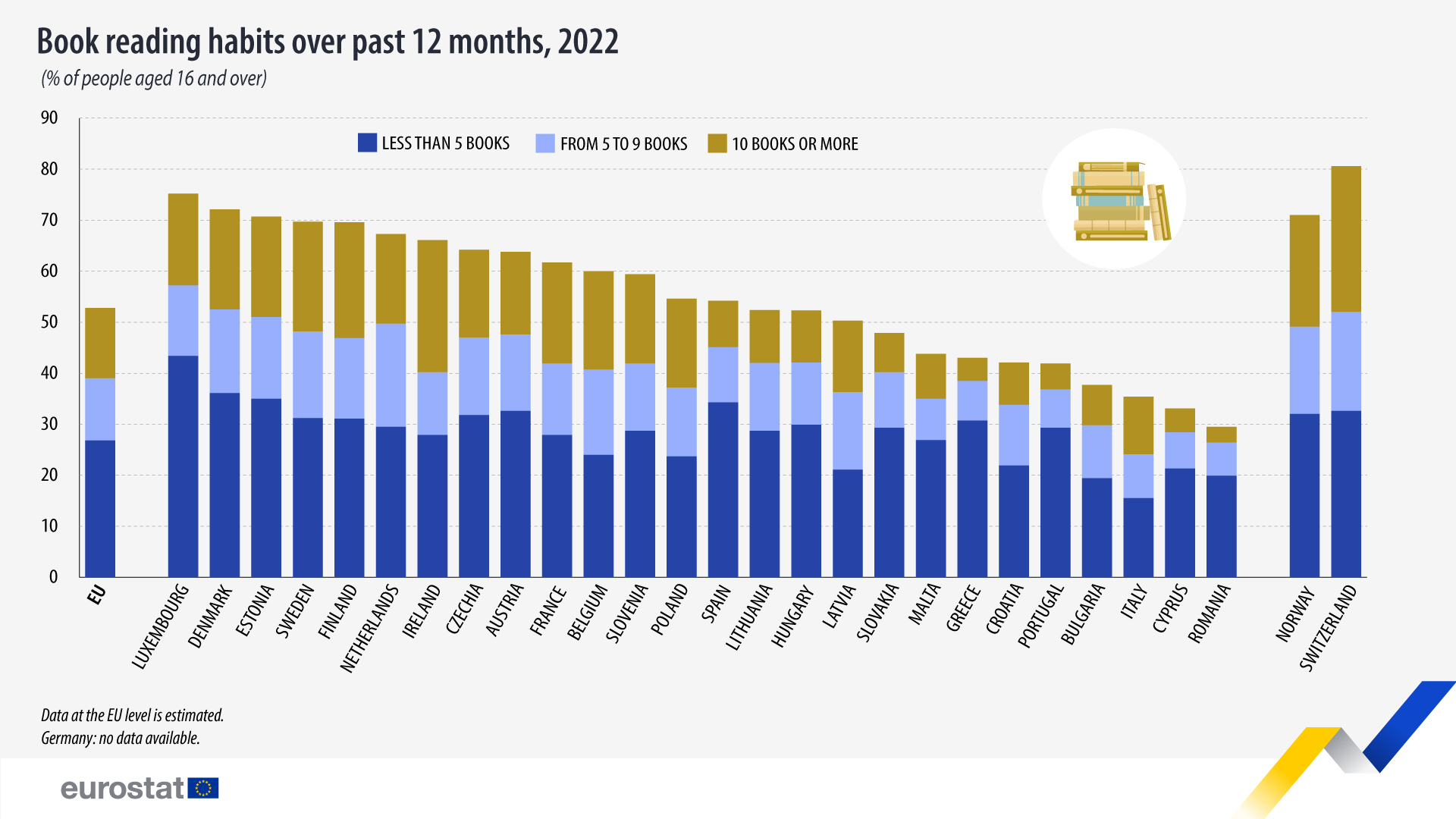
It’s no secret that Cypriots don’t read much. A Eurostat poll from two years ago ranked us second-last in the EU, behind only Romania.
That poll made waves, and was much talked about. Digging deeper, though, reveals an aspect of the research that wasn’t so highlighted, and is actually even more shocking.
Respondents aged 16 and over were asked how many books they’d read in the past year (for pleasure, i.e. not schoolbooks or manuals for work). Overall in the EU, 47.2 per cent of people said they’d read no books at all in the past year.
For Cyprus, that figure was a hefty 67.3 per cent – slightly worse (or better) than Romania at 70.6 per cent, though also behind Turkey (69.7) and Albania (70.8), non-EU countries that were also included in the study.
The encouraging trend shown by the poll was that younger people are reading more than older ones, with that 47.2 per cent of EU non-readers decreasing to 38 per cent in the 16-24 age group. In Cyprus, however, the trend is reversed – dramatically so.
If you take the figures only for the 16-24s, not only are we the least book-loving nation in Europe – the poll also included e-books and audio books, both fiction and non-fiction – it’s not even close.
Almost three quarters of our youngsters (74.9 per cent) hadn’t read a single book in the previous year. The second-place country is Italy, at 53.5 per cent. Romania is actually about average, at 37.3 per cent, so they’re obviously being dragged down by the older generations.
Young Cypriots stand out in European figures
For boys, our figure is 82.9 per cent, nearly 20 points higher than second-place Malta at 63.2 per cent. Girls are at 66.3 per cent, which is more than double the EU average of 28.3 per cent!
A couple of caveats. The EU averages are from 2020, so not directly from this research. It’s unclear if the poll includes comic books (probably), or makes allowance for voracious readers who consume newspapers and scientific articles rather than books (probably not).
Some may downplay the significance, since it’s really just the 16-24 age group that’s so extreme (not that the others are anything to be proud of). Then again, that’s the age when book-reading is perhaps most vital – when the adult self is formed, a young person’s ideas about society and politics are being shaped, the imagination is maturing. It’s the age when people read most, in other countries.
Imagination doesn’t just mean escapism. Reading – even more than watching films or listening to podcasts – also builds the “social imagination”, as Dr Anna Kouppanou, head of the Network of Schools for the Promotion of Reading for Pleasure at the Pedagogical Institute, told the Cyprus Mail.
“A book gives you the ability to imagine other environments. To identify with characters whose problems you may or may not relate to – and to begin changing your perspective a little bit, instead of just seeing through your own eyes.”
In short, books build empathy – an important trait on a small island that’s prone to xenophobia and also, lest we forget, is made up of two warring communities who often don’t know or understand each other.
Why do our young adults go off reading so comprehensively? And why do we read so little in general? On the second point, the poll’s publication two years ago led to some soul-searching.
What is driving the reading gap?
A Reddit thread from that time (in r/Cyprus) proffers various explanations. Cypriots work long hours, and have no time to read. Cyprus has no reading culture, having been till quite recently a village society with very little schooling or book-learning. Our weather is pleasant, so people prefer to go out and socialise.
When it comes to the young, other obvious explanations come to mind. The new generation are visual, not verbal. They’re obsessed with their phones, spending hours on social media. The digital world offers countless other ways to distract and educate themselves, apart from books.
Then again, none of that explains why Cyprus should be so different to other EU countries, where all those things also apply for young people.
What do the 16-24s themselves think? Reading isn’t really “a prominent social identity” among her peers, says Jennifar Ivanova, a 20-year-old archaeology student at the University of Cyprus, where she’s also president of the literature club.
“Someone might happily tell friends they’re into football, gym, travelling, fashion, K-pop or gaming, whereas saying ‘I read a lot’ can sound like an academic/intellectual hobby rather than a mainstream one.
Young people say reading is not part of the culture
“Also the difference in the culture: Cypriot youth has an outdoor/social culture (e.g. cafés, beaches, evening outings, family/social gatherings). Reading competes with a lot of activities that are particularly accessible because of the climate.”
“When other young people see me read in public, I am usually met with the same question: ‘Doesn’t that (reading) bore you?’,” adds 22-year-old history student Evaggelia Stavrinou.
“Personally, I believe the biggest ‘culprit’ is the Cypriot educational system and how it teaches literature as something exclusively academic and distant. Literature is never shown as something fun and entertaining.”
Programmes are in place to counter this, says Dr Kouppanou, various action plans including seminars to create so-called “reading teachers”. A lot does depend on the teacher, the more enthusiastic ones “transform their schools. They create libraries where they didn’t exist”.
Schools struggle to keep teenagers reading
Still, she admits, resistance grows as students hit puberty. “We have no problems passing on a love of reading in primary school. But we lose a lot of readers in the teen years.”
One significant detail, she says, is the relative paucity of Young Adult books in the original Greek (most are translations) – meaning fewer books set in Cyprus, with local dilemmas that Cypriot teens can relate to. That might go some way to explaining the difference from other countries, where youngsters can find books to reflect their reality.
And there’s also another difference.
“It’s because of the way of life in Cyprus,” says Andreas, a 21-year-old studying accounting and finance. Schoolkids “go to school, then they’re doing private lessons for the rest of the day”, so they’re tired out and certainly don’t want to do any more reading. “In other countries, they just have school.”
Private lessons are indeed unusual in Europe, at least to the extent we have here. Could that be part of the root cause – the way Cypriot teens aren’t allowed time to calm down after school, let their imaginations wander and roam a bit, but instead are thrust straight back into learning, so they end up losing their appetite altogether? And of course, by the time they get to uni (where they do have free time), bad habits have already set in.
Maybe. But the overriding factor is surely the lack of a reading culture.
Panayiota Charalambous is a 19-year-old computer science student, also at UCy. She’s an obvious outlier, reading “at least 15 books a year” – and it’s no surprise that her parents read too.
“From the time I was really small, I had contact with books. They were reading themselves, they read to me too. We all read, at home.”
In the end, the exceptions prove the rule: Cypriots just don’t read much. But that can change.



Click here to change your cookie preferences