
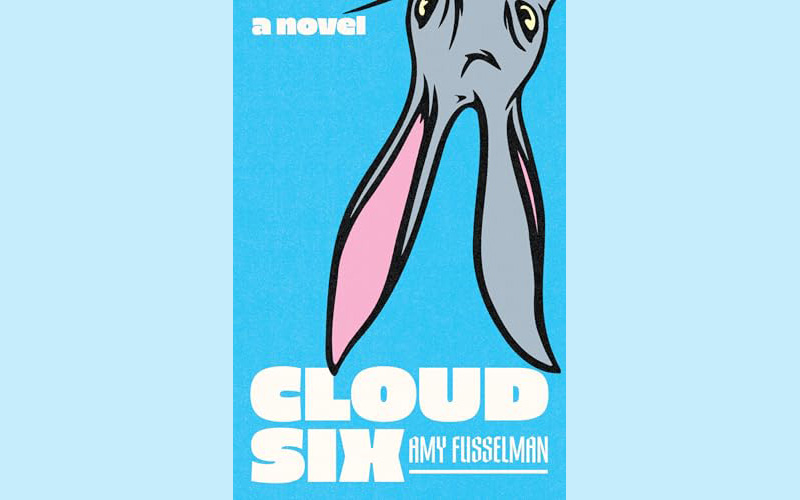
Book review: Cloud Six by Amy Fusselman
When one of Cloud Six’s two central characters describes the low-budget, distinctly unheavenly private extension to heaven that is Cloud Six as ‘just a confusing mishmash of crazy situations with no direction at all on how to navigate any of it’, he’s simultaneously talking metanarrative and existentialism. And, in essence, most responses to Cloud Six can probably be summed up as: if you like the idea of metanarrative and existentialism conveyed via a sequence of crazy situations that are only really held together by their own consistency, you’ll enjoy Cloud Six.
Mam and Bunko are planning a new life in Connecticut. Unfortunately, the plane they’re on explodes. So, the new life they actually get is death, which for Mam and Bunko means Cloud Six, the newest and worst level of Heaven, which is actually run by a demon called Widdershins who is lucratively exploiting a housing shortage in Heaven proper. Cloud Six is, by any measure, awful. It has fluorescent lighting, a floor covered in undulating white handkerchiefs, a lab where a doctor studies your bodily holes, a tree, and a bunch of AK47-wielding skeletons trying to kidnap and/or shoot you for no discernible reason.
The one ray of hope is a bodega that might exist and might have a window that might allow Mam to see her daughter Penny back on earth, where she is now in the custody of Mam’s carefree younger brother and – unbeknownst to Mam – heading to Vegas instead of back to high school.
That death becomes a senseless and terrifying ordeal where the only certainty is a parent’s desire to know what’s happening in their child’s life says much about what Fusselman is trying to do in Cloud Six. There is absurdity here; there is comedy; there is horror; but perhaps above all there is tenderness and concern. A parent’s love transcends death, and it transcends plot and genre too, since the character of Fusselman interpolated within the story (where she has a breakdown, is barred by Satan from writing about Hell, and replaced briefly by her assistant) also speaks of the transformativity of parenthood.
Cloud Six is an ambitious novel and, while well worth reading, doesn’t quite sustain its ambitions aesthetically. The absurdity begins to drag at points, because the balance between it and the fuller realisation of character and relationship is a little off. Which ultimately means that the humanistic message Fusselman is trying to get across doesn’t have the force to sustain the senselessness of Mam’s and Bunko’s experiences. Still, if you like the idea of metanarrative and existentialism conveyed via a sequence of crazy situations that are only really held together by their own consistency, you’ll enjoy Cloud Six.




Click here to change your cookie preferences