
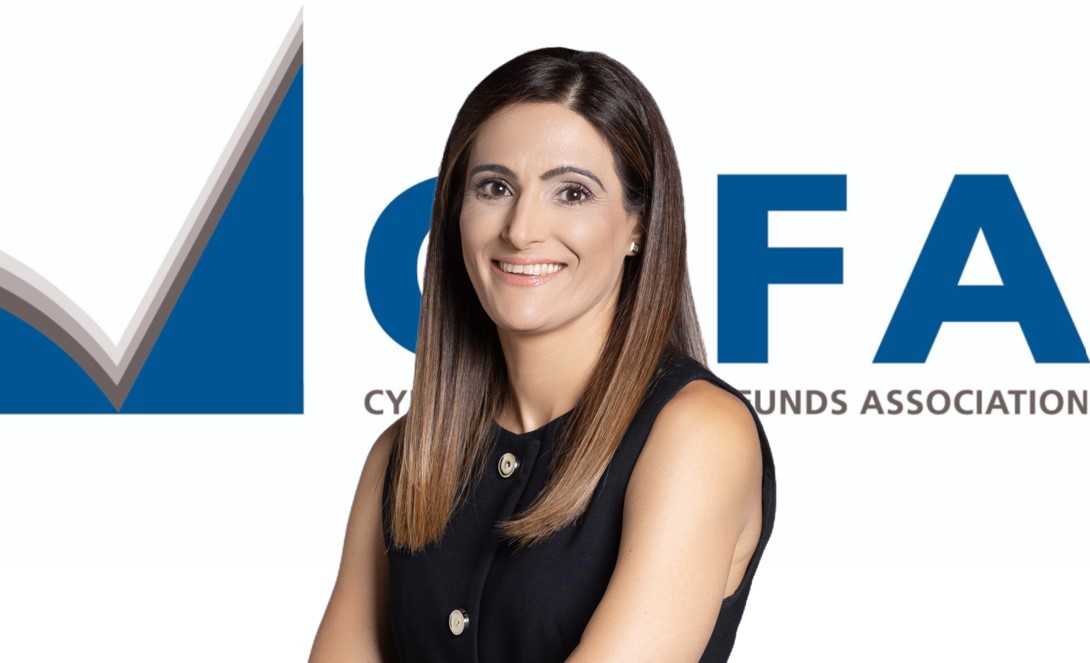
Cyprus’s €11.2 billion investment fund sector is ready to contribute to strengthening the Second Pillar of the pension system through modern, transparent and reliable European investment tools, according to Maria Panayiotou, president of the Cyprus Investment Funds Association (CIFA).
Panayiotou said the intensive dialogue of recent days on the revised pension reform bill confirmed that the State, employers and employees, despite their legitimate differences in approach, shared the same goal.
“Everyone wants a system that secures a decent standard of living for tomorrow’s pensioners and remains sustainable for future generations,” she said.
Alongside the First Pillar, the Social Insurance Fund, Panayiotou pointed to the importance of the Second Pillar, which covers provident funds and occupational pension schemes.
Social partners, independent institutions and the academic community have each emphasised its importance from their own perspective.
In particular, she referred to the chair of the Fiscal Council, Andreas Charalambous, who recently pointed out that the long-term sustainability of pensions in Cyprus requires the gradual strengthening of the Second Pillar.
The Second Pillar, however, is not starting from scratch. At the end of 2025, provident funds were managing €4.65bn on behalf of some 146,000 members, according to the Finance Ministry.
Nevertheless, there is considerable room to strengthen it. According to University of Cyprus professor Andreas Milidonis, Cyprus’s post-retirement income replacement rate stands at around 41 per cent, close to the bottom of the EU, while more than 300,000 workers lack adequate Second Pillar coverage.
As for the final design, Panayiotou explained that the scope of participation, its mandatory or voluntary nature and the timetable remained matters for social dialogue.
Wherever that dialogue leads, she said, one question will remain common to all, “how do we ensure that workers’ savings are managed transparently, safely and professionally, at reasonable cost and without a disproportionate administrative burden on businesses, particularly small and medium-sized enterprises?”
CIFA, she added, is following developments with full respect for the tripartite social dialogue.
“It is not our role to take a position in the negotiations or on the design of the Second Pillar,” she said.
Instead, the association’s role is to make available to the State, the social partners and the management committees of provident funds the solutions offered by the investment fund sector, complementing the existing institutional framework for provident funds and operating under the supervision of the competent authorities.
Turning to investment options, Panayiotou emphasised Undertakings for Collective Investment in Transferable Securities (UCITS) as tried and tested, strictly regulated structures.
“Managing retirement savings leaves no room for experimentation,” she stressed, describing UCITS as a European standard with a track record spanning decades, internationally recognised for its strict supervision, transparency and investor protection.
Their use by provident funds, she explained, can offer significant advantages, beginning with professional management and diversification.
The UCITS framework sets strict limits on where and how capital is invested, while broad diversification limits the risk associated with concentrated, individual holdings.
Furthermore, the value of fund units is calculated regularly, usually daily, and made public. Their operation is overseen by the supervisory authorities, while their assets are held in safekeeping by an independent depositary.
Cost transparency is another advantage, as charges are disclosed in a standardised way so that they can be compared, strengthening competition for the benefit of members.
Panayiotou also pointed to the potential for reducing administrative costs for businesses, particularly small and medium-sized enterprises, through multi-employer provident funds, which already operate in Cyprus.
Through such arrangements, businesses can offer their employees an occupational fund at lower administrative cost, entrusting investment management to licensed professionals.
The trend, she noted, is already clear. In 2025, the 12 multi-employer funds increased their membership from 80,000 to 89,000, while their assets rose from €1.40bn to €1.98bn.
At the same time, a well-diversified investment policy allows provident funds to seek to preserve the value of savings against inflation over time.
Funds can also offer age-based investment profiles, with risk gradually reduced as retirement approaches.
Panayiotou nevertheless cautioned that “No investment is risk-free, and values can go down as well as up.”
“That is precisely why professional management, diversification and a long-term horizon matter so much,” she added.
Alongside UCITS, Panayiotou said Alternative Investment Funds (AIFs) can also play an important role, explaining that the long-term horizon of retirement savings is well suited to their nature.
They provide access to areas of the real economy that are not easily reached through traditional markets, including infrastructure, energy, the green transition and innovation.
In the same context, she referred to European Long-Term Investment Funds (ELTIFs), which, under the revised European framework of 2023, were designed to channel long-term capital into such investments, with uniform European investor protection rules.
However, Panayiotou stressed that their inclusion in provident fund strategies must be measured, with “a limited share of the portfolio, careful attention to liquidity so that members receive their benefits when they are entitled to them, and rigorous risk assessment.”
Under these conditions, better long-term returns can be pursued for future pensioners. At the same time, part of domestic savings can support the growth of the Cypriot economy, creating a virtuous circle.
Indeed, 170 of the 233 active investment funds supervised by the Cyprus Securities and Exchange Commission (CySEC) invest wholly or partly in Cyprus, with investments exceeding €2.9bn at the end of 2025.
Beyond investment options, Panayiotou emphasised the importance of confidence in the pension system.
“Workers’ trust is the foundation of every pension system,” she said, adding that “Whichever model is chosen, certain principles are common: strong and independent supervision, sound governance, transparency on costs and returns, and meaningful information for members.”
The investment fund sector, she continued, already operates on these principles under the supervision of CySEC.
CIFA therefore stands ready to work closely with the Registrar of Institutions for Occupational Retirement Provision and the management committees of provident funds, sharing its expertise wherever it is needed.
Panayiotou also emphasised the development of Cyprus’s investment fund and asset management sector, which had reached €11.2bn in assets under management at the end of 2025, according to CySEC.
“Cyprus’s investment fund and asset management sector has come of age,” she said, explaining that it now has the scale, the expertise, the international partners and a strict European regulatory framework to make a meaningful contribution to strengthening the Second Pillar.
Meanwhile, legislation for the First Pillar is at its final stage, with implementation targeted from 2027.
The dialogue on provident funds, however, is opening now and will, understandably, take its time.
“Whatever framework is agreed, the investment fund sector will be ready,” Panayiotou said.
Concluding, she reiterated that CIFA’s role was not to shape pension policy. “It is not our role to shape policy. We are here to offer employers, workers and provident funds modern, transparent and reliable European tools, making a tangible contribution to a truly sustainable future,” Panayiotou said.



Click here to change your cookie preferences