
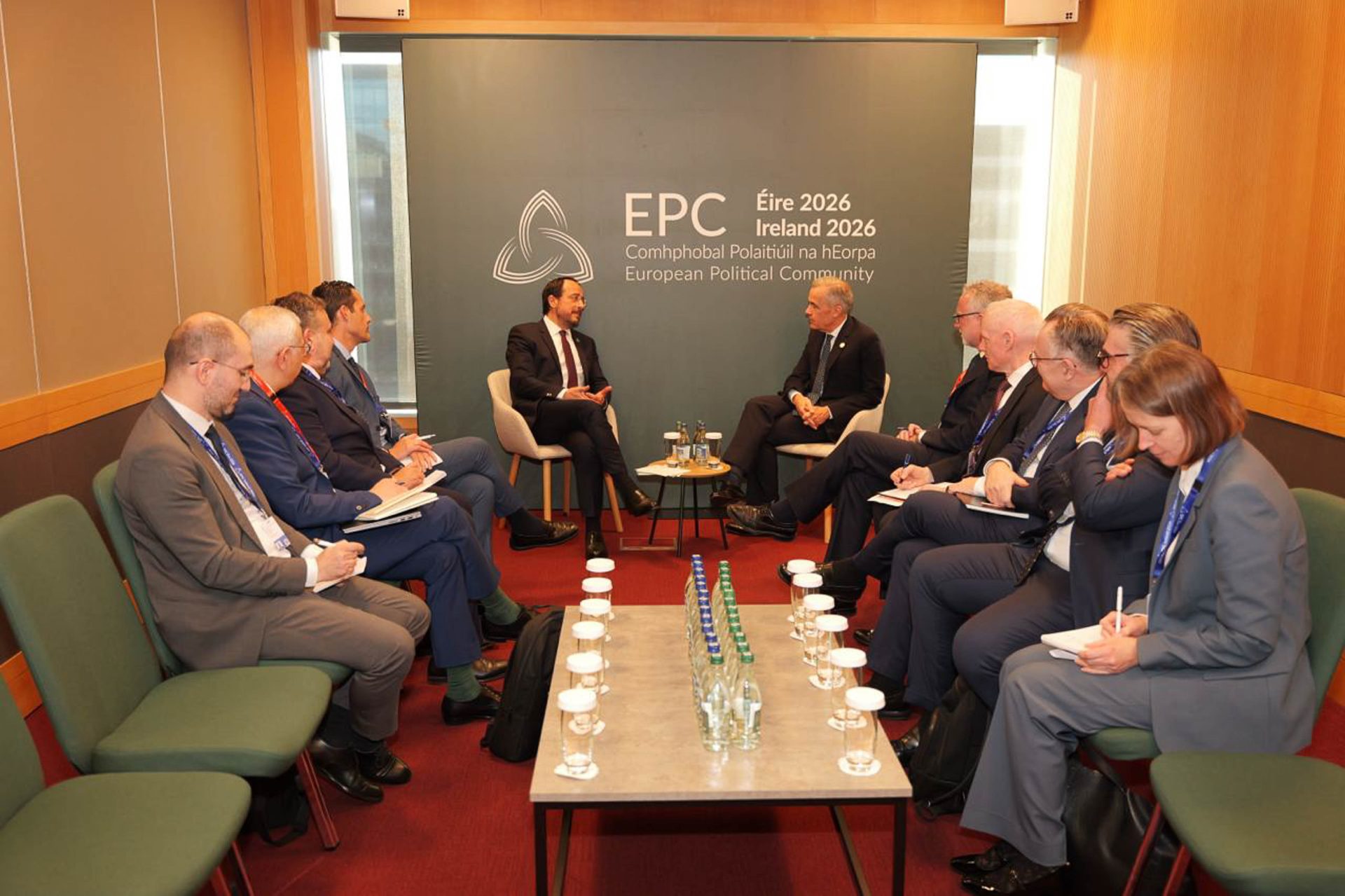
Canadian Prime Minister Mark Carney on Thursday placed back on the table the prospect of his country becoming an associate member of the European Union, with a readout of his meeting with Cypriot President Nikos Christodoulides explicitly stating this as a goal for his country.
It said both leaders “welcomed the strategic momentum of the partnership as Canada and the EU work together to establish Canada’s path to associate [membership] of the EU”.
Additionally, it said that they had “reaffirmed the longstanding relationship between Canada and Cyprus, underpinned by shared democratic values, strong people-to-people ties, and a common commitment to international security and stability”.
On the matter of Canada’s ties with the EU, it said that both leaders had “reaffirmed the importance of strengthening … relations, building on the ‘alliance for the future’ which was announced at the recent Canada-EU summit in Montreal”.
The ‘alliance for the future’ had been declared at last months’ summit, with the European external action service – the EU’s equivalent of a foreign ministry – saying at the time that it had been launched “to crate a common space for growth, prosperity, resilience, and economic security”.
“We are aligning more closely economically, technologically, and strategically. We will focus on six sectors: trade and regulatory cooperation, digital, research, and communication technologies, critical raw materials and energy, financial services and markets, security and preparedness, and people-to-people ties,” it said.
Von der Leyen had announced ‘associate membership’ plans
However, the prospect of Canada becoming an associate member of the EU, which had been announced by European Commission President Ursula von der Leyen at her State of the EU speech in September, appeared to have been dead prior to the Montreal summit following objections from EU member states.
News website Politico reported at the time that “a group of countries including Germany, Greece, and France all objected” to the prospect, and that von der Leyen’s announcement had “caught some EU countries off-guard”.
Likewise, Deutsche Welle reported that German Chancellor Friedrich Merz had led a group of heads of EU governments who had objected to the prospect, and the term was absent from communication on both the Canadian side and on the EU side throughout the summit.
Merz in particular has previously called for Ukraine to be given “associate membership” as a stepping stone towards full membership – something which is not available to Canada as it is not located in Europe.
He had previously described “associate membership” as meaning that Ukraine would be invited to EU summits and ministerial meetings but not acquire voting rights.
‘Strategic relationship’ between EU and Canada
Cypriot government spokesman Konstantinos Letymbiotis also spoke after the meeting, saying that “particular emphasis was placed on the steadily strengthening strategic relationship between the European Union and Canada, especially in the fields of economy, security, and defence”.
He said that Christodoulides had “reaffirmed Cyprus’ active support for developing cooperation between the EU and Canada”, and also “highlighted the new opportunities this creates for bilateral relations” between Canada and Cyprus.
“The discussion focused on attracting Canadian investments to Cyprus … as part of the government’s strategy to secure high-quality investment,” he said.
He said that Christodoulides had to this end “highlighted the comparative advantages of the Cypriot economy, the country’s status as an EU member state, and the opportunities afforded by its geographical location for developing business activities throughout the wider region”.
Christodoulides invites Carney to Cyprus
Pursuant to this, he said that “prospects for bilateral cooperation in the fields of energy and crisis management were also discussed”, with those discussions placing “particular emphasis on Cyprus’ role as an EU member state in the eastern Mediterranean region and as a regional hub for security and humanitarian operations”.
On the latter point, he pointed out that Canadian nationals have in the past been evacuated from conflict regions through Cyprus’ ‘Estia’ plan, through which people are evacuated via the island.
He said that Christodoulides had also offered Carney an update on the latest developments on the Cyprus problem, and on this front expressed his “appreciation for Canada’s longstanding principled stance and its historic participation in the UN peacekeeping force in Cyprus”.
At the end of the meeting, he said, Christodoulides invited Carney to visit Cyprus.
He said that while Carney responded “positively”, no date for such a meeting has yet been set.


Click here to change your cookie preferences