
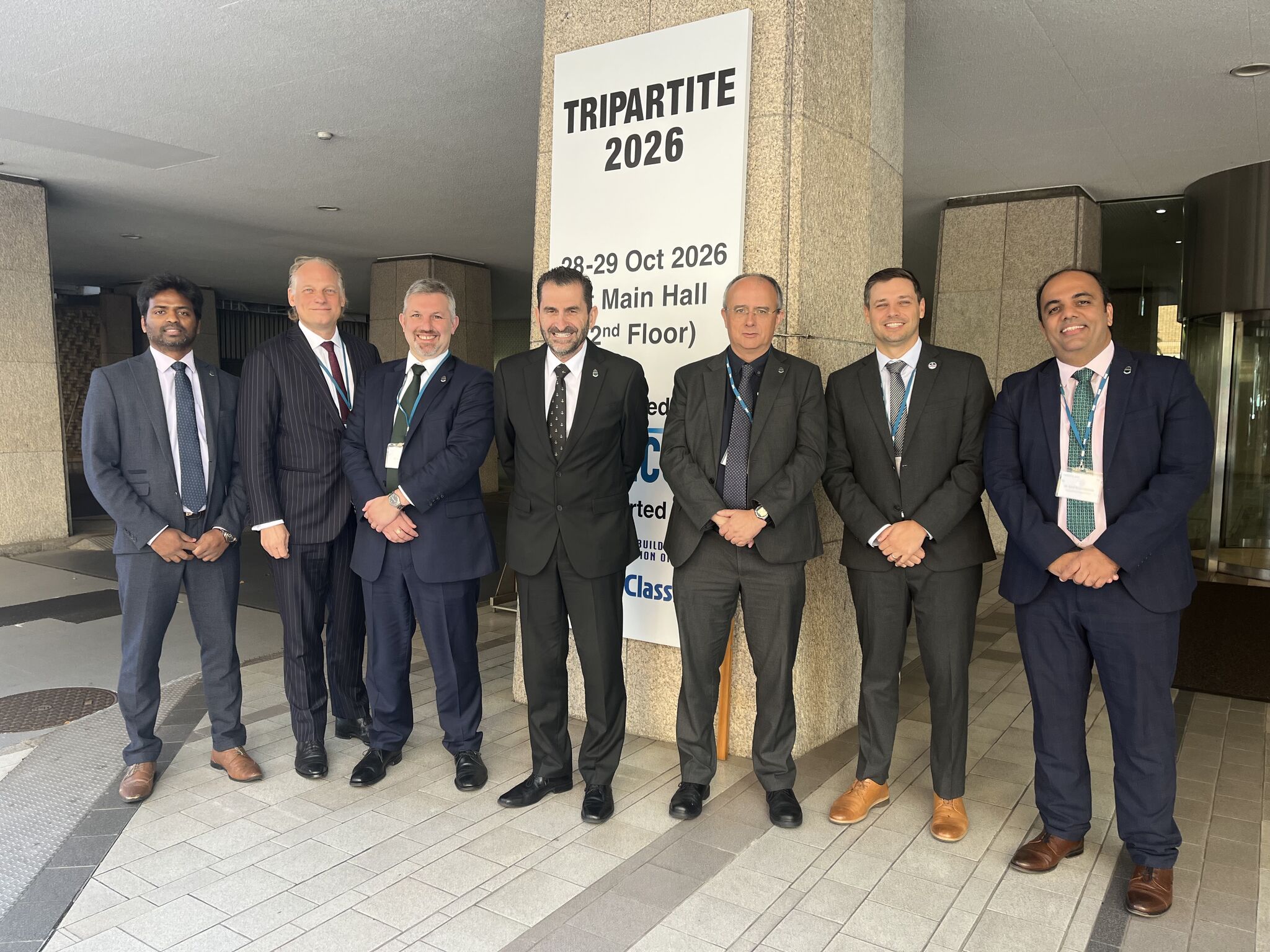
International Chamber of Shipping (ICS) Secretary General Thomas Kazakos, the former director general of the Cyprus Shipping Chamber (CSC), joined some of the world’s leading maritime organisations in Tokyo as the shipping industry sought answers to some of its most pressing questions, from the future of marine fuels to the cost of greener, safer and increasingly digital vessels.
The Tripartite Forum 2026, held in the Japanese capital on October 28 and 29, brought together more than 85 representatives of shipowners, shipbuilders and classification societies, alongside invited observers, for discussions on the technologies, regulations and investment decisions that will determine how the next generation of ships is built and operated.
For Kazakos, who took over as ICS Secretary General in June 2025 after three decades at the CSC, the gathering offered another opportunity to bring the industry’s concerns into an international debate that carries considerable weight for maritime nations such as Cyprus.
At the centre of the discussions was a problem that has become increasingly difficult for shipowners to ignore. The industry is expected to invest in cleaner vessels and new technologies, but the rules governing their future operation are still developing, leaving companies to make expensive decisions without knowing precisely what will be required of them.
According to BIMCO, the forum concentrated on regulatory clarity, decarbonisation and digitalisation, with participants reaffirming their support for the International Maritime Organisation (IMO) as shipping’s global regulator.
The discussions also reflected a growing recognition that shipowners, shipyards and classification societies cannot tackle these challenges independently, particularly when decisions made during a vessel’s design and construction could influence its commercial viability for decades.
BIMCO Deputy Secretary General Lars Robert Pedersen explained that cooperation between the different sides of the industry was essential to turning regulatory ambitions into workable solutions. “By sharing hands-on experience and working together through this unique forum, we contribute with realistic solutions that can be implemented effectively across the industry to deliver on the ambitions of the regulators at IMO,” he said.
The question of alternative fuels featured prominently, with delegates examining how safety regulations can keep pace with new propulsion technologies and the industry’s efforts to reduce greenhouse gas emissions.
One session went further, exploring whether nuclear technology could eventually play a role in maritime decarbonisation, an option that raises complex questions over safety, regulation and practical application.
For an industry whose ships frequently remain in service for 20 years or longer, the uncertainty carries financial consequences. Choosing the wrong technology could leave shipowners facing expensive modifications, higher operating costs and vessels that struggle to meet future environmental requirements.
The debate is particularly relevant as the IMO continues work on its proposed Net-Zero Framework, intended to establish global measures for reducing greenhouse gas emissions from international shipping.
The framework’s delayed adoption has added to the uncertainty surrounding future fuel choices, reinforcing calls for internationally consistent rules rather than a collection of separate regional requirements.
Alongside these broader discussions, ICS specialists contributed to several technical sessions, examining how environmental objectives can be reconciled with the practical realities of operating commercial vessels.
During the session on energy efficiency, ICS Technical Director Chris Waddington presented the relationship between reducing fuel consumption and limiting underwater radiated noise, two environmental concerns that are increasingly being considered together.
Improving a ship’s hull performance, propulsion efficiency and maintenance practices can help reduce the energy required to move through water. Some of these measures can also lower the noise generated beneath the surface, where commercial shipping can affect marine mammals and other aquatic life.
The subject has attracted growing attention from the IMO, which has developed revised guidelines addressing underwater radiated noise from commercial vessels.
Waddington also chaired the Tripartite working group dedicated to the issue, extending ICS involvement beyond the formal discussions in Tokyo.
Meanwhile, digitalisation emerged as another area where the industry’s ambitions are running into practical difficulties.
ICS Nautical Director Gregor Stevens delivered a recorded presentation entitled Data harmonization in practice: how to achieve interoperability across ship, shore, and stakeholder systems, examining how information could be exchanged more effectively between vessels, shipping companies and other maritime organisations.
For shipowners, the problem is familiar. The same operational and emissions information is frequently requested by different authorities, charterers, verification bodies and commercial partners, often in incompatible formats that require additional processing and administrative work.
In a significant development connected with the forum, a BIMCO-chaired Tripartite working group released two voluntary frameworks designed to reduce this duplication and establish common methods for exchanging maritime data.
The Operational Vessel Data (OVD) framework provides a standard structure for sharing vessel operations and fuel consumption information, while Vessel Emissions Reporting (VER) introduces a common format for emissions data, including its verification status.
The intention is relatively straightforward. Information collected once should be capable of being used across different reporting systems without repeatedly entering, converting and checking the same figures.
The initiative could be particularly useful for shipping companies dealing with reporting requirements under the IMO Data Collection System, the EU Monitoring, Reporting and Verification system, and commercial arrangements associated with emissions trading and FuelEU Maritime.
Importantly, the frameworks do not create new legal obligations. Instead, they offer a common approach that companies and technology providers can adopt voluntarily.
Jeppe Skovbakke Juhl, BIMCO’s chief naval architect and chairman of the working group, described the problem facing shipping companies, explaining that “the maritime industry does not need more ways of exchanging the same information.” Instead, he stressed that “it needs a common approach that allows data to move efficiently between organisations and systems.”
The work is already moving beyond discussion, with Bureau Veritas adopting OVD for emissions data collection and RINA taking steps to incorporate the framework into its own reporting processes.
Environmental compliance was also examined in Tokyo, where ICS Senior Marine Adviser Manoj Subramanian presented on ballast water management system selection and compliance verification.
Ballast water management has become an important regulatory responsibility for international shipping because vessels can inadvertently transport invasive aquatic species between different marine environments.
Under the IMO’s Ballast Water Management Convention, ships must comply with requirements governing ballast water treatment, documentation and discharge, with inspections and verification forming part of the compliance process.
Subramanian also participated in the Tripartite working group on biofouling, another environmental concern involving the accumulation of marine organisms on hulls and underwater structures.
Beyond the ecological risks, biofouling can increase resistance as a vessel moves through water, raising fuel consumption and emissions. Effective hull management therefore has both environmental and commercial benefits.
Safety was another important part of the programme, with Waddington chairing the sixth session, during which ICS General Manager for Singapore Sunil Krishnakumar presented an update on the development of IMO greenhouse gas safety regulations.
His contribution addressed the regulatory work needed to ensure that the transition towards new fuels and propulsion technologies does not compromise the safety of ships and the crews operating them.
ICS also contributed to six papers submitted to the IMO through the Tripartite working group process, demonstrating how technical discussions between industry representatives can feed into international policymaking.
The forum itself has been bringing together the three branches of the maritime industry for more than two decades. Its work has contributed to developments including common structural rules for bulk carriers and tankers, permanent access arrangements for tankers and mandatory protective coating standards for ballast and cargo tanks.
This year’s participating organisations included ICS, BIMCO, IACS, INTERCARGO, INTERTANKO, ASEF, CESA and SEA Europe, with support from ClassNK, the Japanese Shipowners’ Association and the Shipbuilders’ Association of Japan.
The next Tripartite Forum is scheduled to take place in China in the final quarter of 2027, although work will continue through the various technical groups in the meantime.




Click here to change your cookie preferences