
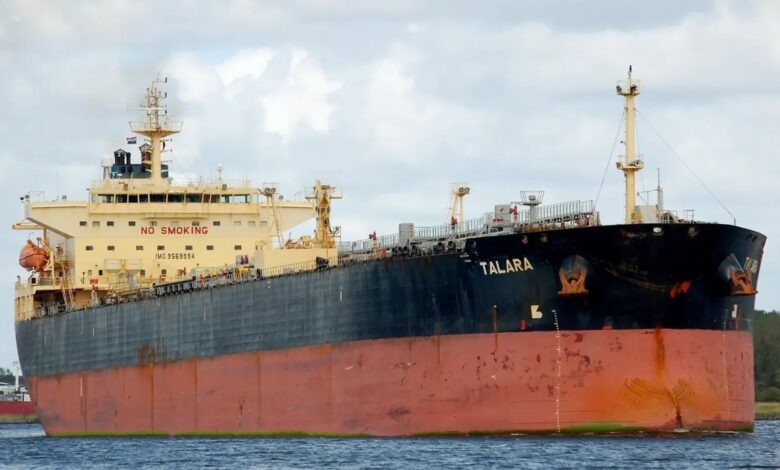
The Iranian government on Saturday confirmed that it had seized a tanker vessel operated by Cyprus-based company Columbia Shipmanagement, with news agency Reuters quoting state media as saying the ship was carrying “unauthorised cargo”.
The ship, the Marshall Islands-flagged Talara, was intercepted by the Iranian Revolutionary Guards on Friday while sailing towards Singapore, with what Reuters described as a “cargo of petrochemicals” on board.
Reuters later quoted maritime sources as saying that the ship was carrying “high-sulphur gasoil” from the United Arab Emirates’ port of Sharjah towards Singapore, with high-sulphur gasoil typically used for power plants, industrial furnaces, and other stationary applications.
Columbia Shipmanagement said it had lost contact with the Talara while it was located around 20 nautical miles (37 kilometres) off the coast of Khor Fakkan, which is located on the UAE’s east coast, south of the Strait of Hormuz, a chokepoint between the most northerly point of Oman and Iran’s southern coast.
The strait is immensely important to global trade and energy, as it provides the only seaborne access between the Persian Gulf and the open ocean.
Columbia Shipmanagement added that it was “working closely with relevant parties” with the aim of restoring contact, while the United States’ military said it was aware of the incident and actively monitoring the situation.
Publicly available shipping data shows that the ship is owned by a Cyprus-based company named Pasha Finance.
Pasha Finance is owned by PrimeBulk Shipmanagement Ltd., which in turn is owned by the Coronis Family Group of Companies that is ultimately beneficially owned by Nicholas and Paul Coronis, members of a prominent Greek shipping family.
The seizing of the ship and any further, similar actions may have knock-on effects for the global economy, too, with Shipping Deputy Minister Marina Hadjimanolis having warned earlier this year that there may be “global implications” if Iran blockades the Strait of Hormuz.
She added that if the strait is blockaded, the first effects to be felt in Cyprus will be an increase in fuel prices and increases in the price of insuring ships, while “supply chains and transport in general” are also expected to be impacted.
While the seizure of one ship does not constitute a blockade, eyes will be firmly fixed on Iran in the coming weeks in light of the seizure of the Talara.
News website Euronews reported earlier this year that around 20 per cent of global oil passes through the Strait of Hormuz, including European imports from Saudi Arabia, Qatar and the United Arab Emirates.
As such, if the strait were to be closed, energy prices would spike, and Europe could face energy shortages.




Click here to change your cookie preferences