

Gamification may have become one of the tech industry’s most overused buzzwords, yet very few have attempted to measure it as an investment category.
According to Diana Barsukova, who led InvestGame’s first-ever systematic review of the space, the sector has now expanded into a capital-intensive ecosystem that spans EdTech, Fitness & Wellness, and Entertainment & Social.
As she noted, gamified consumer apps built on explicit progression mechanics have generated more than $20.7 billion across 208 transactions since 2020, revealing a market that is both larger and more structurally important than most industry observers realised.
This feature is sponsored by GDEV, the Cyprus-headquartered global gaming group behind franchises such as Hero Wars and Island Hoppers, which also supports research initiatives examining the evolution of gaming and gamification across consumer markets.
Barsukova explained that the shift is not cosmetic. Retention systems initially created for video games, streaks, adaptive difficulty, leaderboards and reward loops, have become direct drivers of performance in consumer apps tied to real-world outcomes.
In her words, mobile gaming in-app purchase revenue stagnated over the past year, while non-gaming consumer apps grew by 24 per cent year-on-year and, for the first time, surpassed games in the first half of 2025.
She described the change as structural rather than cyclical, adding that gamification has become “a growth engine rather than just a UX layer.”
She said the team at InvestGame decided to map the market because, despite the hype, no comprehensive analysis existed on how much capital had actually been deployed or which companies had exited successfully.
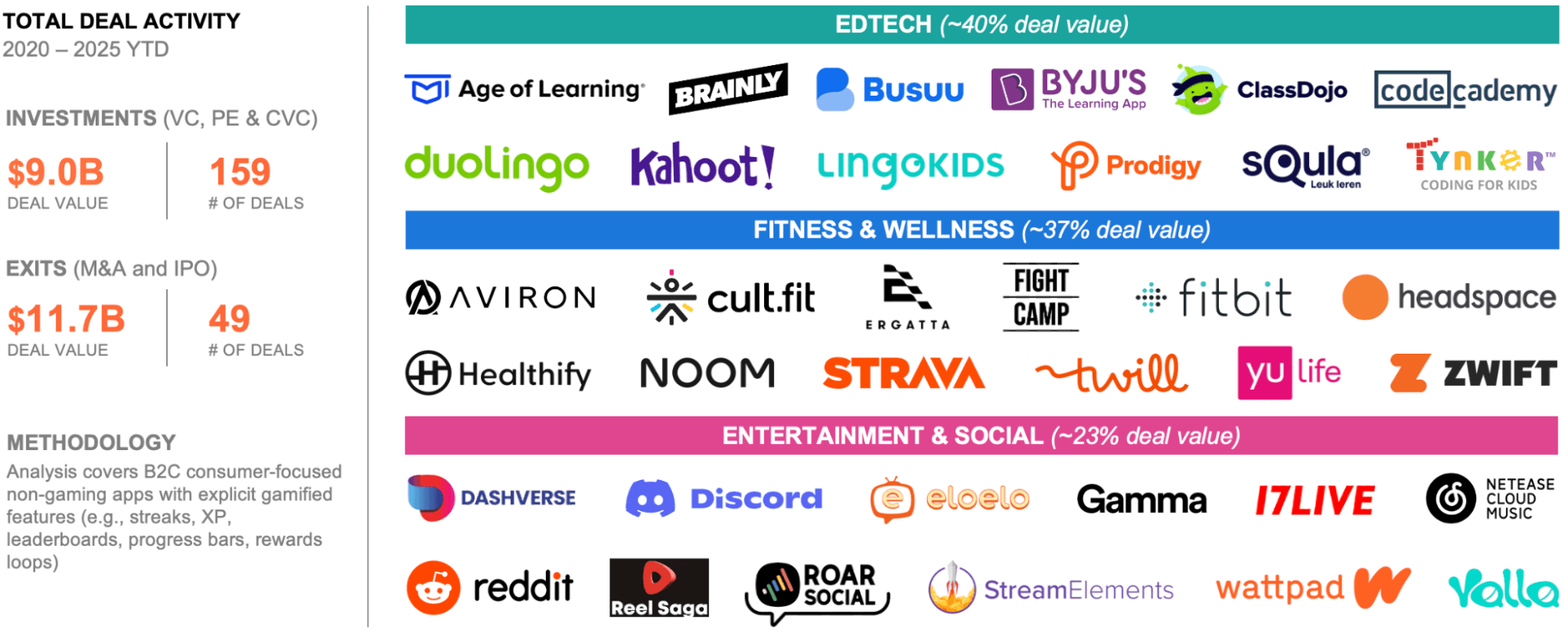
Their research examined B2C consumer-focused non-gaming apps using explicit gamified systems, covering $9bn raised across private deals and $11.7bn generated through exits, including 49 M&A and IPO transactions.
Barsukova noted that EdTech accounted for the largest share by number of deals, followed by Fitness & Wellness and Entertainment & Social.
She explained that the funding cycle mirrored the broader pandemic-era investment wave.
Capital peaked in 2021, when low interest rates and post-lockdown digital adoption created favourable conditions for consumer apps.
Barsukova mentioned that 2021 alone produced $5.9bn in investment, nearly two-thirds of all capital deployed during the period, driven by mega-rounds for companies such as BYJU’S, ShareChat, Noom and Discord.
The correction that followed in 2022 and 2023 did not mirror the sharper downturn seen in video gaming; instead, she described it as a transition from FOMO-driven deployment to more disciplined investment.
By 2024 and into 2025, deal flow had stabilised and even surpassed full-year 2024 levels, suggesting a durable subscription-based habitual economy rather than a short-lived pandemic spike.
Barsukova emphasised that the aggregate picture masks distinct vertical stories.
EdTech, for example, proved gamification at scale earlier than any other category. She pointed to Duolingo as the most prominent success, noting that the company went public in 2021 and has since delivered around 160 per cent returns to IPO investors.
This validation, she said, triggered a wave of follow-on fundraising across the sector.
Overall, EdTech attracted $4.4bn in private investments since 2020, though she clarified that capital remained highly concentrated: the top three companies accounted for more than half of all deployment.
She also noted that the sector delivered significant exits, including the $1.7bn acquisition of Kahoot!, as well as the sales of Codecademy and Busuu. EdTech, she said, has now evolved beyond pure consumer subscriptions into hybrid D2C and B2B2C models, with leading companies partnering with schools and enterprises to complement individual users.
She described Fitness & Wellness as the category where gamification has become ritualised in users’ daily lives. Morning meditation streaks, cycling power outputs and sleep scores, she explained, create measurable behavioural loops with strong switching costs.
According to her, the vertical attracted $2.4 billion across 53 deals, with early conviction shown by major private equity rounds for Noom, Zwift and Strava.
On the exit side, she pointed out that Fitness & Wellness recorded $5.2bn in M&A transactions, including Google’s $2.1bn purchase of Fitbit and the $3bn Headspace–Ginger merger.
She added that early-stage momentum remains strong, with newer entrants such as Ergatta, Sweatcoin and Ladder continuing to raise capital for hardware-integrated or behavioural-tracking products.
Entertainment & Social, Barsukova said, has always sat closest to the gaming industry. She explained that interactive storytelling and creator-driven content loops turned platforms like ShareChat, Discord, Wattpad and Holywater into hybrids of social networks and entertainment ecosystems.
The category secured several major funding rounds during the peak years, though its exit trajectory has differed from the other two verticals.
Barsukova noted that public listings, such as Reddit and NetEase Cloud Music, have played a larger role than strategic M&A. Wattpad’s $600 million acquisition remains the segment’s most significant deal.
She stressed that the exit environment across the entire sector confirms a broader thesis: strategic buyers increasingly see gamified retention loops as defensible infrastructure.
Google acquired Fitbit to anchor its wearables platform, Naver bought Wattpad to strengthen its creator ecosystem, and Chegg expanded its EdTech portfolio with the acquisition of Busuu.
Private equity players demonstrated similar conviction through the take-private of Kahoot! by Goldman Sachs Asset Management and the large-scale rounds for Noom and Zwift.
According to Barsukova, the companies that succeed are not the ones that invented their category but those that turned engagement into progression, Duolingo with streaks, Strava with social competition and Noom with behavioural psychology wrapped in gaming mechanics.
Looking ahead, she said that early-stage deployment continues to accelerate even as late-stage deals mature into exits. Companies such as Ergatta, GammaTime and Wayground are experimenting with new mechanics across interactive learning, storytelling and fitness.
In her view, the boundary between gaming and utility is dissolving quickly, and the next billion-dollar live-ops business may not be a game at all but a consumer app that turns progress itself into play.
She concluded that InvestGame will continue tracking this convergence, where capital flows, which mechanics prove defensible and which exits cement gamification as a lasting competitive advantage in consumer engagement.




Click here to change your cookie preferences