
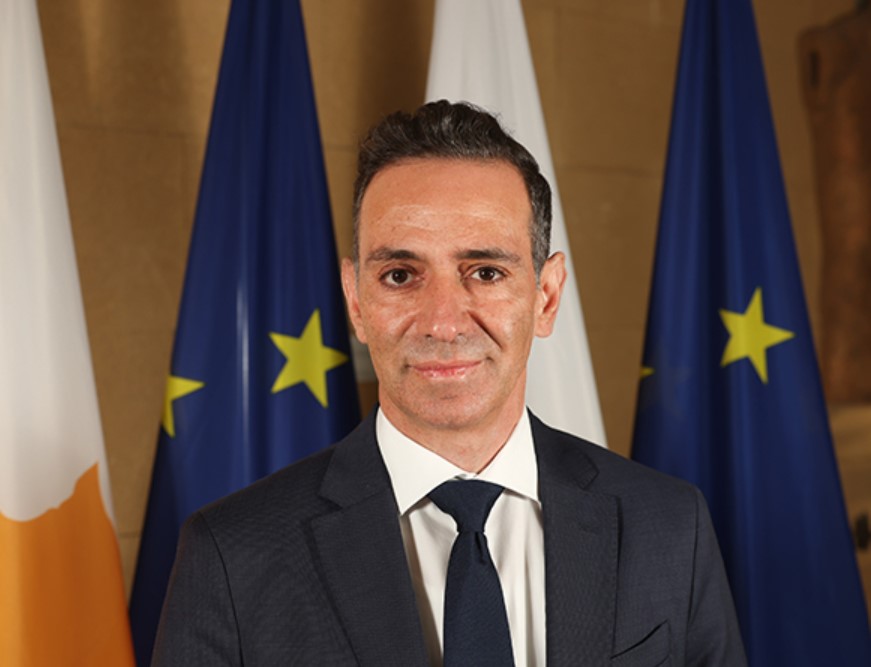
Cyprus can secure a leading role in the next era of smart and sustainable tourism if it embraces Artificial Intelligence (AI) with urgency and strategic clarity, Deputy Minister for Research, Innovation and Digital Policy Nicodemos Damianou said on Wednesday, addressing a joint government conference on AI and tourism.
Damianou opened his remarks by congratulating Deputy Minister of Tourism Costas Koumis for the island’s record tourist arrivals this year, noting that he had achieved it “without AI”, before adding that this alone shows “where we can go with the use of AI”.
He told the audience that the question is no longer whether AI will transform tourism, stressing that “it is already doing so” and that the conference would showcase “several examples, but also ways in which this can be achieved”.
Drawing on global cases, he pointed to Singapore as “the most complete case of the use of AI in tourism internationally”, referencing everything from airport operations to city traffic and the Marina area, as well as the city-state’s digital twin.
The government there, he said, has created “a complete digital twin of the city with AI”, which supports planning for pedestrian routes, analysing tourism by region, predicting ecological impacts, and improving accessibility and safety.
According to Damianou, the real question for Cyprus is “with how much boldness and speed, with what planning and actions will we choose to lead this new era”, and how the island will align innovation with its cultural identity, economic ambitions and the visitor experience.
“There is no doubt that countries that place AI at the core of their tourism strategy will, at the very least, attract more visitors,” he noted.
The programme of the conference, he said, covered the full spectrum of what can be said on the subject, including applications of AI for tourism, policies and strategy, opportunities and prospects, as well as the actions the government has already put into practice.
He also referred to his recent trip to Brussels, where Cyprus presented its priorities for the island’s EU Council Presidency in 2026 to both the communications council on digital affairs and the competitiveness, research and innovation council.
Throughout those discussions, he explained, “the acceleration of digitalization, technological infrastructure and innovation is presented as an absolute necessity”, almost existential when comparing Europe’s trajectory with that of the US and China.
He added that this broader debate on Europe’s strategic autonomy, economic development and even military competitiveness has “AI as a central point of reference: capabilities, computing infrastructure, talent, funding, etc.”
However, what is less visible, Damianou warned, is the direct application of AI in sectors where Europe risks losing ground, even though such sectors do not require the massive investments currently being channelled into data centres and GPUs.
Tourism, he said, is “an obvious example”, where no additional heavy infrastructure is needed beyond the application of AI solutions, alongside efforts to strengthen data management, expertise and the AI business ecosystem.
Turning to Cyprus, Damianou emphasised that the island’s long-standing status as a major Mediterranean destination gives it a unique opportunity to integrate AI into how it designs and delivers the tourism experience.
Tourism already contributes 13.1 per cent of GDP, rising to an estimated 14 per cent in 2025, while the broader technology sector has reached 15 per cent.
As a result, he said, the convergence of the two sectors “creates a new, strategically important axis of growth”.
He outlined three primary objectives: improving the competitiveness of the tourism product through smart solutions, promoting sustainable tourism by leveraging AI for green and responsible development, and creating innovative services that differentiate Cyprus and enhance its image as a technologically advanced destination.
Damianou also pointed to the government’s wider digital agenda. He said the Deputy Ministry’s emphasis on AI is visible across several levels, from the “AI in Government” programme and Human Resource Development Authority (Anad) training schemes, to support for SMEs integrating AI into operations.
In parallel, the government is strengthening computing power for research and innovation, implementing an integrated smart-cities platform and introducing AI into systems such as Hippodamus and iJustice.
The centrepiece of these efforts is the new National Strategy for AI, now in an advanced stage of preparation. Damianou said he is awaiting its first comprehensive version, noting that the government wants to understand how AI can give Cyprus a competitive advantage in key sectors and solve structural issues in the state, society and public administration.
He reminded the audience that the National AI Taskforce, appointed by the Council of Ministers and chaired by the Chief Scientist, is driving this work.
Concluding his remarks, Damianou said Cyprus “has all the characteristics to play a leading role in the new era of smart and sustainable tourism”.
Damianou congratulated the officials of both Deputy Ministries for organising the conference, stressing the need for small states to focus on AI applications “where it can make a difference”, and noting that tourism is precisely such an example.





Click here to change your cookie preferences