
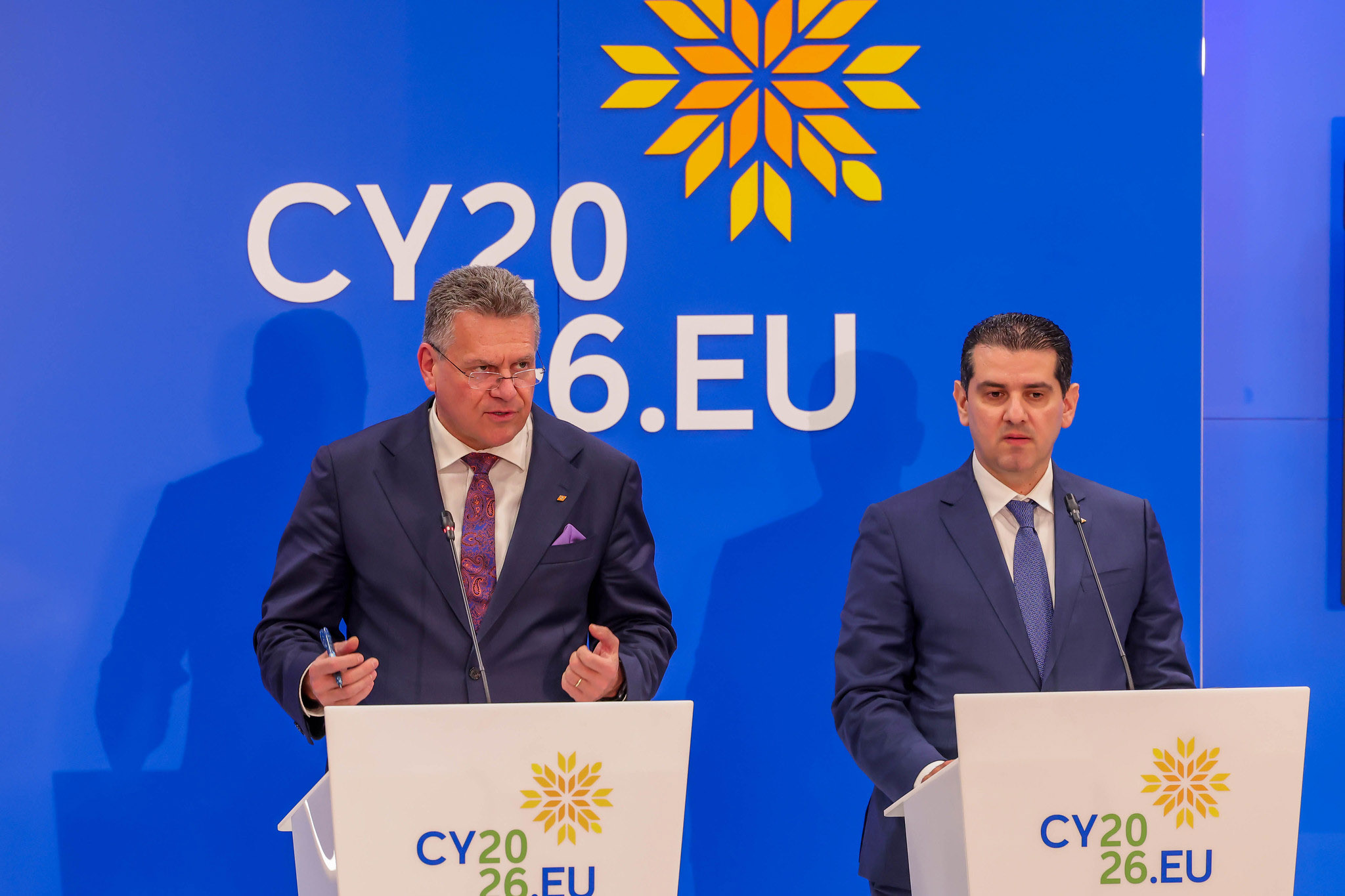
The European Union’s economy has lost hundreds of billions of euros due to the bloc’s failure to ratify a trade deal with South American trade bloc Mercosur, European Trade Commissioner Maros Sefcovic said in Nicosia on Friday.
“We have lost almost €300 billion because we do not have an agreement in place with Mercosur,” he said during a joint press conference with Cypriot Trade Minister Michael Damianos, before later clarifying that the amount refers to the amount the EU had been projected to gain in terms of its gross domestic product between 2021 and now.
He also added that this loss is “accompanied by more than €200bn lost in export opportunities”.
To this end, he said that “when complex negotiations are concluded, the EU cannot wait years for agreements to enter force”, in reference to recent delays brought about by the European Parliament’s decision to refer the EU–Mercosur trade deal to the European Court of Justice.
With the ECJ possibly not set to deliver a ruling on the legality of that trade deal until 2028, Sefcovic said that “I do not think we can operate in this environment with this timetable”.
Instead, he said, the approval process for trade deals should be reduced “to about a year after negotiations are concluded”.
While Damianos did not speak on the matter of the Mercosur trade deal on Friday, he had earlier told the Cyprus Mail that “the agreement creates clear and substantial benefits for the Republic of Cyprus, both in terms of trade and services, in an environment of increased international uncertainties”.
He had added that as a result of the deal, the country’s security of supply for critical raw materials would be strengthened, adding that almost all of Cyprus’ imported soybeans came from Argentina and that a “significant part” of imports of coffee and fruit juices come from Brazil.
“By reducing or eliminating tariffs and establishing predictable rules, greater price stability and better conditions for Cypriot farmers, livestock breeders, and consumers has been ensured,” he said.
Crucially, he said, the deal would bring about “new prospects … for exports of Cypriot products and services” through the abolition of export tariffs on products being sent from the island to South America.
However, despite his and the Cypriot government’s support for the trade deal, four of Cyprus’ six MEPs – Akel’s Giorgos Georgiou, Elam’s Geadis Geadi, Diko’s Costas Mavrides, and independent Fidias Panayiotou – voted to send the deal to court and thus slow down the process of its ratification.
Overall, the European Parliament voted by MEPs 334 to 324 to send the deal to the ECJ, warning that the deal may be incompatible with existing EU law, and that guidelines for negotiation issued by the Council of the EU may not have been “respected” by the commission.
With the matter now in the ECJ’s hands, the European Parliament cannot vote to ratify the deal until a verdict is reached.
Under EU law, the agreement could still be provisionally implemented without parliamentary ratification, although such a move following last week’s vote would likely strain relations between EU institutions.
After the vote, a European Commission spokesperson told the Cyprus Mail that it “strongly regrets the decision”.
“This comes at a time when EU producers and exporters urgently need access to new markets, and when the EU must deliver on its diversification agenda and demonstrate that it remains a reliable and predictable trade partner,” it said, before saying that the questions raised last week’s motion “are unjustified”.





Click here to change your cookie preferences