
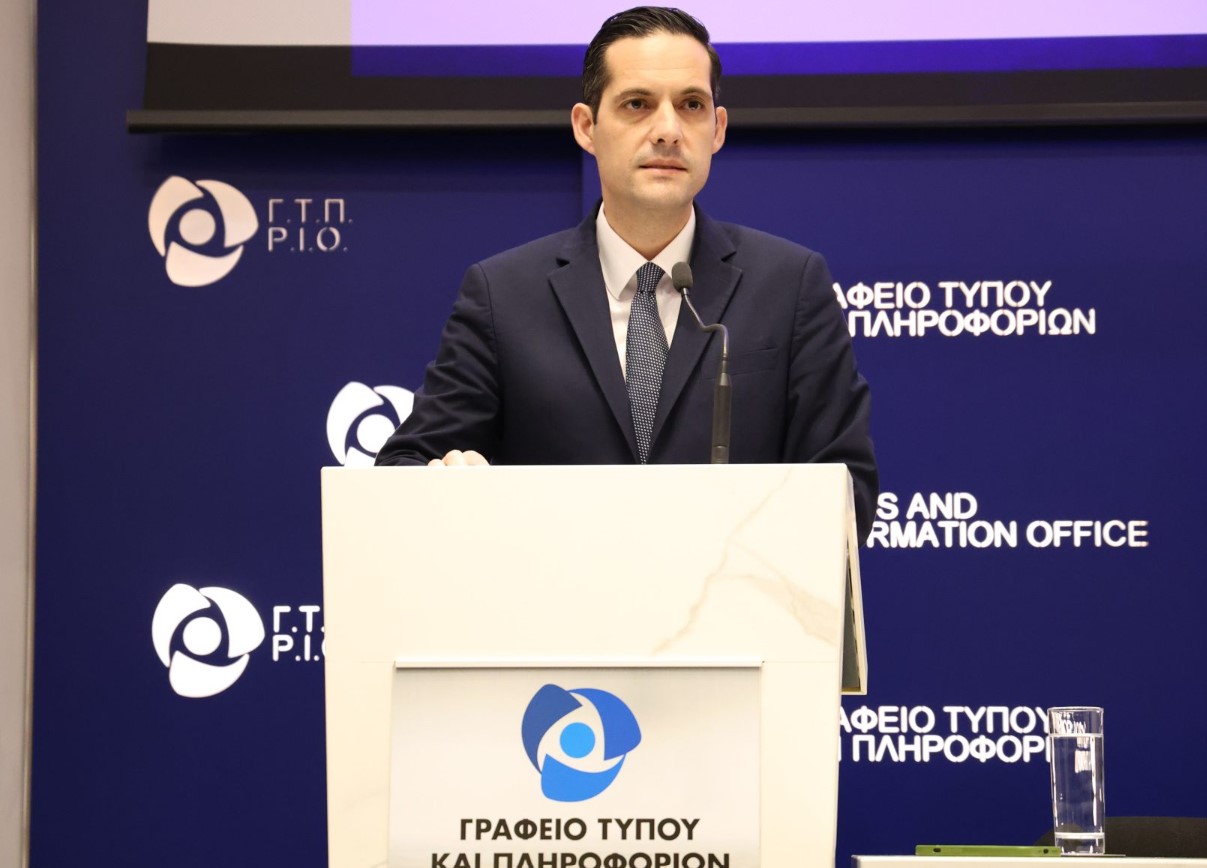
Government spokesman Konstantinos Letymbiotis on Sunday hailed what he described as a “return to the substance of the Cyprus problem” as he attended a memorial service for five men from the Paphos district village of Letymbou who died for the Greek Cypriot cause at various junctures between the 1930s and the 1970s.
“The sacrifice of the heroes of our community is a wake-up call and a compass of unity. It calls upon us to defend the law, history, and our dignity with determination. Freedom and justice require national unity, clear orientation, a plan, and relentless effort,” he said.
He added that the Greek Cypriot side is “following this path with a plan, consistency, and political will”, and said that President Nikos Christodoulides has, since taking office in 2023, “set the resumption of the negotiation process as the highest national priority”.
“Our systematic effort yielded concrete results,” he said, pointing to the appointment of Maria Angela Holguin as the United Nations’ Cyprus problem envoy and the convening of enlarged meetings on the Cyprus problem in Geneva and New York last year, as well as UN Secretary-General Antonio Guterres’ visit to the island last month.
In addition, he said, Guterres’ announcement at the end of his visit to Cyprus that he would convene another enlarged meeting “after adequate progress” is achieved on confidence-building measures, the meeting’s methodology, and the substance of the talks creates “a clear prospect of returning to the substance of the Cyprus problem”.
“The new mobility has a clear political content and a specific basis. The starting point remains the security council resolutions, the agreed framework, and the convergences reached up to Crans-Montana,” he said, in reference to the most recent round of negotiations in earnest, which were held at the Swiss ski resort in 2017.
He added that “time does not legitimise the faits accomplis of the invasion, nor will it conceal the pursuit of partition”, but said that to combat this, “we have made the European Union an active factor in the UN effort”.
“The European Council conclusions, the clear interconnection of relations between Europe and Turkey with progress on the Cyprus problem, and the appointment of Raffaele Fitto [as the European Commission’s Cyprus problem envoy] constitute a new political state of affairs,” he said.
On this front, he said that “European prospects and the perpetuation of the occupation are politically incompatible” for Turkey, and that “anyone who aspires to a substantial upgrade of their relations with the European Union must demonstrate in practice their respect for international and European law, and primarily to Cyprus itself, a full EU member state”.
“At the same time, we are strengthening the Republic of Cyprus diplomatically, economically, and defensively. Strengthening our homeland is a multiplier of our negotiating power and the foundation of an active foreign policy,” he said.
He then added that the Greek Cypriot side “approaches every effort with a sincere will for a solution and with unwavering commitment to our principles”.
“The goal remains unchanged: a free and reunified Cyprus, without occupying troops, anachronistic guarantees, and intervention rights,” he said, before adding that a post-solution Cyprus must be “a functional and viable European state” and “a common homeland for all its legal inhabitants”.


Click here to change your cookie preferences