
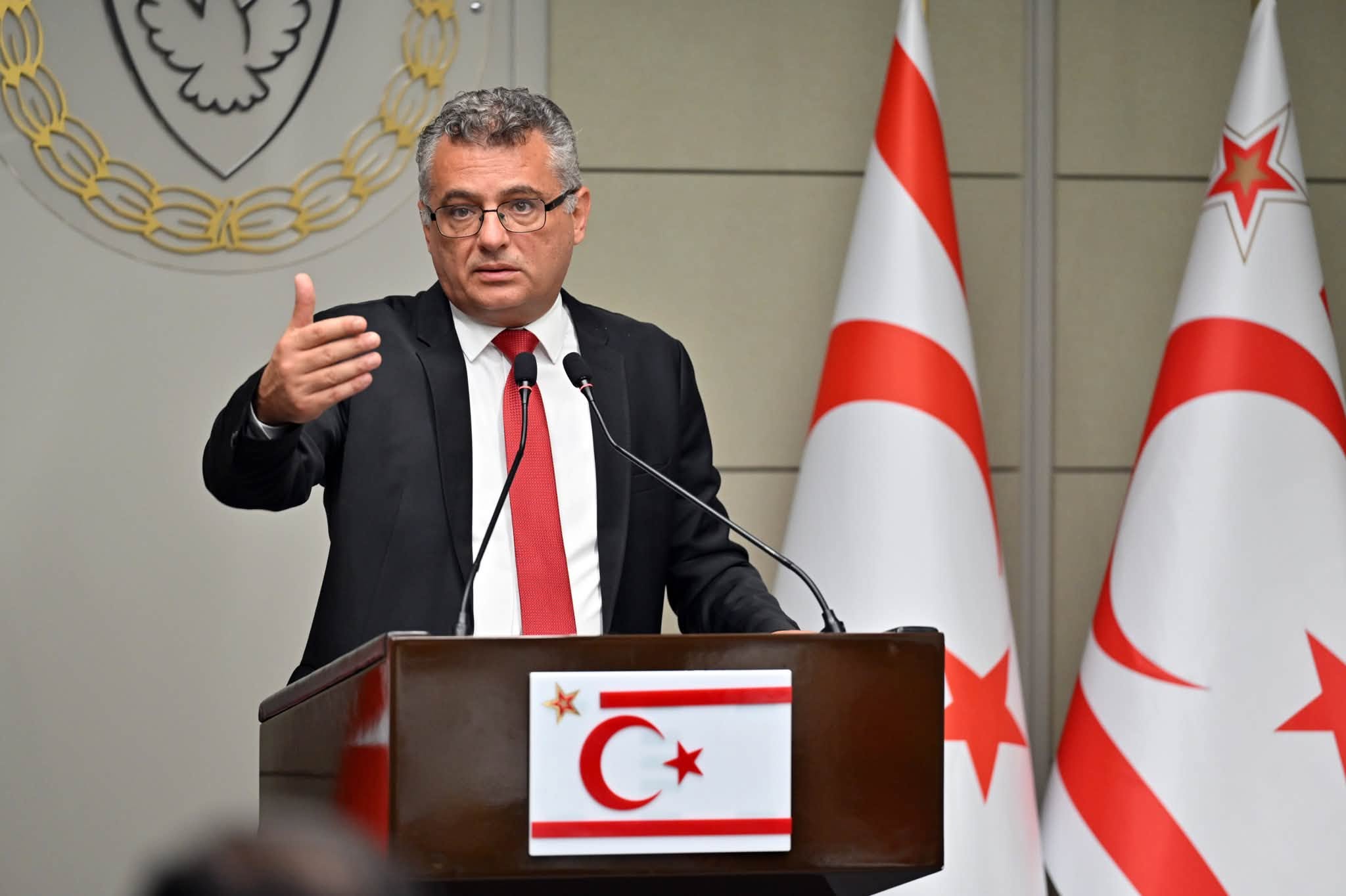
Turkish Cypriot leader Tufan Erhurman on Wednesday said that President Nikos Christodoulides rejected a proposal for more landmines to be cleared across the island, which was made by United Nations Secretary-General Antonio Guterres during his visit to the island last week.
“We agreed to clear the mines, the Greek Cypriot side rejected it,” he told journalist Nazar Eriskin, before explaining that the plan would have seen mine-clearing efforts begin in the buffer zone and then continue elsewhere.
He also pointed out that previous UN security council resolutions have set as their goal a “mine-free Cyprus”, and said that Christodoulides had rejected the proposal citing “security reasons”.
Agreements regarding work to demine areas of Cyprus where mines were laid had been reached at previous enlarged meetings on the Cyprus problem held in Geneva and New York last year.
However, the UN peacekeeping force in Cyprus (Unficyp) estimates that there are a total of 47 such hazardous areas in Cyprus which “may be contaminated with mines or other explosive remnants of war”, with those areas amounting to around 1.7 million square metres of land.
Unficyp spokesman Aleem Siddique had previously explained to the Cyprus Mail that landmines near civilian areas are “clearly demarcated by the UN”, and that the largest remaining minefields are in or near either military installations or the buffer zone on either side of the island.
However, he said, this does not mean the danger posed by those mines is non-existent.
One such example offered by Siddique was the village of Mammari, which lies to the west of Nicosia and is partially located in the buffer zone.
He said a team of 29 Cambodian deminers had been brought in to help clear mines around Mammari in 2015, given the present danger posed by the mines to local farmers
“When it rained, the water would wash the mines out of the demarcated area, given that the area is on a slope. Farmers would also occasionally stray in, and on one occasion, a tractor hit a landmine, though thankfully he was not harmed,” he said.
In addition to their work in Mammari, the Cambodian deminers were also tasked with clearing minefields south of Lefka. This work in turn opened the way for the Apliki crossing point to be opened in 2018, restoring direct access between Lefka and Kalopanayiotis.
The UN’s mine action service (Unmas) formally became an “integral component” of Unficyp in 2016, allowing for the direct coordination and passing on of expertise. In addition, Unmas provides assistance to the Committee on Missing Persons (CMP) to facilitate safe access to areas in which it conducts activities.
In 2024, government sources had said the Greek Cypriot side considered that demining in the buffer zone had been completed on its part, and that the only minefields of which they are aware are located inside the Republic.
Those minefields, they said, “are an integral element of our defence organisation”.
“They are in areas where it is not dangerous, and where it is necessary for them to continue to exist. When we agreed on demining, the agreement was that not all minefields would be removed. The agreement was that minefields inside the buffer zone would be removed,” the sources said.
They added that the remaining mines in the Republic are anti-tank mines and have been left in place “so someone cannot just pass through”.
However, they said, all the anti-personnel mines have now been removed.
“We have destroyed all of them, both those that were in minefields and those that were in storage, because it is our obligation under the Ottawa Convention on the elimination of anti-personnel mines,” they said.
For this reason, they said, “if there are any left, they belong to the Turkish military, which has them either in minefields or in storage.”
Mines were laid in Cyprus during 1963, 1964, and 1974, with Unficyp having been eager to stress in the past that “landmines are not rendered inactive” and that they can in fact become more dangerous over time.




Click here to change your cookie preferences