
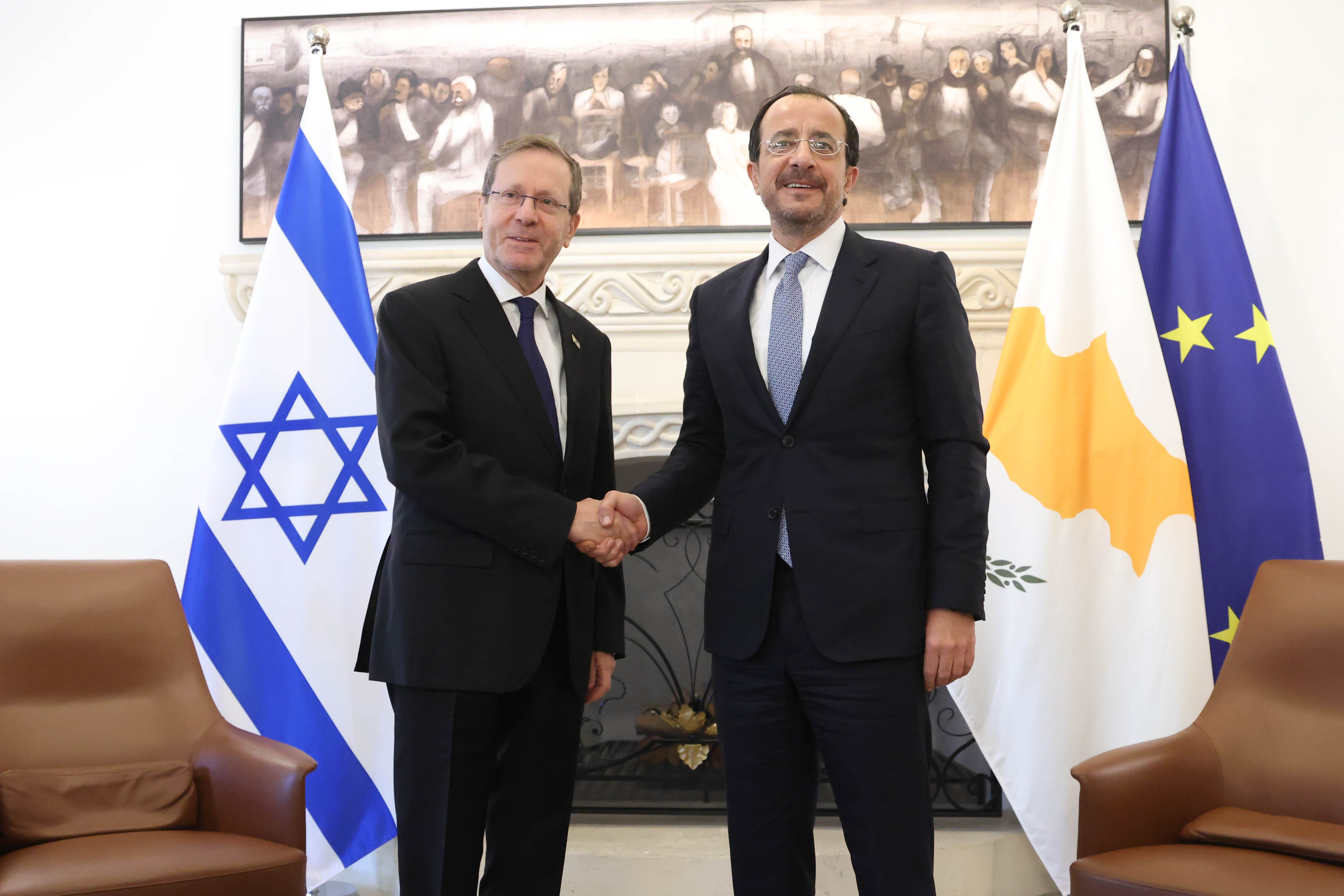
Welcoming the President of Israeli Isaac Herzog to the presidential palace on Thursday morning, President Nikos Christodoulides said the two would discuss “how we can work together on regional developments in our neighbourhood” to create conditions of “security, stability and cooperation.” This would be achieved with other “likeminded countries,” while Christodoulides said he looked forward to discussions on strengthening the countries’ “strategic partnership at all levels.”
As usual, the president was reading more into the one-day visit than was there. President Herzog, as head of state, does not have the powers to take decisions on how Israel’s government would approach regional developments and how its strategic partnership with Cyprus would be strengthened. This was why he stuck to diplomatic generalities, about bringing a “message of friendship” and expressing the “hope that together we can enhance further the unique partnership between our peoples.”
Herzog slightly deviated from this script in revealing that “my dream is that we would be able to meet with the President of Lebanon, yourself and myself, even here.” It was a strange dream, but perhaps it was a diplomatic opening to Lebanon, a message to the Lebanese president that a meeting in Cyprus was a possibility. And it is certain that Christodoulides would seize the opportunity to host such a meeting.
There were some talks between the two sides, according to the Cyprus government, but the information was vague. Apparently, they discussed cooperation in the defence field and the two sides would be in contact about weaponry Cyprus could buy from Israel as part of its arms programme. The government also said there was interest from Israeli arms manufacturers to set up operations in Cyprus, but whether this was discussed by Herzog is another matter. He was, however briefed about the Great Sea Interconnector as Israel would, reportedly, like to see the Cyprus-Israel electricity connection proceed, while Christodoulides supposedly brought up the issue of double taxation that has been pending for 15 years.
All this would seem to suggest that the Christodoulides government was greatly exaggerating the practical importance of what was a courtesy visit that included lunch and lasted a couple of hours. Director of the president’s press office Victoras Papadopoulos did not follow the government script, when speaking on a radio show on Friday morning, saying that Herzog’s visit “had a symbolic, but also a substantive character”. It was a diplomatic admission that nothing of practical value was discussed.
Making so much out of a courtesy visit and playing up the strategic partnership with Israel at a time when Christodoulides is supposedly working on securing a resumption of the talks does not stand to reason. Relations between Turkey and Israel are at an all-time low with the two countries at odds over a range of issues and the tension between them rising. One Israeli medium, i24NEWS, picked up on this in its coverage of Herzog’s visit, saying it took place “in the shadow of tension with Turkey,” while presenting Cyprus as a “vital strategic advantage for Israel.”
Will it help Christodoulides’ peace efforts to antagonise Ankara by promoting Cyprus’ strategic partnership with Israel and its defence cooperation? What is the likelihood that Turkey will see Israel’s growing influence over the Republic and its military presence, in some form, as a direct threat to its own security? How will this assist the Cyprus peace efforts and encourage Turkey to take a positive approach to talks? If anything, it will have exact opposite effect.
It could be argued that it is none of Turkey’s business which countries the Republic pursues a strategic cooperation with and, theoretically speaking, this is correct. But Turkey, whether we like it or not, is a key player in the Cyprus issue and her support to the peace process is vital if there is to be any movement. Do Christodoulides and his advisors not understand this?




Click here to change your cookie preferences