
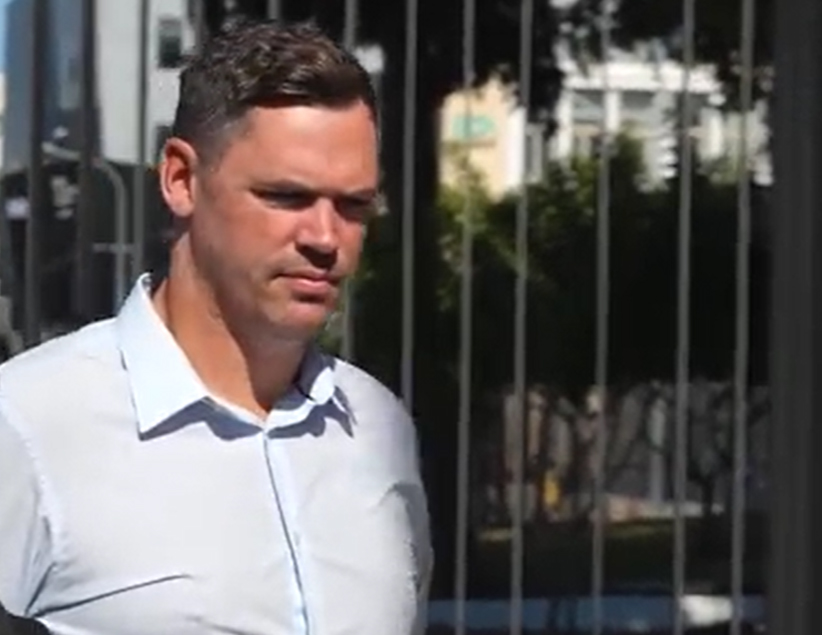
Joshua Foster, the British father whose young son died after falling from a fourth-floor hotel window in Paphos, was fined €3,000 on Friday, with the court ruling that the tragedy resulted from a momentary lapse of judgement rather than prolonged or conscious disregard for the child’s safety.
The decision brings to an end three months of criminal proceedings arising from a tragedy that unfolded during what was meant to be a family holiday in Cyprus. Foster, who attended the hearing with his parents, appeared visibly relieved and overwhelmed by emotion as he had to relive that fatal moment one last time, as the sentence was delivered.
Outside court, he told reporters “Thank you for your support, now I can collect my documents so that I can be back with my family”.
For a father who has spent the past three months facing criminal proceedings over the death of his own child, the decision also finally marks the beginning of a grieving process that his lawyer believes has been overshadowed by the case. Foster had pleaded guilty to causing death by a rash or negligent act following the death of his son during a family holiday in Chlorakas in July.
Delivering her decision during an emotional hearing, Paphos district court judge Froso Christodoulou acknowledged the seriousness of the offence and the devastating loss of a young child’s life, but said the circumstances surrounding the incident were central to determining the appropriate punishment.
The judge found that Foster’s conduct did not demonstrate sustained negligence or indifference towards his son’s safety. Rather, “it was a fatal mistake made within seconds”, when the father lifted the child towards a hotel window without realising that one of its panels was open.
The court heard that Foster had been walking along the fourth-floor corridor with his son and father-in-law when the child asked to look outside towards the swimming pool where the family had previously been playing. Believing the window was closed, Foster lifted his son towards it. The child fell almost immediately, before his father could react.
The judge observed that “the incident unfolded extremely quickly and that there was no evidence Foster had deliberately exposed his son to danger or continued acting recklessly after becoming aware of a risk”.
Although lifting the child without first checking whether the window was secure constituted negligence, the court concluded that the conduct was not characterised by conscious indifference to the child’s safety.
Christodoulou described the incident as a “fatal, unfortunately, momentary error”, acknowledging the tragic consequences while distinguishing Foster’s conduct from cases involving prolonged or conscious disregard for another person’s safety.
The court also addressed evidence concerning Foster’s alcohol consumption, noting that “no witness who encountered him before or after the incident, including hotel staff and police officers”, had reported behaviour suggesting that his faculties were impaired. It found no evidential basis to conclude that alcohol had contributed to the fatal fall.
Speaking to reporters following the sentencing, defence lawyer Alexandros Alexandrou welcomed the decision, saying the court had accepted the defence’s central argument that the tragedy was the result of a momentary mistake rather than serious negligence.
“It was precisely a momentary error, without any form of serious negligence,” he said, adding that the fine reflected what the defence considered the lowest degree of culpability.
Alexandrou particularly welcomed the court’s findings concerning alcohol, an issue which he said had attracted considerable public attention.
“The court is called upon to decide on the basis of actual facts, not assumptions or speculation,” he said.
He stressed that no evidence had been presented to establish that Foster’s actions resulted from alcohol-related impairment, describing the finding as particularly important for his client’s psychological wellbeing and for the public’s understanding of the tragedy.
The lawyer also renewed his criticism of the decision to pursue criminal proceedings, recalling that the defence had previously requested that the prosecution be discontinued on humanitarian grounds.
“Unfortunately, that did not happen, and three months later the sentence imposed is the least severe available,” he said.
He argued that those three months represented a missed opportunity for Foster to be with his family, particularly his daughter, who has also been struggling with the loss of her brother.
“No sentence, not even imprisonment, can bring the child back,” Alexandrou said.
It is worth mentioning that during the proceedings the judge also referred to previous cases under Article 210 of the Criminal Code, noting that the overwhelming majority concerned fatal road accidents.
Alexandrou told the Cyprus Mail that “only six prosecutions under Article 210 had been identified”, highlighting not only the relatively limited case law available but also the fact that these cases were much more severe than the case at hand.
In considering mitigation, the judge took into account Foster’s clean criminal record, his immediate admission of responsibility, cooperation with the authorities and guilty plea, which spared the family the additional ordeal of a contested trial. Particular weight was also given to the fact that the victim was his own son and as the that the consequences of the tragedy would remain with Foster and his family for the rest of their lives.
The court considered the possibility of imprisonment but concluded that a financial penalty would adequately serve the purposes of punishment and deterrence in the particular circumstances.
The judge nevertheless stressed that “the seriousness of an offence involving the loss of human life could not be overlooked”.
Foster was consequently ordered to pay a €3,000 fine, which will be deducted from the bail money previously deposited with the court, with the remainder returned to his father. The court also directed that the exhibits seized during the investigation be destroyed by police.
Alexandrou said Foster was waiting for the necessary administrative procedures to be completed, including the return of his passport and bail money, before travelling back to Britain, possibly as early as Friday or Saturday.
He also expressed hope that the court’s findings would help Foster in potential professional disciplinary proceedings in the UK, where his conviction could affect his career.
The lawyer became visibly emotional as he reflected on the case, admitting that despite the professional distance lawyers are trained to maintain, the experience had affected him profoundly.
“This is a case that has marked me deeply. It has affected me psychologically to a very great extent,” he said. “I came to know the person behind the word ‘defendant’, his family, an exceptional father, a very good husband and a family man.”
He said he would always remember the family’s resilience and the support they had shown one another throughout the proceedings. “Personally, I feel I am leaving emotionally richer,” he said. “His enormous strength of character will remain engraved in my memory forever.”




Click here to change your cookie preferences