
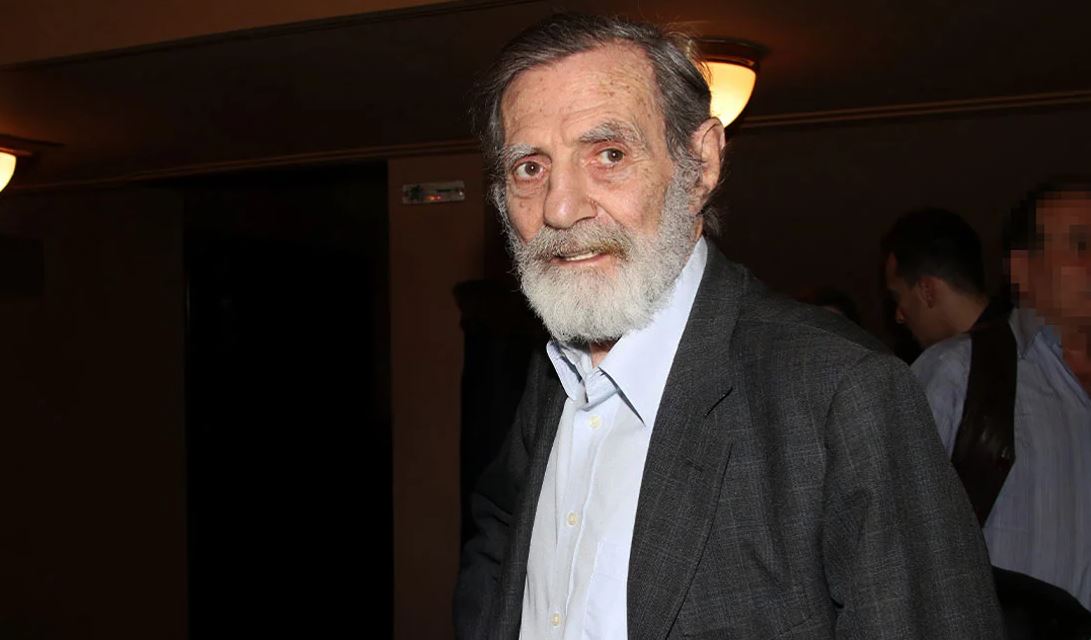
Greek shipowner Giorgos Vardinogiannis, a member of the family whose shipping and energy interests extended into Cyprus and president of Panathinaikos for almost 21 years, died on Friday aged 90.
Known as the ‘Captain’, Vardinogiannis died following a short stay in hospital. He began his career at sea and served two terms on the board of the Union of Greek Shipowners, while becoming widely known through his leadership of the Athens football club.
Born in Episkopi, Rethymno, in 1936, he was one of ten children of Giannis Vardinogiannis and Chrysi Theodoroulaki. He trained at a merchant navy college in Southampton before serving aboard merchant ships. His brothers Nikos and Vardis went into business after serving in the Greek navy, while other family members pursued careers in shipping and politics.
The family built its business around ships, marine fuels and oil refining. Among its early ventures was SEKA, established at Kaloi Limenes in southern Crete in 1963 alongside Mobil and Aristotle Onassis to supply fuel to vessels on eastern Mediterranean routes. Nikos also founded Varnima, with interests in shipping and hotels.
One of the most closely documented episodes of Giorgos’ seafaring career came in 1966, when he captained the Joanna V, also known as Ioanna V, during the international oil embargo against Rhodesia’s white-minority government.
He took the tanker towards Beira in Mozambique, then a Portuguese colony, despite British efforts to prevent oil reaching landlocked Rhodesia through the port’s pipeline. The voyage became the subject of a diplomatic dispute and helped prompt Britain to seek explicit UN Security Council authority to intercept shipments.
The family subsequently expanded into refining. Motor Oil’s refinery at Ayioi Theodoroi, near Corinth, opened in November 1972. Days later, the group’s tanker Gold Star delivered its first crude cargo, carrying 130,000 tonnes from the Persian Gulf, according to the company’s historical account.
After Nikos died in July 1973, Vardis took over the running of the business.
The wider family’s business interests later extended to Cyprus’ fuel market. In November 2016, Motor Oil subsidiary Coral agreed to acquire Lukoil Cyprus in a deal announced at €10 million, covering a network of 31 petrol stations.
The acquisition was completed in January 2017, with the business renamed Coral Energy Products Cyprus. Shell-branded petrol stations began operating on the island that year.
Motor Oil also acquired financial businesses from Laiki Bank through its Cyprus-based subsidiary Ireon Investments. The €73.5 million transaction, agreed in October 2018 and completed in 2019, included a 97.08 per cent stake in Investment Bank of Greece, 94.52 per cent of CPB Asset Management and full ownership of Laiki Factors and Forfaiters.
Alongside these investments, the family maintained its shipping interests through Avin International, established in 1977. The company says it manages more than 35 oil and chemical tankers, with a combined capacity exceeding 2.5 million tonnes.
Among its more recent vessels is Kriti Future, delivered in 2022 and described by classification society ABS as the world’s first ammonia-fuel-ready vessel. Built to allow a future conversion to ammonia, the tanker entered service using conventional fuel.
It was through Panathinaikos, however, that Giorgos became a household name. He assumed the presidency in July 1979, when the family acquired a majority stake in the newly incorporated football company as Greece introduced professional football.
He remained in charge until May 2000, overseeing six league titles, nine Greek Cups and three Super Cups. His relationship with supporters was sometimes strained, with praise for the club’s successes giving way to criticism of his decisions and the team’s performances.
Under his leadership, Panathinaikos opened its Paiania training ground and signed players including Dimitris Saravakos, Velimir Zajec, Juan Ramon Rocha, Stratos Apostolakis, Juan Jose Borrelli and Krzysztof Warzycha. Coaches during his tenure included Jacek Gmoch and Ivica Osim.
The club reached the European Cup semi-finals against Liverpool in 1985 and the Champions League semi-finals against Ajax in 1996. In the latter campaign, Warzycha scored in a 1 – 0 victory in Amsterdam, although Ajax overturned the deficit in the return leg in Athens.
In a tribute following his death, Panathinaikos described Vardinogiannis as “one of the most emblematic figures in the history of Panathinaikos and Greek football as a whole”.
The club also recalled its run to the UEFA Cup quarter-finals in 1987 – 88 and its place among the final eight teams in the 1991–92 European Cup, when a group stage was introduced ahead of the Champions League’s launch.
Beyond the first team, Panathinaikos credited him with developing its academy along professional lines, producing players who later formed part of Greece’s Euro 2004-winning side. His commitment to youth development, the club said, provided a model for Greek football.
His football dealings also brought a direct connection with Cyprus, notably through the signing of Omonia midfielder Costas Malekkos in January 1997.
Recalling the move in an interview with Cypriot radio station, Malekkos said he had agreed to join Iraklis and was passing through Athens when Panathinaikos intervened. He met Vardinogiannis and signed for the club, spending six months there before returning to Cyprus.
Vardinogiannis had three children with Agapi Politi, Pavlos, Nikos and Chrysi. His daughter married Nikolaos, son of Greece’s late former King Constantine II, in Athens in February 2025.



Click here to change your cookie preferences