
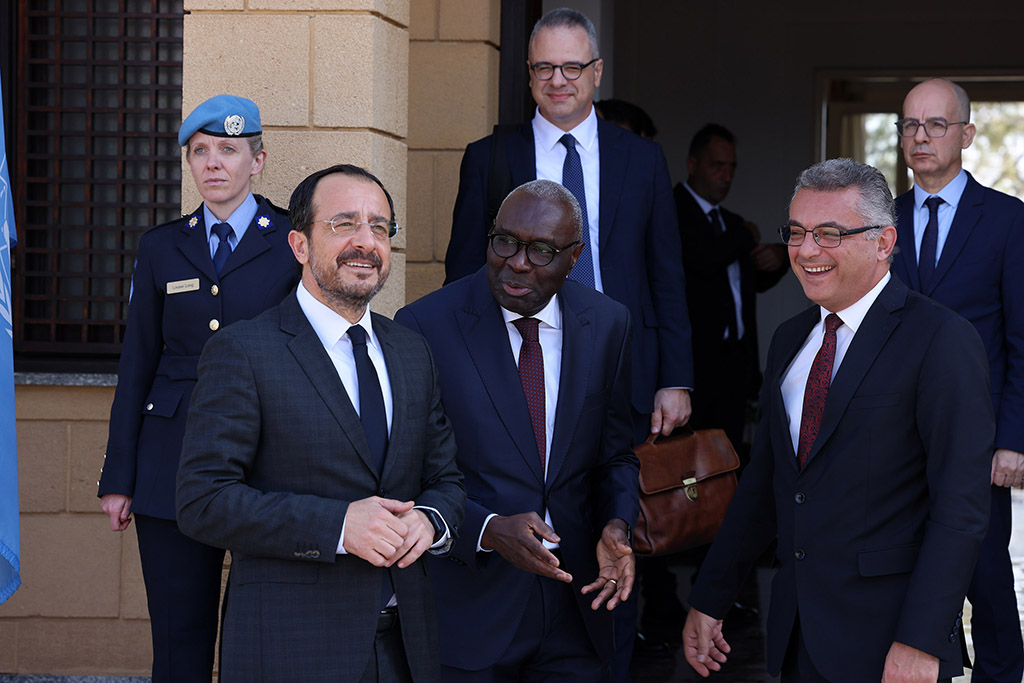
President Nikos Christodoulides and Turkish Cypriot leader Tufan Erhurman will next meet on Tuesday, government spokesman Konstantinos Letymbiotis said on Friday, with the meeting set to be the latest in an ongoing series of weekly talks between the pair.
Letymbiotis also said that following the conclusion of the leaders’ meeting, the pair will hold a joint meeting with the bicommunal technical committees on youth and cultural heritage, as well as the civil society steering committee.
The meeting will come with the Greek Cypriot side reporting that progress has been made on the prospect of opening new crossing points between the island’s two sides, with Greek Cypriot chief negotiator Menelaos Menelaou saying that a dispute over the routing of the planned transit road between Athienou and the Nicosia suburb of Aglandjia “has been overcome”.
He said that the outstanding dispute now remains over the question of whether a planned crossing point to connect Louroujina, the southernmost Turkish Cypriot village, with nearby Lymbia, will open at the same time.
The Turkish Cypriot side’s position is that the road between Athienou and Aglandjia constitutes two crossing points, one in Athienou and one in Aglandjia, and that they are part of a package of four alongside plans for a crossing point in the eastern Nicosia suburb of Mia Milia, and one in Louroujina.
However, the Greek Cypriot side treats the road between Athienou and Aglandjia as one crossing point, counterweighted by the Mia Milia crossing point, and is therefore of the view that the Louroujina crossing point should only be opened if a second transit road, through the Turkish Cypriot Kokkina exclave in the Tillyria region, also be opened.
Sides remain at odds over meaning of political equality
Away from the matter of crossing points, the sides remain locked on the question of the meaning of political equality, with the Turkish Cypriot side insisting that a rotating presidency between the island’s two major communities is an “indispensable component” of political equality which must be agreed upon before negotiations begin.
However, Christodoulides has on this front accused Erhurman of attempting to set “preconditions” on the resumption of negotiations.
“It is clear that the Turkish side … is setting terms and preconditions for the resumption of talks. They are demanding that we accept, in advance, specific positions of interest to the Turkish Cypriot community, while showing absolutely no willingness to discuss or accept our own positions on other significant aspects of the Cyprus problem,” he said.
Erhurman remains resolute on his four-point methodology which he says must be met before negotiations recommence in earnest.
Those four points foresee that the Greek Cypriot side accept political equality, time-limit negotiations and preserve all past agreements, and that the UN guarantee that embargoes placed on the Turkish Cypriots be lifted if the Greek Cypriot side leaves the negotiating table again.
Erhurman rejects Varosha proposal, asking instead for direct trade regulation
However, more recently, Christodoulides brought 19 new points for discussion to the table, among which was a proposal to open and repopulate the fenced-off area of Varosha under the United Nations’ administration and open the port of Famagusta under the European Union’s control.
Erhurman said he had rejected this because it falls short of the entry into force of the European Union’s direct trade regulation.
The direct trade regulation is a pending EU regulation which would allow Turkish Cypriot goods, as certified by the Turkish Cypriot chamber of commerce, to be exported directly into Europe via the Green Line, and given preferential treatment inside the European single market as European goods.
It was proposed in July 2004, three months after the rejection of the Annan plan by the Greek Cypriot side in a referendum, shortly after the Republic of Cyprus’ accession to the EU.




Click here to change your cookie preferences