
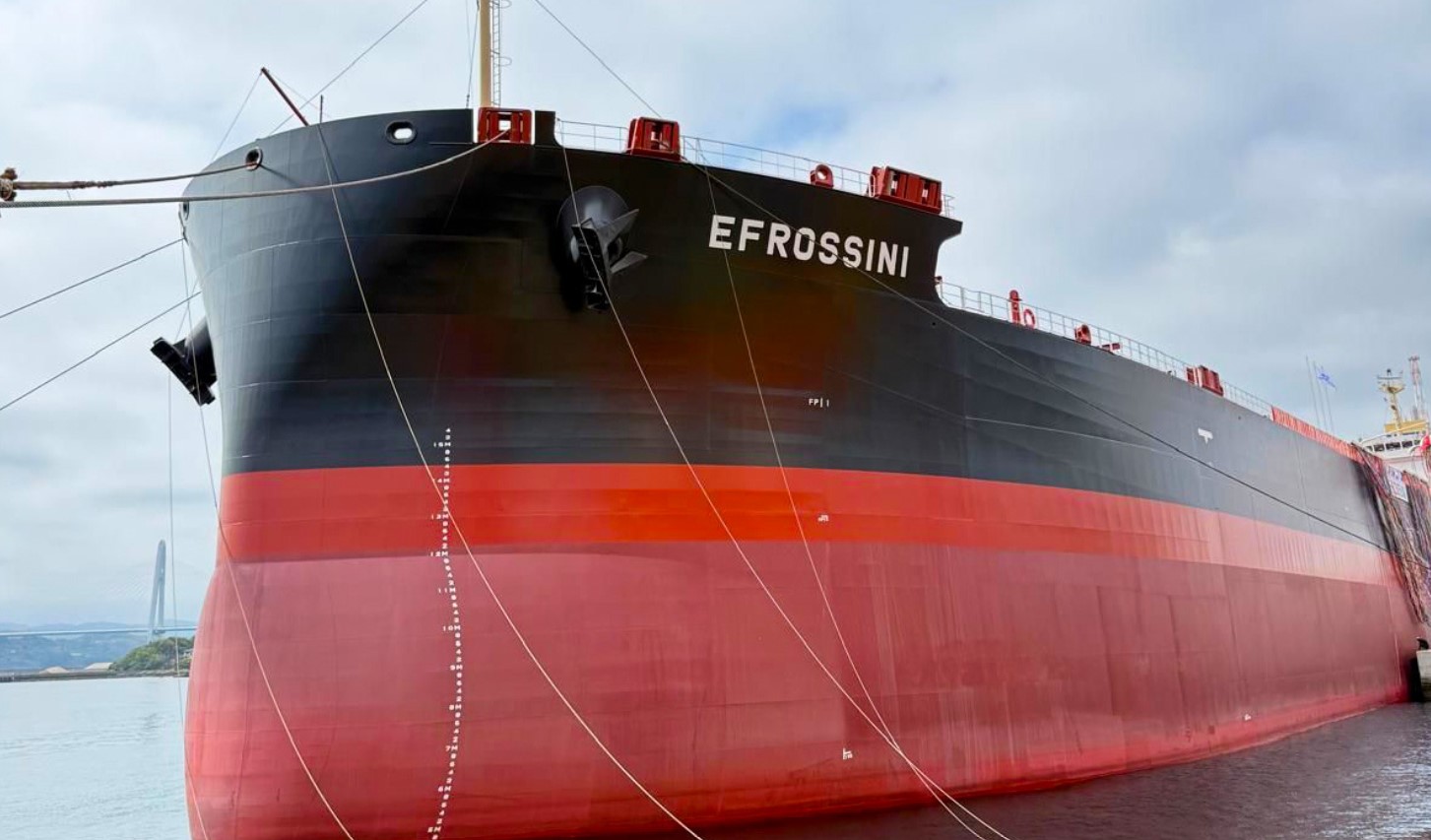
Cyprus-linked shipowner Safe Bulkers, led by Polys Hajioannou, more than tripled its net profit to $96.3 million in the first nine months of 2026, benefiting from stronger dry-bulk freight rates, as the company increased its dividend and continued investing in new vessels.
According to its latest results, released this week, net profit rose from $26.7m during the corresponding period of 2025, representing an increase of approximately 260 per cent.
Net revenue also climbed by 24 per cent to $252.9m, compared with $203.2m a year earlier, reflecting higher charter rates and additional earnings from vessels equipped with exhaust gas cleaning systems.
The improvement was particularly pronounced in the third quarter, when net profit reached $39m, more than double the $17.8m recorded a year earlier.
Quarterly net revenue increased by 25 per cent to $91m, from $73.1m, while adjusted net profit rose to $34m, compared with $13.9m in the same period last year.
The stronger performance was largely driven by the recovery in freight rates, with the company’s average daily time charter equivalent (TCE) earnings rising by 37 per cent to $21,235 in the third quarter, from $15,507 a year earlier.
For the nine-month period, average daily earnings reached $19,658, compared with $15,011 in 2025, despite the company operating slightly fewer vessels on average.
Earnings per share also improved considerably, reaching $0.35 in the third quarter, against $0.15 a year earlier. Adjusted earnings per share rose to $0.31 from $0.12.
Following the results, the board approved a 20 per cent increase in the quarterly dividend, raising the payment to $0.09 per common share from the previous $0.075.
The dividend will be paid on December 9, with shareholders entitled to receive it based on holdings recorded on November 25.
Safe Bulkers president Loukas Barmparis attributed the results to the stronger charter market, describing the company’s performance as being “in line with charter market conditions”.
He also pointed to the improvement in adjusted earnings per share and the company’s recent fundraising in Athens, which has strengthened its financial position and widened its investor base.
The shipowner reported $318.9m in cash, deposits and restricted funds at the end of September, alongside $195.8m in undrawn credit facilities.
By October 30, cash and deposits, including restricted funds, stood at $252.7m, while available borrowing capacity had increased to $255.8m.
Meanwhile, outstanding consolidated debt stood at $526m at the end of October, down from $567m at the end of September.
The company has also secured additional financing through two sustainability-linked agreements concluded this year, comprising a $60m loan in July and a further $50m credit facility in October.
Both arrangements link borrowing costs to independently assessed environmental performance targets.
Alongside its stronger financial results, Safe Bulkers is continuing to renew and modernise its fleet, replacing older ships with newer, more fuel-efficient vessels.
As of October 30, the company operated 46 bulk carriers, with a combined capacity of approximately 4.5 million deadweight tonnes and an average age of 9.8 years.
Its fleet comprised eight Panamax, 15 Kamsarmax, 16 Post-Panamax and seven Capesize vessels.
The company’s investment programme includes eight additional newbuildings, consisting of seven Kamsarmax carriers and one Capesize vessel, with deliveries scheduled between 2027 and 2029.
Two Kamsarmax vessels are expected in 2027, another in 2028 and four in 2029. The Capesize carrier is also scheduled for delivery in 2029.
One of the vessels on order will be capable of operating on methanol, continuing the company’s investment in alternative-fuel shipping.
This follows the October delivery of Kypros Island, the first methanol dual-fuel bulk carrier to join both the company’s fleet and the Cyprus ship register.
The 81,200-deadweight-tonne Kamsarmax vessel was built by Japan’s Tsuneishi Shipbuilding at its Chinese shipyard and named by Shipping Deputy Minister Marina Hadjimanolis during her official visit to China.
Its delivery also formed part of Safe Bulkers’ wider environmental investment programme, under which the company is introducing vessels designed to meet stricter international emissions requirements.
At the same time, Safe Bulkers has been disposing of older tonnage, having sold three vessels, Michalis H, Pedhoulas Commander and Xenia, for a combined $62.7m.
The company has already committed substantial funds to its remaining orderbook. By October 30, it had paid $61.2m towards seven newbuildings, with another $219.8m in capital expenditure outstanding.
The eighth vessel, a Capesize carrier, is being financed separately through a leasing arrangement.
Beyond its shipbuilding programme, Safe Bulkers has secured approximately $166.9m in contracted charter revenue, excluding additional income generated by its exhaust gas cleaning systems.
Of that amount, $88.9m relates to its seven Capesize vessels, all of which were operating under period charters at an average daily rate of $24,692.
The company had also secured employment for 83 per cent of its available fleet days for the remainder of 2026, providing substantial revenue visibility for the final months of the year.
Coverage for 2027 stood at 19 per cent, leaving a larger proportion of the fleet exposed to future freight market conditions.
Separately, the company continues to expand its presence in European capital markets following its dual listing in New York and Athens.
In June, Safe Bulkers became the first shipping company to have its common shares traded on both the New York Stock Exchange and Euronext Athens.
It subsequently raised €80.4m through a private placement of 12 million new shares at €6.70 each in September, attracting institutional investors and strengthening its funding position.
Hajioannou, the company’s chief executive and largest shareholder, also participated in the share placement, acquiring 1.5 million shares.
The additional capital is intended to support fleet investment and provide greater financial flexibility, while expanding the company’s shareholder base beyond the US.
For Safe Bulkers, the first nine months of 2026 have therefore delivered a substantial increase in earnings, higher returns to shareholders and additional capital for its fleet renewal programme.



Click here to change your cookie preferences