
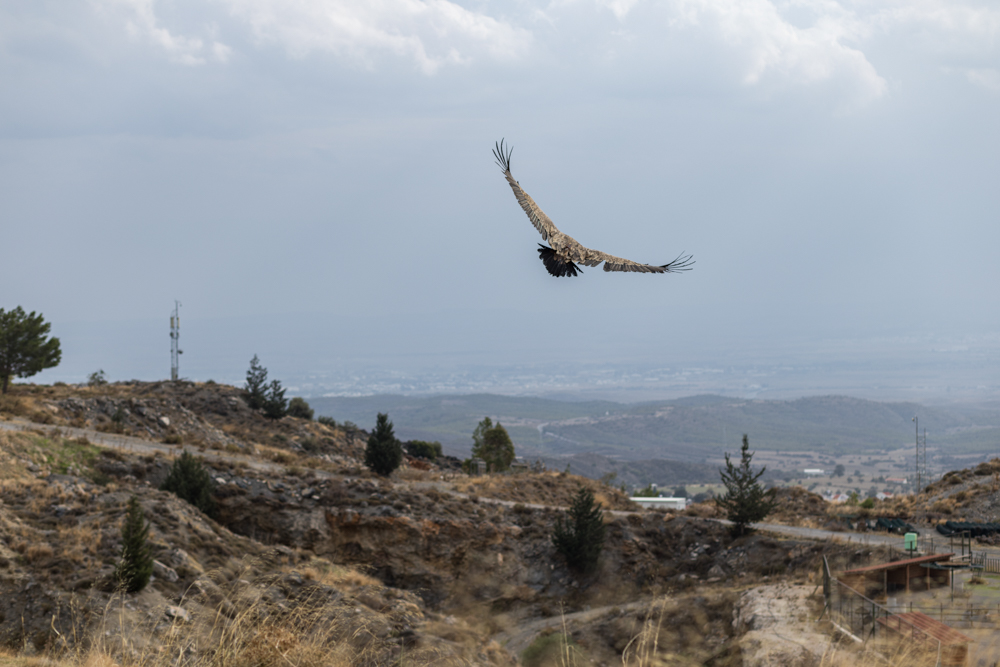
A Gyps Fulvus vulture, which had been brought to Cyprus from Spain in the framework of the Life with Vultures project, has fully recovered and was released back into the wild on Thursday, after being found weak and dehydrated in October.
The bird has been fitted with a GPS transmitter, so that its progress can be monitored, securing his smooth reintegration to its natural habitat.
This vulture had been first released in Cyprus in July 2024, in the framework of efforts to enhance the exceptionally small population of the species on the island.
The efforts had been carried out by the Life with Vultures – BirdLife Cyprus team, the Game and Fauna Fund, the Vulture Conservation Foundation and Terra Cypria.
In October 2025, after over a year in the wild, the transmitter indicated a prolonged immobility in Varosha area, which is considered unusual behaviour for the species.
The monitoring team immediately informed the Cyprus Wildlife Research Institute in Vouno community in the Kyrenia district, which found the bird severely weak and dehydrated.
Due to the immediate mobilisation, veterinary intervention and care provided by the staff, the vulture’s condition stabilised and the bird’s health began to improve.
After six weeks at the rehabilitation centre, where it fully regained its strength and passed all necessary tests, including toxicological analysis negative results for lead and pathogens, the vulture was ready to be released.
BirdLife Cyprus said it the vulture’s return to nature signalled the successful completion of a significant effort to rescue and rehabilitate the bird, which was made possible through the cooperation of bodies across Cyprus.
The bird is being systematically monitored, so that its health and movements are evaluated in real time now that it is back in its natural habitat.
Vultures are usually found in the southwest of the island, in the mountainous areas of Paphos and Limassol.
As their population recovers and grows, the birds are expected to begin exploring and recolonising historical colonies, such as Pentadaktylos mountain range, where the species once thrived.
This natural expansion highlights the importance of close and coordinated cooperation on a Cyprus-wide level.
Reducing threats, such as poisoning and electrocution, as well as responding promptly to any incident, regardless of region, constitute critical factors for the conservation and survival of Cyprus’ vultures.
BirdLife has extended its gratitude to all those who contributed to the rescue and rehabilitation of the vulture, including the BirdLife and Game Fund monitoring team, the state General Laboratory for the toxicological analyses, the Veterinary Services for testing for disease, veterinarian Constantinos Antoniou, the Vulture Conservation Foundation and the staff of the Cyprus Wildlife Research Institute for their professionalism, their immediate response and their dedication to protecting the natural heritage of the island.
Click here to change your cookie preferences