
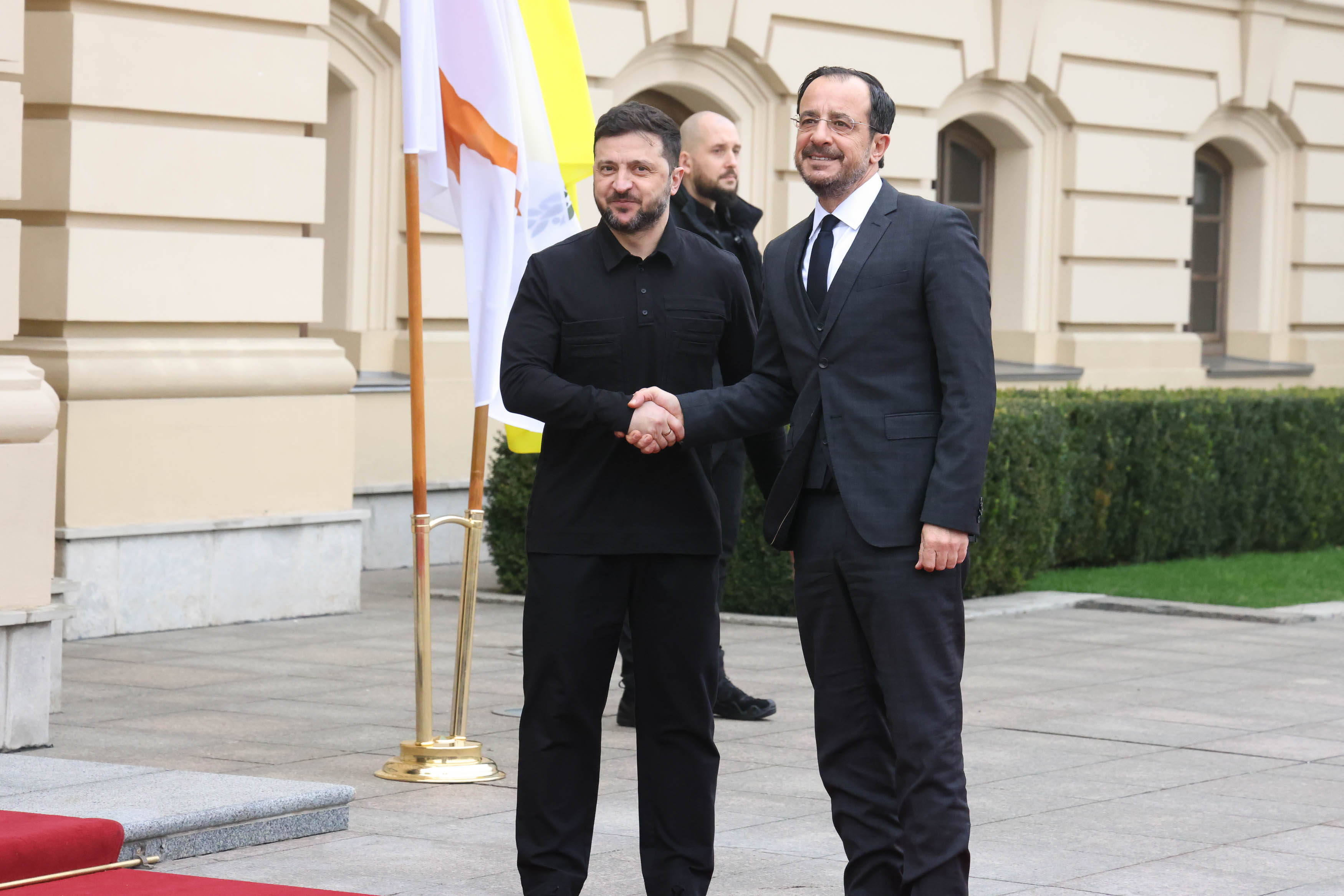
President Nikos Christodoulides on Thursday said the European Union must “confront” countries which attempt to help Russia evade sanctions placed on it as a result of its invasion of Ukraine.
Speaking upon his arrival at the day’s European Council summit in Brussels, he said that the imposition of sanctions is “a powerful tool for the EU”, and that “we should ensure that it is fully effective, confronting all these countries which attempt to violate sanctions”.
This issue, he said, would be discussed at the day’s summit, with the issue of Ukraine set to “dominate” the day’s talks.
“I hope that tonight, we will emerge even more united,” he said, before also speaking of plans to discuss the “necessary” financial support for Ukraine to be pledged by the European Union, so that Ukraine “can cope with the challenges of the Russian invasion and occupation”.
“What we want to ensure is … that any financial assistance from the EU, especially for the defence and security issues of Ukraine, cannot be spent on countries which are occupying European territory or threatening member states of the European Union,” he said.
This reference to Turkey comes with newspaper Phileleftheros having reported earlier on Thursday that Christodoulides will present to the European Council evidence of violations of EU sanctions on Russia in which “Turkey appears to be involved”.
The newspaper added that Christodoulides had also presented the evidence to Ukrainian President Volodymyr Zelenskiy during his trip to Kyiv earlier this month.
Reports have surfaced elsewhere regarding alleged Turkish links to Russian attempts to evade international sanctions, with the Sweden-based Nordic Monitor reporting that an “international smuggling network” used Turkey as a “key logistical hub to disguise the re-export of sensitive industrial equipment to Russia”.
It wrote that a Georgian national had been arrested in Spain for exporting machinery to Russia via Turkey through a “chain of shell companies”, with the machinery’s destination said to be Newton-ITM – a Russian company named on international sanctions lists.
According to the United States’ treasury department, Newton-ITM is “a supplier and producer of metalworking equipment and high-precision parts for the aerospace industry”.
Nordic Monitor reported that the chain of shell companies had seen goods imported into Turkey, repackaged as Turkish exports, and then shipped onwards to Russia, “allowing the network to sidestep EU trade restrictions” on a key sector of Russia’s war machine.
It added that the court ruling in the case of the Georgian national “shows how Turkish-registered companies provided crucial cover for the network”, and that Turkey was “instrumental in disguising the real destination of the prohibited exports”.
“It raises questions about Ankara’s enforcement of export controls and whether some Turkish firms are willingly providing cover for Russian procurement efforts with the full knowledge and approval of Turkish President Recep Tayyip Erdogan,” it wrote.
The EU unveiled its most recent round of sanctions against Russia – its 19th since the invasion of Ukraine in 2022 – in October, with those sanctions including a full ban on imports of Russian liquefied natural gas (LNG), which will come into effect on January 1, 2027, for long-term contracts and “within six months” for short-term contracts.
This sanction may prove to be a boon for Cyprus, which expects to be able to export its own LNG to Europe via Egypt in 2027.
European energy commissioner Dan Jorgensen described the ban on Russian LNG as “an unprecedented move that the EU makes in unity and full solidarity with Ukraine”.
“It will deal a major blow to Putin’s war machine and sustain peace efforts for Kyiv. Europe must regain its energy independence. Ukraine must prevail,” he said.
The EU has also placed a full transaction ban on Rosneft, as well as fellow large oil company Gazprom Neft, while five banks in Russia have also been added to the EU’s list of banks with which transactions are banned.
Kaja Kallas, the EU’s foreign affairs chief, said of the new sanctions package that it is now “becoming increasingly difficult for Putin to finance his war”.
“Every euro we deny Russia is one it cannot spend on war. The 19th package will not be the last,” she said.


Click here to change your cookie preferences