
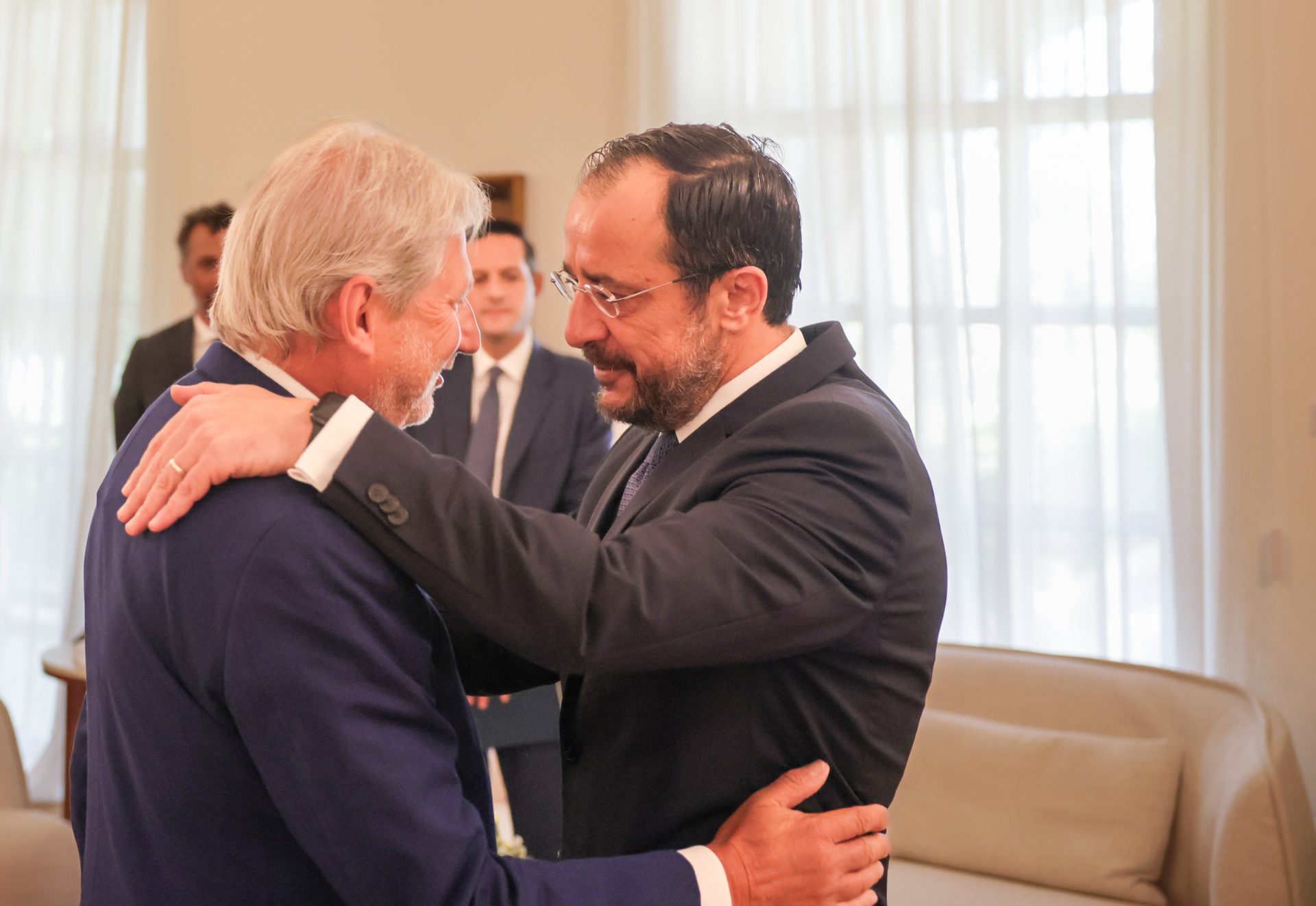
The European Union will facilitate a comprehensive solution to the Cyprus problem but will not act as a mediator between the parties, the EU’s envoy for Cyprus Johannes Hahn told local media on Saturday.
“The situation in Cyprus is a very important issue for the European Union as a whole, both for the effective implementation of its policies and the promotion of its values, as well as for stability and security in the Eastern Mediterranean,” Hahn said in interviews with Politis and Yeni Duzen.
He emphasised that the implementation of the EU’s acquis communautaire was a fundamental prerequisite for any solution and constituted the core objective of the EU’s involvement in the Cyprus issue.
“We are at a promising juncture. The leaders of both communities have declared their commitment to resuming negotiations within the framework of the United Nations,” he said. “Both should understand that their approach towards each other is an investment, not a concession.”
Hahn said EU assistance currently included efforts to harmonise the north with EU regulations in view of a potential accession following reunification, as well as financial support aimed in part at reducing economic disparities between the two communities.
This financial assistance, averaging €34.4 million per year, serves as the EU’s primary instrument for supporting reunification efforts.
He added that support for environmental sustainability and the ‘green transition’, along with aligning Turkish Cypriot products with EU standards, were central elements of the ongoing harmonisation process.
In this context, Hahn said legal experts had been mobilised to assist the Turkish Cypriot community, ensuring that draft legislation is compatible with EU law.
“More needs to be done as we move closer to reunification,” he said.
Asked about specific EU contributions that could help the Greek Cypriot and Turkish Cypriot sides reach an agreement, Hahn said these would become clearer once formal negotiations are relaunched.
“It is clear that any settlement must be achieved within the agreed UN framework, on the basis of a bicommunal, bizonal federation with political equality,” he said.
Such a settlement, he added, must comply with relevant UN Security Council resolutions and EU principles, as well as the EU acquis, including the rights and obligations that form the body of EU law incorporated into each member state’s legal system.
“For now, we are focusing on supporting the informal process under the auspices of the UN and implementing our own confidence-building measures,” Hahn said.
Among these measures, he highlighted the full implementation of the pan-Cypriot protected designation of origin (PDO) for halloumi/hellim, noting that remaining administrative issues are expected to be resolved soon.
The EU is also seeking to facilitate trade across the Green Line and support the creation of a bicommunal photovoltaic park in the buffer zone, which will be co-financed by the European Commission.
“The EU is also willing to explore financing the potential memorandum of understandings (MoUs) that the two leaders have identified with the UN Secretary-General, should they agree to implement them,” he said.
He underlined the importance of compromise and overcoming differences in reaching a solution, stressing that the current momentum should not be lost.
“This is a very good time to do so, and both I and the EU will provide all the necessary support. It is time to deliver,” he concluded.

Click here to change your cookie preferences