
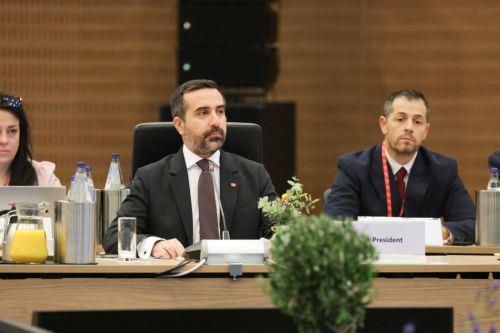
The full implementation of the EU’s new pact on migration will be the central priority of Cyprus’s EU council presidency, deputy migration minister Nicholas Ioannides told the European parliament on Tuesday.
Addressing the parliament’s justice committee, Ioannides assured that preparations for the pact, which is expected to enter into force in 2026, were in their final phase, with member states completing the necessary legal, administrative and operational measures.
He said Cyprus would support implementation “at all levels” and facilitate dialogue and cooperation where required.
Ioannides announced that Cyprus would host a ministerial conference on the day the pact formally enters into force.
He placed migration at the centre of the presidency’s political agenda, linking the issue directly to geopolitical instability.
“Cyprus assumes the presidency at a time of acute geopolitical uncertainty,” he said, admitting that conflicts in several regions were increasingly affecting both the external and internal security of the EU.
He stressed that no member state could meet these challenges alone, arguing that coordinated action is essential.
A key focus of the presidency, Ioannides said, would be the issue of voluntary returns, which he described as crucial to an effective and sustainable migration management system.
He told MEPs that Cyprus would work intensively to complete the relevant legislative dossier, adding that the new EU regulation would ensure that non-cooperation could no longer be used to avoid removal.
“It sends a clear message,” he said, “that those who do not have a legal right to remain in the EU will ultimately be returned.”
A strong external approach, he said, was essential for managing returns and migration more broadly.
Ioannides also condemned the instrumentalisation of migrants by third countries or hostile non state actors, saying such practices were aimed at destabilising the EU and posed risks to public order and national security.
He reaffirmed the EU’s commitment to protecting its territorial integrity and that of its member states.
Beyond migration, the deputy minister outlined priorities including judicial and police cooperation to combat human trafficking, stronger border security and improved EU preparedness for crises.
Border security, he said, was essential for safeguarding the Union and the integrity of the Schengen area.
In closing, Ioannides assured MEPs that Cyprus was ready to work constructively with the European Parliament, stressing that only through solidarity and respect for international law could the Europe respond effectively to current migratory challenges.
His remarks come amid increased scrutiny of migration management domestically, including the repatriation of detainees and prisoners, as part of broader efforts to ease pressure on the asylum system and align national policy with forthcoming EU reforms.





Click here to change your cookie preferences