
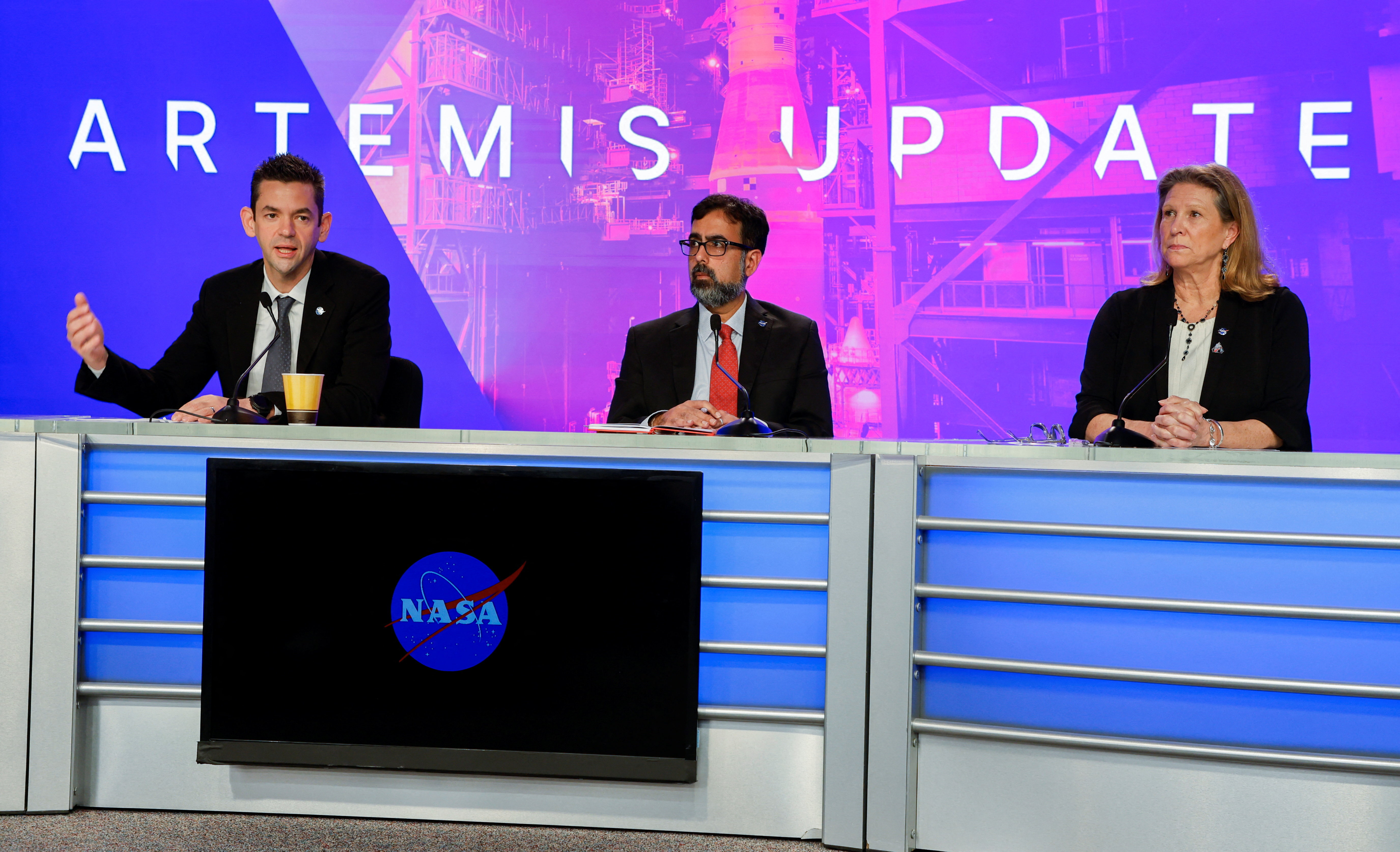
NASA is adding a spacecraft docking test to its Artemis moon program before landing its first astronauts on the moon in over half a century, overhauling the flagship U.S. moon effort amid mounting delays and competitive pressure from China.
The new Artemis mission in Earth’s orbit, planned for 2027 and involving lunar landers from Elon Musk’s SpaceX and Jeff Bezos’ Blue Origin, was one of many moon program changes announced by NASA chief and billionaire entrepreneur Jared Isaacman on Friday.
It comes as China inches closer to its own 2030 crewed moon landing goal, and U.S. safety experts warn more testing is needed before NASA makes its crewed attempt to land on the moon, now planned as Artemis IV in 2028.
“We all have arrived at the point that this is really the only pathway in order to achieve success with a lunar landing within the timeframes that we are targeting,” Isaacman told reporters on Friday, stressing a need to move faster and minimize delays with various spacecraft involved in the program.
As part of the updated Artemis III mission, NASA’s Orion astronaut capsule will demonstrate its ability to dock with one or both of the lunar landers in low-Earth orbit. The process is a crucial juncture in the agency’s path to the moon.
The space agency also canceled an effort to upgrade its Space Launch System rocket to instead focus on increasing that rocket’s production and flight rate, which has been slow relative to newer rockets. The move impacts Boeing’s roughly $2 billion contract to build a more powerful SLS upper stage, current plans for which have been canceled.
Those moves, Isaacman said, would help SLS achieve a flight rate of at least one launch per year and enable yearly missions to the moon, speeding up a launch cadence that currently stands at one launch every two or three years.
The decisions amount to NASA’s most significant reshuffling of its Artemis program since its inception in 2017, as the U.S. aims to establish regular lunar missions as a long-awaited follow-up to its first moon missions in the Apollo program that ended in 1972.
Isaacman said the agency’s many contractors, from Boeing to SpaceX, are on board with the new goals. Lockheed Martin, which builds the Orion capsule, lauded the announcement. Boeing said its workforce and extensive SLS supply chain are prepared to increase the rocket’s production and flight rate.
SECOND ARTEMIS MISSION STRUGGLES TO LAUNCH
SpaceX and Blue Origin are each developing an astronaut lunar lander for the program, dueling to be the first to achieve the moon landing for NASA. Boeing and Northrop Grumman build SLS, which carries the Lockheed Martin-built Orion astronaut capsule that will taxi the astronauts to one of the lunar landers in space before landing on the moon.
The new mission allows more practice for NASA before its more ambitious step of landing on the moon, which had long been planned for Artemis III. The agency launched an uncrewed test of SLS and Orion in 2022 and is targeting an April launch of Artemis II, taking four astronauts around the moon and back.
NASA since earlier this month has attempted to launch its second Artemis mission, the program’s first flight carrying a crew of astronauts. Three U.S. astronauts and a Canadian astronaut will fly Orion around the moon and back over ten days.
But a leak of hydrogen, a key propellant that fuels SLS, occurred during a launch rehearsal this month, followed by an issue involving the rocket’s upper stage that forced NASA to roll the rocket back for repairs.





Click here to change your cookie preferences