
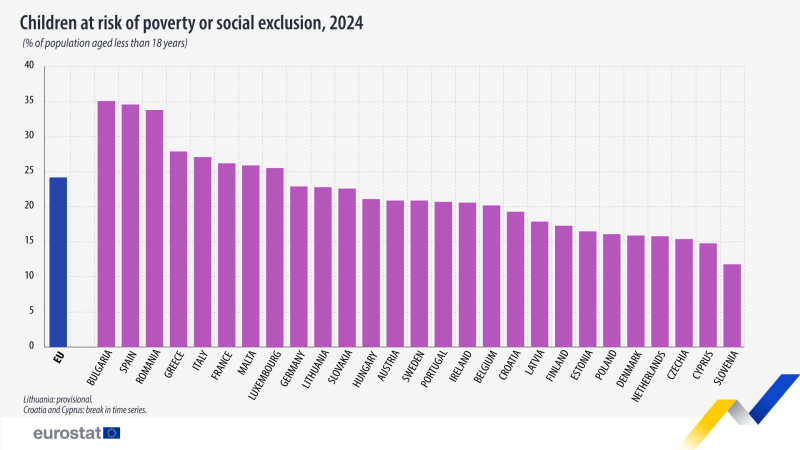
Decisive action is required to combat child poverty in the European Union, with current estimates putting quarter of the EU’s infant population – 20 million children – at risk, deputy minister of social welfare Clea Hadjistefanou-Papaellina said on Monday.
“The timing is particularly important, as the first ever EU anti-poverty strategy is to be presented during our Presidency,” she said.
Chairing the council on social policy, consumer affairs, employment and health, whose Monday agenda focused on the wellbeing of children, she warned that poverty experienced in the early stages of life had “profound and long-lasting consequences”
“It limits opportunities, widens inequalities and reinforces the perpetuation of these phenomena from generation to generation,” Hadjistefanou-Papaellina said.
She appealed to the council members to take coordinated action and implement targeted solutions to ensure improvement for the situation of the children at risk of poverty or social exclusion in the EU, warning that currently one in four children was at risk of such.
“The numbers speak for themselves. Almost 20 million children in 27 EU member states are at risk of poverty or social exclusion. These are the numbers and this is our priority,” she said.
Cyprus currently records the second lowest proportion of children at risk of poverty, standing at 14.8 per cent, around 26,000 children, in 2024, with the only lower rate recorded in Slovenia, at 11.1 per cent.
The highest rate of children at risk of poverty was recorded in Bulgaria, where the figure stood at 35.1 per cent.
Overall, there was a tendency for these figures to slightly decrease between 2023 and 2024, having decreased by 0.6 per cent and reaching 24.2 per cent as of 2024.
Former social welfare deputy minister Marilena Evangelou had described the development as a result of the government’s substantial backing for households and children.
“We have increased the child support income and have twice expanded subsidies for preschool tuition and meals, and various policies are set in place for certain at-risk populations, such as electricity subsidies for large families and single-parent households,” she said.
The government’s initiatives included amendments to the legislation governing state subsidies to single parents, whereby they no longer forego their right to receive benefits should they choose to cohabit.
The European Parliament had first called for the creation of a comprehensive anti-poverty strategy in 2021, with preparations of a first draft of the strategy expected to be completed by the Commission in 2026.
In addition to the 20 million children living in poverty or experiencing social exclusion, a further 93.3 million Europeans of all ages are facing similar challenges. This accounts for 20.7 per cent of the whole EU population, which currently stands at 450.6 million.





Click here to change your cookie preferences