
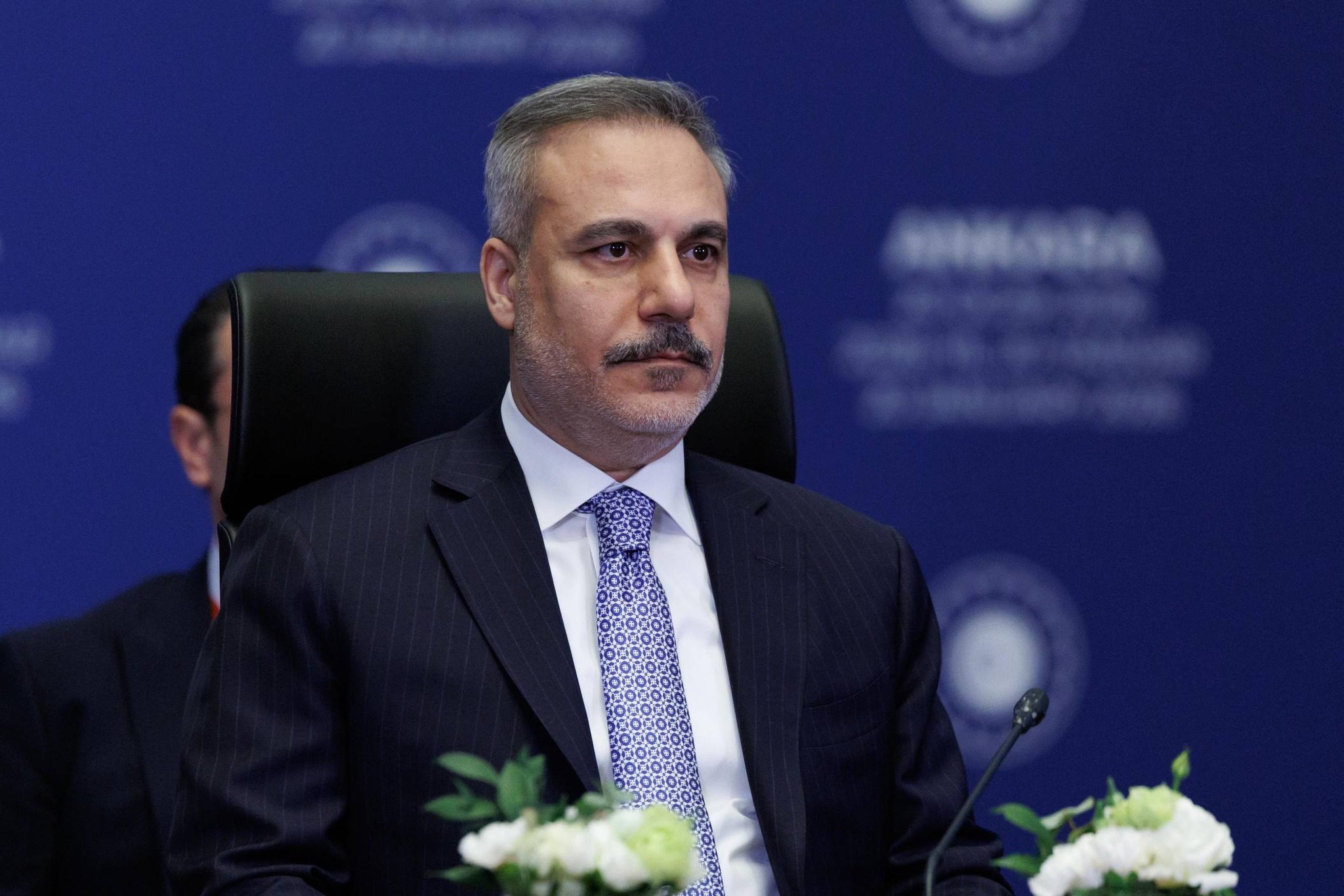
Turkish Foreign Minister Hakan Fidan lamented that relations between his country and the European Union are being “held hostage by one country” during a joint press conference with his Austrian counterpart Beate Meinl-Reisinger in Vienna.
“Unfortunately, there are some inherent rule-based dilemmas within the European Union. For example, 26 out of 27 countries, representing 400 million people, may want something, but the preference of less than a million people, or even a country with a population of less than a million, can render it sufficient,” he said.
Therefore, he added, “Turkey and the European Union – 500 million people – can be held hostage by one country”, before stressing that “the current system makes this possible”.
“This is not just about membership. It is also about pragmatic steps taken in the relationship. There are steps related to European security, critical infrastructure issues, areas concerning Europe’s increased competitiveness and areas related to expanding the digital space in Europe,” he said.
He added that “while a common structure of 500 million people could achieve something in all these areas, a country with less than a million people can be a significant obstacle, and nobody can say anything about it”.
“Now, the fact that such a tactical problem is preventing a major strategic benefit, and that a solution cannot be found, is another impasse. This, of course, is a problem which Europe needs to solve within itself,” he said.
Earlier during the same press conference, he had called on the EU to allow Turkey full membership of the European customs union.
At present, Turkey has a customs union agreement with the EU, but as Turkey is not a full EU member, it does not enjoy the full benefits of the union. As such, when the EU signs a trade deal with a third country, imports to Turkey from that third country can no longer be tariffed, but that third country can continue to place tariffs on Turkish exports.
Fidan as such pressed for better terms during the press conference, saying, “when we look at the war between Russia and Ukraine, and considering the role Turkey has played there, what is the European Union waiting for?”.
“Given the numerous geostrategic, geopolitical and geoeconomic benefits Turkey could offer, why is this membership not happening? Of course, every story has two sides. We have never demanded that membership conditions not be met or that Turkey join without fulfilling them,” he said.
He added, “naturally, if you want to join a place, there are conditions”, and that “these conditions are presented to you, and you join when you meet them”.
“However, the problem is that there is no political will within the European Union to say, ‘we will accept Turkey as a member of the European Union when the conditions are met’. Therefore, this political will was unfortunately killed by [former French president Nicolas] Sarkozy in 2007,” he said.
Sarkozy had in 2007 said, “I do not think that Turkey has a place in Europe because Turkey is a part of Asia minor”, and that “what I propose for Turkey is not a union, but a partnership”, and his comments were seen at the time as an indication of Europe moving away from the idea of Turkey joining the EU.
In light of this, Fidan said that “for us to move to the evaluation stages, the political will needs to be declared within the European Union, and then we can see to what extent and under what conditions accession will be opened and closed”.
Returning to the matter of upgrading the customs agreement between the EU and Turkey, he said that “both sides want to do this, but they cannot seem to take the first step”.
“In other words, there are some difficulties on the European Union’s side in demonstrating the necessary will. We are not talking about membership, but about taking that existing agreement between us, the customs union agreement, and updating it,” he said.
He added that this “is in the interests of both sides, and EU bureaucrats tell us this as well”, but that “there is a blockage of will somewhere”.



Click here to change your cookie preferences