
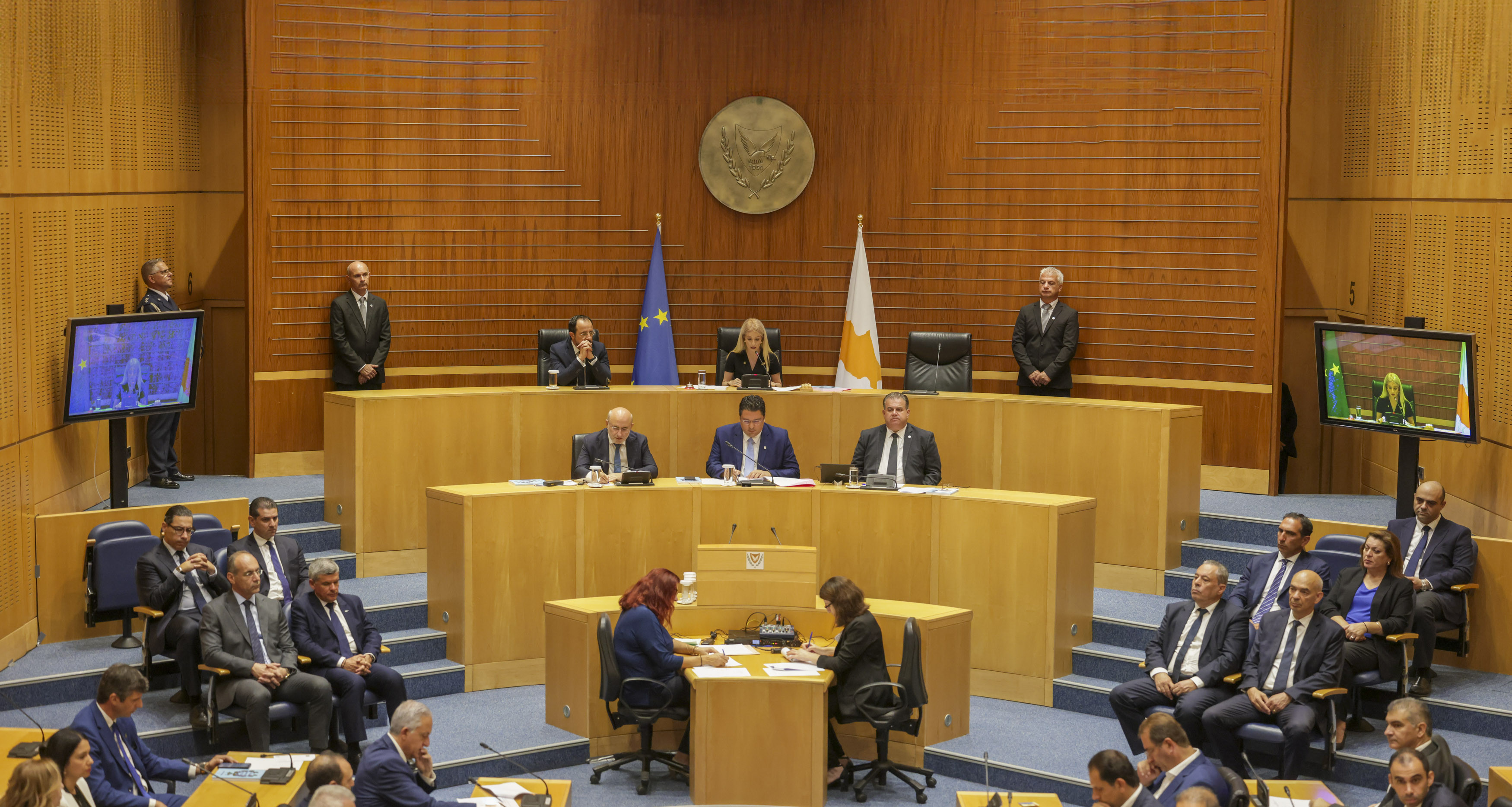
The House formally approved on Thursday night the composition of its selection committee as well as the appointment of new parliamentary secretaries and the administrative clerk.
The plenary session lasted just 13 minutes and was chaired by Diko MP Zacharias Koulias in the absence of House President Annita Demetriou, who is serving as acting head of state while President Nikos Christodoulides is abroad.
Disy MP Nikoleta Constantinou and Anastasia Hasikou of Akel were appointed as House secretaries, while Elam MP Marios Pelekanos was appointed dean.
The House also confirmed parliamentary representatives for the four largest parties.
Disy will be represented by Demetris Demetriou, Akel by Giorgos Loukaides, Elam by Sotiris Ioannou and Diko by Panikos Leonidou.
The main focus of the session was the approval of the selection committee, the body responsible for determining the composition and leadership of parliamentary committees for the new legislative period.
The committee consists of three Disy MPs, Demetris Demetriou, Giorgos Karoulas and Savia Orphanides, alongside three Akel MPs, Stefanos Stefanou, Giorgos Loukaides and Aristos Damianou.
Diko is represented by Panikos Leonidou and Elam by Linos Papayiannis.
House President Annita Demetriou also participates in an unofficial capacity.
The vote followed objections from Alma leader Odysseas Michaelides, who argued that his party was entitled to representation on the committee despite not meeting the parliamentary threshold traditionally applied in such appointments.
Michaelides maintained that neither the Constitution nor parliamentary rules exclude parties with fewer than seven MPs from participating.
He submitted his own candidacy for membership of the committee, but the proposal did not secure support.
During the debate, Akel parliamentary representative Giorgos Loukaides clarified that his party was not supporting the election of an Elam representative to the committee.
Demetris Demetriou responded that Michaelides had every right to submit a candidacy but argued that the issue had not been raised during previous consultations among party leaders.
Following the plenary session, the newly elected selection committee immediately convened its first meeting to begin discussions on the allocation of parliamentary committee chairmanships.
The committee’s work is expected to determine not only which parties will control individual committees but also whether the overall number of parliamentary committees will remain unchanged or be restructured.
Discussions have centred on whether the current total of 16 committees should be reduced, as proposed by Elam.
Different scenarios remain under consideration, and the final number will directly affect the distribution of committee presidencies among the parties.
According to parliamentary sources, the first meeting concluded without agreement.
Committee members are expected to resume discussions in an effort to reach a compromise before the next plenary session.
The allocation of committee chairmanships is due to be put before the House for approval on June 18.





Click here to change your cookie preferences