
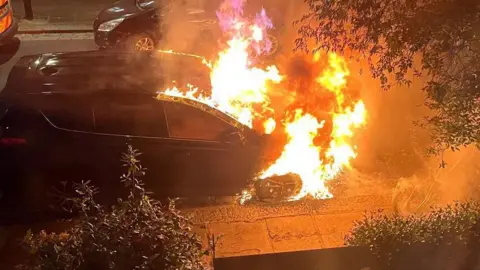
A Ukrainian man was found guilty on Monday of carrying out arson attacks on properties linked to British Prime Minister Keir Starmer in May last year on behalf of a mystery figure known only as “EL Money”.
Over a five-day period in May, emergency services responded to fires at a house in north London linked to Starmer, a nearby property where he had previously lived and where his sister-in-law still resided, and a Toyota vehicle that had once belonged to the prime minister.
At London’s Old Bailey, 22-year-old Roman Lavrynovych was convicted of two counts of arson while being reckless as to whether life was endangered. Lavrynovych and 27-year-old Romanian national Stanislav Carpiuc, who was born in Ukraine, were also found guilty of conspiracy to commit arson.
A third defendant, 35-year-old Ukrainian national Petro Pochynok, was acquitted of conspiracy to commit arson. Lavrynovych was cleared of a separate charge of arson with intent to endanger life.
All three men are due to be sentenced on Friday.
Jurors heard that Lavrynovych had been offered payment to carry out the attacks through a Telegram account operating under the name “EL Money”. The account communicated with him in both Russian and Ukrainian. Prosecutors did not identify who was behind the account.
“It is no part of your considerations to decide who ‘EL Money’ is and what reason he might have had to coordinate the actions of these defendants against these properties and this car associated with the prime minister,” prosecutor Duncan Atkinson told the court.
According to the prosecution, Carpiuc’s role involved planning the attacks and receiving payment.
Ahead of the verdict, Helen Flanagan, head of counter-terrorism policing in London, said investigators had found no evidence linking the attacks to Moscow.
“Obviously, it was a Russian-speaking entity that created those taskings, but we have seen no evidence to link this back to any Russian-backed tasking,” she said. “At the moment, we’ve got no evidence to suggest that this was a state-backed threat and target on the prime minister.”
Giving evidence in his defence, Lavrynovych said he believed more than one person operated the EL Money account and claimed that one of them was a woman. He told the court he did not know who Starmer was and accepted the work because he needed money to help his father, who was suffering from health problems.
The court was shown messages in which EL Money urged Lavrynovych to leave Britain after the attacks, warning him that he had targeted “a very high-ranking individual”. Another message instructed him to use the code word “geranium” if arrested so that a lawyer could be arranged.
Following the verdict, Frank Ferguson, head of the Crown Prosecution Service’s Special Crime and Counter Terrorism Division, described the offences as “deliberate and dangerous acts of arson” which posed “a serious risk to life”.
“Such offences go beyond damage to property. They are intended to intimidate and undermine public confidence, and that will not be tolerated,” he said.





Click here to change your cookie preferences