
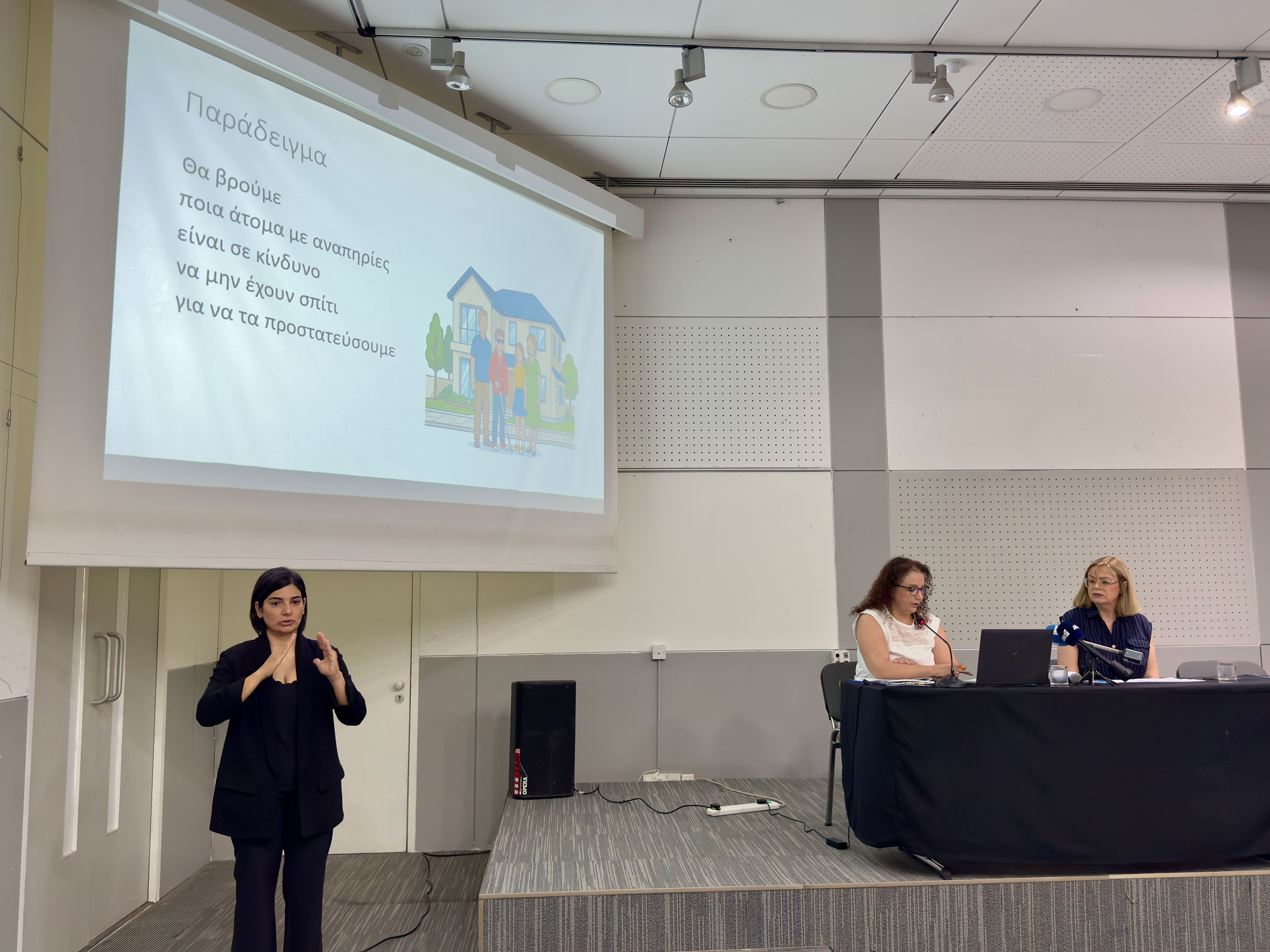
The government presented an ‘easy to read’ format of Cyprus’ national disability action plan in Nicosia on Friday, marking the first official release of the policy aimed at people with intellectual disabilities and those who face linguistic or cognitive barriers.
The publication is intended to make the state’s disability policy easier to understand while broadening access to public information.
Social Welfare Deputy Minister Clea Hadjistefanou-Papaellina said the initiative should become the foundation for wider use of the format across the public sector.
“Today’s presentation does not mark the end of an effort, but the beginning of a new path,” she said.
“A path that we aspire to lead to the broader integration of the ‘text for all’ format in public documents, policies, informational material and state services.”
She said the disability action plan forms the state’s main policy framework for promoting the rights of people with disabilities, covering areas including education, employment, accessibility, as well as healthcare.
Papaellina said accessibility extends beyond physical infrastructure.
“Without understandable and accessible information, there can be no meaningful participation in political and public life,” she said.
She added that 54 people with intellectual disabilities and people on the autism spectrum took part in evaluating and testing the document before publication, describing the process as putting into practice the principle of “Nothing for us without us”.
Senior social inclusion department official Vasiliki Fragkaki said access to information is fundamental to exercising rights.
“Access to information is not a privilege. It is a right,” she said.
“When information becomes truly accessible, people with intellectual disabilities can participate equally, make decisions about their lives and claim their rights as active citizens.”
Disability advocacy group (Epana) officer Maria Georgiou said converting the original strategy, which exceeded 60 pages, took up to five months, and included creating 95 original illustrations to support understanding.
The final publication also includes alternative text for every image, allowing screen reading software to access the content for people with visual impairments.
During the discussion, representatives of disability organisations called for Cyprus to develop its own expertise in accessible publications and for future work to include people with severe communication difficulties who rely primarily on images.
Organisers said cooperation with local universities is already under way as part of efforts to expand specialist knowledge in the field.




Click here to change your cookie preferences