
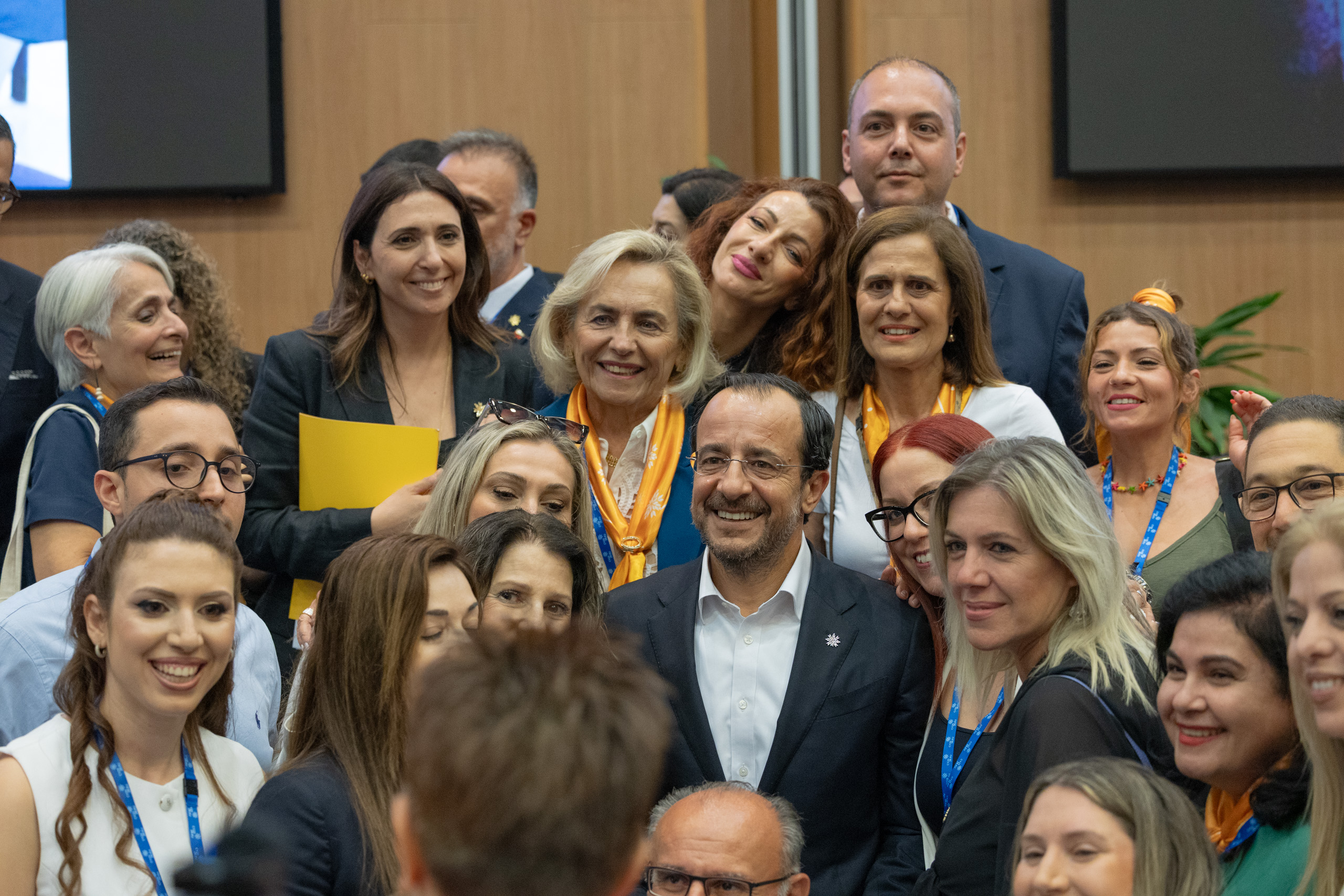
As Cyprus formally closed its six-month presidency of the EU Council on Tuesday, emotion was high at the Filoxenia Conference Centre – the building that for six months served as the beating heart of the presidency – with officials, civil servants and volunteers reflecting on what has widely been described as one of the bloc’s most effective recent presidencies.
European Affairs Deputy Minister Marilena Raouna, who led preparations for the presidency over the past two and a half years, struggled at times to contain her emotions as she addressed what she described as “the family of the Cyprus presidency”.
“I promised myself I would try not to become emotional,” she said. “I have been fighting this for the past month, as we passed one final milestone after another.”
Looking around the packed hall, Raouna paid tribute to the hundreds of officials in Cyprus and Brussels who had worked, often behind the scenes, to deliver a presidency that hosted almost 300 meetings across Cyprus, including 19 informal ministerial councils and, for the first time, an informal summit of EU leaders alongside regional leaders.
More than 30,000 visitors travelled to Cyprus during the six-month period.
“The success of the Cyprus presidency is you,” she told those gathered.
Her speech was as much a personal reflection as it was an institutional farewell as she recalled arriving in office in January 2024 with no building, no team and no established structure for what lay ahead.
“We built a service from scratch,” she said. “We fell and got back up many times. But never once did we believe we would fail.”
Foreign Minister Constantinos Kombos also praised what he described as an unprecedented collective effort, recalling that many had doubted whether Cyprus, one of the European Union’s smallest member states, could successfully navigate a presidency marked by multiple geopolitical crises.
The presidency, though, had demonstrated that “what matters is not the size of the country, but the quality of its preparation, coordination and determination”, adding that Cyprus had left behind a legacy that would continue to strengthen its role within the European Union.
President Nikos Christodoulides struck a similarly personal tone, abandoning what he described as the usual language of politics and policy.
“Today, I don’t want to talk about political priorities or conclusions,” he said. “I want to talk about people.”
Behind every successful summit, every agreement and every positive international headline, he said, stood the countless individuals who had worked weekends, late nights and often at the expense of their personal and family lives.
“I am truly proud,” he said. “Proud because you proved that a small country under occupation can organise, coordinate and deliver a presidency that earned the respect of all 26 other member states, of the European institutions and of international media.”
Cyprus EU presidency was against a backdrop of multiple geopolitical crises, including conflicts in the Middle East and wider regional instability.
“Every presidency faces a crisis,” Christodoulides said. “Ours faced several. But we turned those challenges into an opportunity to demonstrate professionalism, unity and effectiveness.”
Recalling remarks by the President of the European Council that Cyprus would have to wait another 17 years before holding the EU presidency again, Christodoulides joked that officials had now earned a well-deserved rest.
“You will rest,” he said, “but only for a very short time.”
He announced that, unlike after the 2012 presidency, Cyprus would retain the structures created for the presidency, including the Deputy Ministry for European Affairs and specialised EU units across government, arguing that “Europe is not simply foreign policy – it shapes the everyday lives of our citizens and every area of government policy.”
The president also singled out Raouna for special praise, saying that without her leadership “we would not have achieved this result”.
Throughout the event, speakers returned to a common theme, that the presidency’s greatest achievement may not have been any single agreement or diplomatic breakthrough, but the confidence it gave Cyprus itself.
“We proved that what matters is not the size of a country,” Raouna said. “What matters is what you bring to the table.”
One final remark by the Head of the Volunteers for the EU Presidency, perhaps captured the mood better than anything, “I will tell my grandchildren one day,” she said, “that I was there.”




Click here to change your cookie preferences