
The Great Sea Interconnector (GSI) project took another step forward on Thursday after Greece’s Independent Power Transmission Operator (Admie), the project promoter, submitted an investment request for the Cyprus-Israel electricity interconnection to the energy regulators of both countries.
The application marks the next stage in the implementation of the project under the European Union’s Trans-European Networks for Energy (TEN-E) framework and comes amid renewed momentum for the strategic electricity link connecting Greece, Cyprus and Israel.
The development follows the agreement under which French infrastructure investment group Meridiam became the majority shareholder in the GSI project company. It also comes after a recent telephone conversation between Greek Energy Minister Stavros Papastavrou and his Israeli counterpart Eli Cohen on advancing the Cyprus-Israel section of the project.
The investment request follows the completion of the required cost-benefit analysis (CBA) and the proposal for cross-border cost allocation (CBCA), both prerequisites under EU rules.
According to Admie, the studies were prepared following extensive consultation with the relevant authorities in Cyprus and Israel, including the two countries’ energy ministries, Cyprus’ Transmission System Operator (TSO) and Israel’s system operator Noga. The assessments took into account updated forecasts on electricity demand, renewable energy deployment, grid development and future energy system requirements.
The studies concluded that the Cyprus-Israel interconnection remains economically viable under all scenarios examined.
They also found that the project would significantly strengthen security of electricity supply, support greater integration of renewable energy sources and further connect the eastern Mediterranean electricity market with the wider European grid.
The submission now triggers the formal assessment process by the energy regulators in Cyprus and Israel, which must reach a joint decision on how the project’s costs will be shared between the two countries and recovered through regulated revenues.
Admie said it continues to work closely with the competent authorities, transmission system operators and other stakeholders on the technical, regulatory and financing aspects required to deliver the project.
Once both countries approve the investment framework, the project is expected to move to a final investment decision (FID), allowing financing arrangements to proceed.
The company said it also intends to attract additional investors for the Cyprus-Israel section, following the model used for the Greece-Cyprus leg, where Meridiam recently joined the investment consortium.
The Great Sea Interconnector is designated as a Project of Common Interest (PCI) by the European Union. It will have a transmission capacity of 1,000MW using a 500kV high-voltage direct current (HVDC) system.
Under the current plans, the converter station in Cyprus will be built at Kofinou, while the Israeli converter station will be located in the Hadera area.
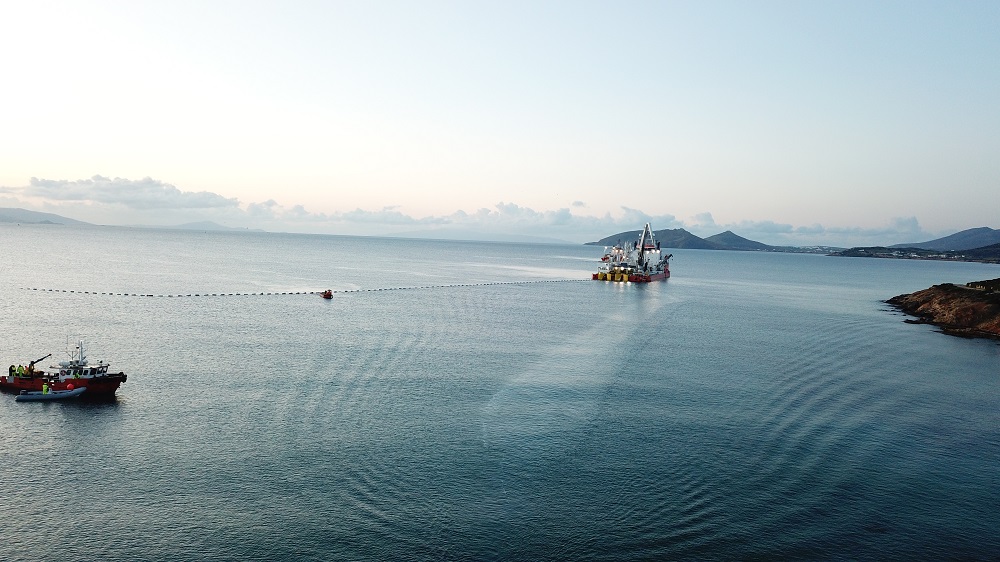
The submarine cable linking Cyprus and Israel will stretch approximately 324 kilometres, with installation depths ranging between 2,200 and 2,400 metres. The interconnection will allow electricity to flow in both directions, enabling power transfers between the two countries according to system needs.
Energy Minister Michael Damianos last week welcomed the entry of French investment group Meridiam and said the Cyprus government would first await the results of the European Investment Bank’s due diligence study into the project’s financial viability prior to examining whether the Republic of Cyprus will participate as a shareholder.
Meanwhile a bipartisan group of US lawmakers has called on Secretary of State Marco Rubio and US International Development Finance Corporation (DFC) chief executive Ben Black to make the Great Sea Interconnector (GSI) a priority, arguing that the project is strategically important for strengthening cooperation, energy security and US interests in East Med.





Click here to change your cookie preferences