
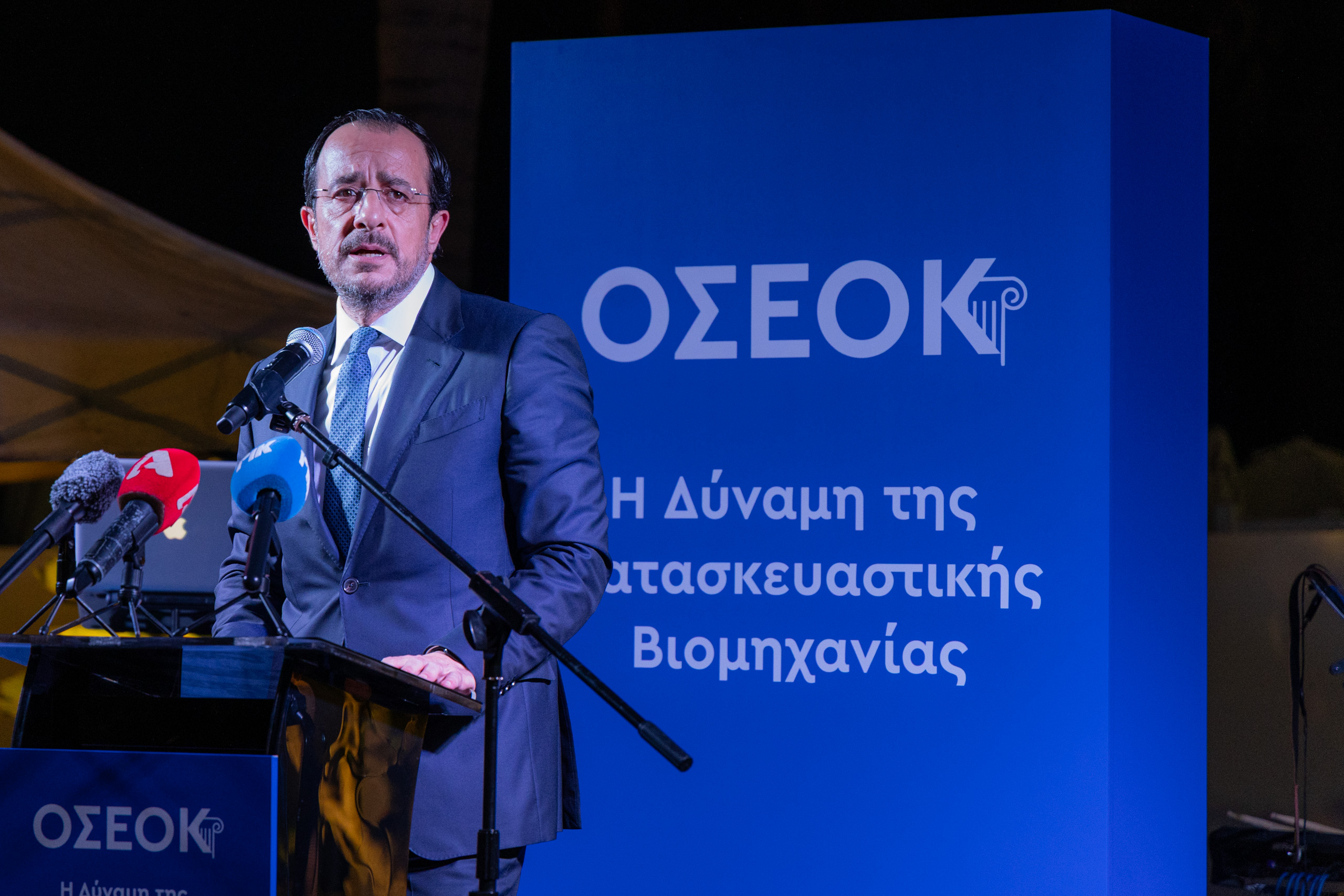
President Nikos Christodoulides on Thursday said the construction sector was central to Cyprus’ shift towards a more sustainable development model, while stressing its role in housing, jobs and regional growth.
Speaking at a dinner hosted by the Cyprus association of building contractors (Oseok) in Nicosia, Christodoulides said that “the transition to a greener and more sustainable model was a common goal of the state, the government and the private sector.”
He said the sector’s importance went beyond its contribution to economic activity, as it supports employment, a wide range of related professions and businesses, regional development and “the environment in which citizens live and create”.
Cyprus, he added, is going through a period of “substantial transformation”, with the demands of the modern economy, technological developments and sustainable development requiring a more flexible and effective state.
This, he said, was necessary to support entrepreneurship, attract investment and promote growth, which in turn allows the state to pursue targeted social policy, adding that “the government is promoting a broad reform programme aimed at modernising procedures, reducing administrative burdens and using technology for the benefit of citizens and the economy.”
Christodoulides placed particular emphasis on the reform of the development licensing system, promoted by the Interior Ministry, saying the aim is to simplify procedures, introduce digital tools and set clear timetables.
The goal, he said, is to substantially reduce the time needed for an investment to move ahead, while maintaining transparency, safety and quality standards.
He pointed to the first results of the reform, saying that almost 3,000 residential units and around 1,000 apartment buildings had been licensed within 40 and 80 working days, respectively.
“The significant acceleration in the issuance of permits for new residential developments proves that when the state wishes, it can operate more effectively,” he said, adding that this also strengthens competitiveness and helps address social challenges.
One of the most pressing challenges, he continued, is access to quality and affordable housing, particularly for young people and young families.
The president said the government is implementing a comprehensive housing policy, combining targeted schemes, financial incentives and institutional interventions, with the aim of increasing housing supply and creating more options for citizens.
As part of this effort, he said the government had effectively reactivated the Cyprus Land Development Organisation, which he described as having been dormant after 2022, through financial support and new actions.
However, Christodoulides said the success of housing policy depends heavily on the construction sector itself.
Without a strong, modern and competitive construction industry, he said, there can be no meaningful increase in the country’s housing stock.
Contractors, he added, are the ones who turn planning into action, implement investments, build new homes and deliver projects that respond to society’s real needs.
For this reason, he said the Oseok is viewed by the state as a strategic partner in implementing housing policy.
Through continued dialogue, he said, the two sides can help increase the supply of homes, contain construction costs and create sustainable housing developments.
Christodoulides also said the government is working to modernise public services linked to development and construction, through the reorganisation of relevant departments, stronger digital services and simpler procedures.
He stressed that development should not be measured only through economic indicators, but also through the quality of projects, the resilience of infrastructure, environmental protection and citizens’ quality of life.
The energy upgrade of buildings, the use of innovative materials and technologies, the digitalisation of construction and the adoption of modern practices are now essential parts of building a competitive and environmentally responsible economy, he said.
The president also emphasised the importance of maintaining trust between the state and the construction industry, saying that honest dialogue, institutional cooperation, transparency and accountability are the foundations of a stronger development model.
He thanked the association for its cooperation and said their regular contacts were already producing results, before congratulating it for its longstanding contribution to the sector.
Finally, Christodoulides said that “he was confident the association would continue to be a responsible interlocutor of the state and a valuable partner in building a Cyprus with modern infrastructure, more opportunities and a better quality of life for citizens.”




Click here to change your cookie preferences