
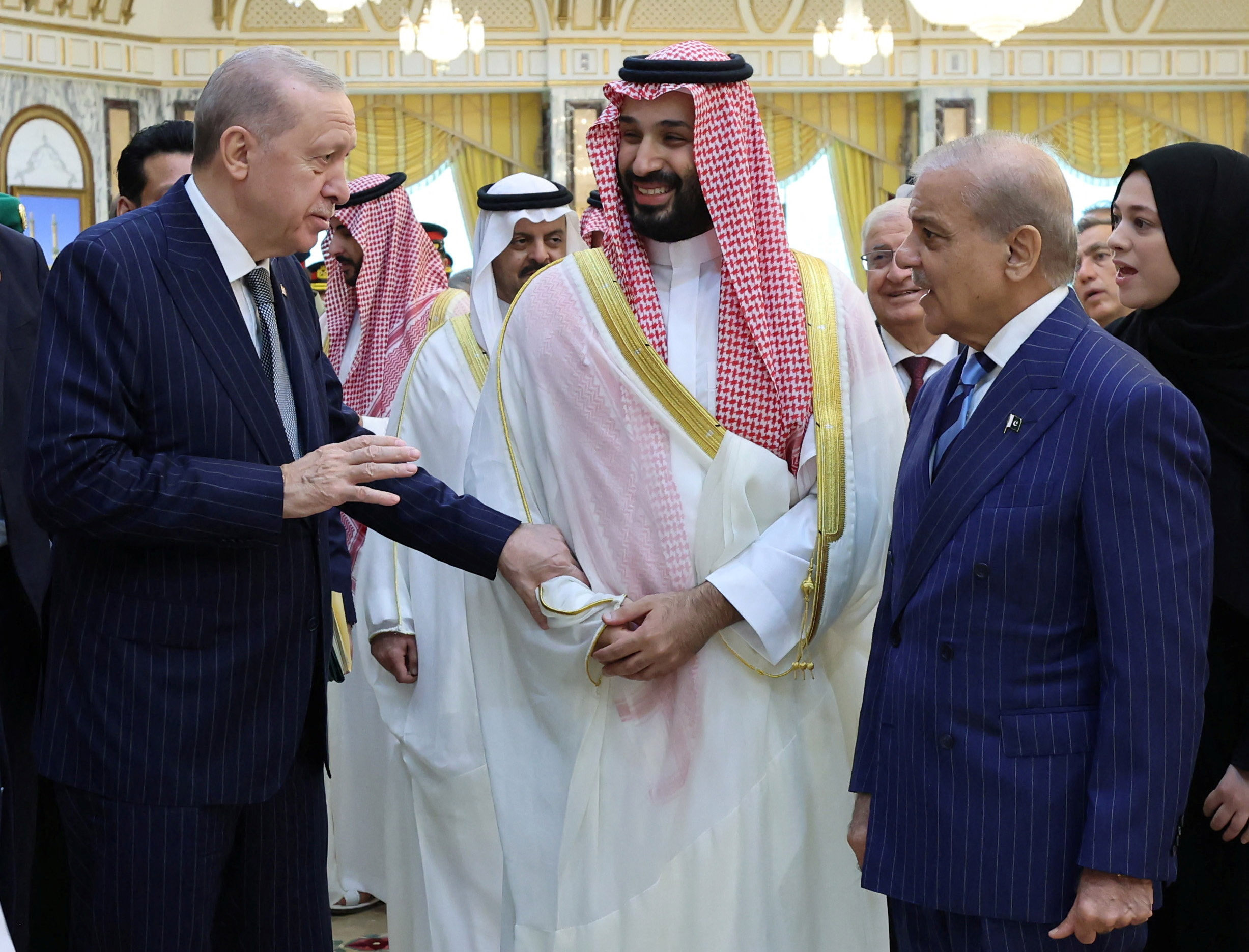
Emerging security architecture in the Middle East risks leaving Cyprus with less control over its own security as regional powers are pushed towards competing alignments, area studies analyst and research fellow at the Institute of International Relations (IDIS) in Athens Ilya Roubanis warned on Monday.
Speaking to the Cyprus Mail about the Mecca joint defence agreement signed between Saudi Arabia, Turkey and Pakistan earlier this month, Roubanis said its significance for Cyprus lies less in the prospect of a new military alliance and more in what it reveals about an increasingly polarised region.
He was quick to reject comparisons with Nato, particularly suggestions that the agreement amounts to an Article 5-style collective defence commitment.
“The Mecca agreement is not an alliance,” he said, stressing that the actual document has not been released.
There is no evidence, he explained, of a joint command-and-control structure, common security policy or established framework for political coordination.
“At best this is a sum of deep bilateral relations. We should not assume that a war of Turkey, say around Cyprus, would involve Saudi troops or indeed Pakistani troops.”
Asked specifically about the Article 5 comparisons, Roubanis said much of the discussion had come from commentators rather than diplomats or foreign ministries.
Saudi Arabia and Pakistan already had a deep bilateral defence relationship before the latest agreement, meaning it could, in some respects, be viewed as the existing Saudi-Pakistani relationship with a Turkish component added.
The same caution applies to speculation that Saudi Arabia could benefit from Pakistan’s nuclear deterrent.
“One should distinguish between facts and thought,” he said, describing discussion of an Article 5-style guarantee as “largely hot air”.
What is real, however, is deepening defence-industrial cooperation.
“There is deep and ever-expanding cooperation of the military-industrial complex of Pakistan, Saudi Arabia and Turkey. This is real, this is tangible, and it’s ever deepening.”
Turkey also maintains substantial defence relationships with countries including the UAE and Qatar, illustrating that the region is developing overlapping networks rather than clearly defined military blocs.
“There is no multilateralism here. There are strong networks. There are complementarities between these partners,” Roubanis said. “Military cooperation is real. But this is not Nato.”
For Cyprus, the concern is therefore not that Saudi or Pakistani forces could automatically become involved in a confrontation involving Turkey, but the wider political realignment taking place around the island.
Roubanis said an emerging divide was crystallising between Israel and the UAE on one side and Saudi Arabia, Pakistan and Turkey on the other.
Caught between them are countries including Egypt, Jordan and Oman, which have relationships and dependencies spanning both sides.
“Cyprus is likely to find itself in a polarising environment with neighbours that need to make mutually exclusive choices,” he said.
Nicosia could consequently have “less control over its own national security policy because a lot of its national security will depend on the goodwill and fortune of others”, both allies and adversaries with whom it does not have symmetrical relationships.
“So it’s a bad day for Cyprus because it has less control over its own destiny.”
Egypt is particularly important in this equation given its close strategic, energy and security relationship with Cyprus.
Asked about Cairo’s absence from the agreement, Roubanis said Egypt had been invited to join.
Egypt maintains a strategic relationship with Israel while simultaneously depending heavily on its Gulf relationships, including with Saudi Arabia and the UAE. It also relies on the Suez Canal as a major source of revenue.
Choosing between Israel and Saudi Arabia could therefore be “devastating for its national security”, he said.
Joining the agreement could be interpreted as “a statement of regional agency and a commitment against both Israel and the Emirates”, something Cairo cannot readily afford.
While its relationships with Cyprus and Greece matter, Roubanis said Israel and the UAE inevitably carry greater weight among Egypt’s immediate security priorities.
For Cyprus, Roubanis said, the European question may prove more consequential.
He described the Mecca agreement as “a statement of regional agency for regional issues” at a time when the EU is being forced to reconsider its own role in an increasingly multipolar world.
He expressed doubts over whether the bloc could establish a consolidated security position towards its southern neighbourhood, but said Cyprus and Greece could no longer remain on the sidelines of that debate.
“They cannot anymore hide behind the normative, legalistic, procedural process of vetoing or nodding or agreeing. They have to address challenges,” he said.
“I’m not sure that either Athens or Nicosia are ready for that.”
Britain’s presence in Cyprus adds another layer, particularly following the drone strike at RAF Akrotiri in March.
Asked what the changing regional order means for Britain’s Sovereign Base Areas, Roubanis questioned London’s longer-term purpose in the region.
“What is the purpose of the British presence in Cyprus?” he asked.
“The British position in Cyprus is about being able to project power in the Middle East and the Eastern Mediterranean.”
But why a middle power such as Britain, which also has deep ties with Saudi Arabia and the UAE, continues to need that ability is becoming an “existential question” for London, he said.





Click here to change your cookie preferences