
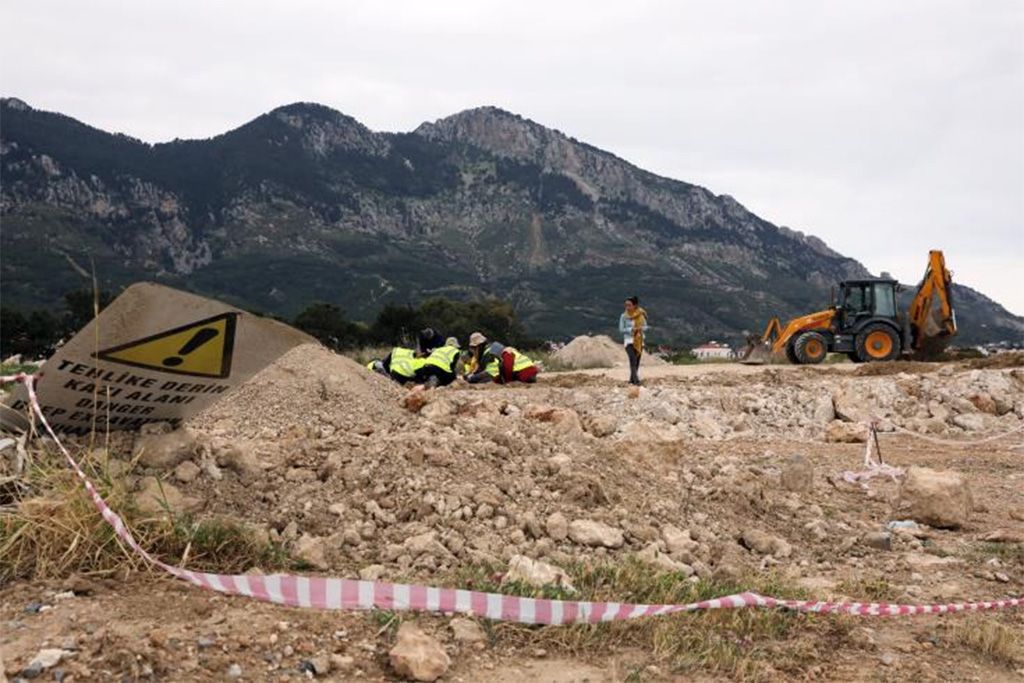
President Nikos Christodoulides affirmed on Sunday that he would press Turkish Cypriot leader Tufan Erhurman to allow excavations at suspected missing persons burial sites in military areas in the north during this week’s meeting with UN Secretary General Antonio Guterres.
Speaking at a memorial event in Kornos, Christodoulides said he would again seek permission for excavations in areas controlled by the Turkish military where information exists regarding possible burial sites.
“In all my meetings with the Turkish Cypriot leader, I have submitted requests in writing,” he said.
“If they really want a confidence building measure, the simplest, easiest confidence building measure is to allow excavations to be carried out in all these areas.”
He added that he hoped the issue would receive “a response” during the joint meeting with Guterres and Erhurman.
The president said excavations are currently under way in Agia, Assia, Yerolakkos, Lapithos, Exometochi and Livadia, while another 120 locations remain on the list for investigation, including sites within military areas.
He described resolving the fate of the missing as a humanitarian obligation, telling relatives that “our conscience will never rest if we do not ascertain the fate of our last missing person.”
Christodoulides said Turkey continues to deny access to military archives which could help establish the fate of those still unaccounted for.
Of the 1,619 Greek Cypriots listed as missing following the 1974 invasion, 764 have been identified, while 746 remain missing.
Of the 81 missing Greek servicemen, only 19 have been identified.
He also singled out the stalled investigations at Mia Milia, describing explanations that excavation costs were too high despite the project receiving European Union funding as “unacceptable responses”.
He demanded that the investigations should begin immediately.
The president announced that a memorandum of cooperation between the defence ministries of Cyprus and Greece has been finalised to strengthen efforts to determine the fate of missing persons, with the two defence ministers expected to sign the agreement shortly.
He also confirmed the government has allocated a permanent building for the Republic’s anthropological laboratory, saying the move would strengthen the infrastructure supporting investigations and provide a more appropriate setting for families receiving identified remains.
Addressing relatives, Christodoulides acknowledged failures by successive governments to adequately support affected families.
“As a state, since 1974 we have been slow to respond to many of your requests. I want to apologise to you tonight for the state’s omissions since 1974,” he said, adding that the government would also respond to requests submitted by children of the missing.
The event also heard renewed calls for greater cooperation from Turkey to establish the fate of those still missing.
Archbishop Georgios said the unresolved issue remained “a stigma for the global civilisation of our time”, while House President Annita Demetriou said that “for as long as there is even one mother who is waiting, one father who is searching, one child who never learned what happened to a parent, our debt remains unfulfilled.”
missing persons relative’s association president, Nikos Sergides, further urged Christodoulides to keep the issue high on the agenda during his international contacts.


Click here to change your cookie preferences