
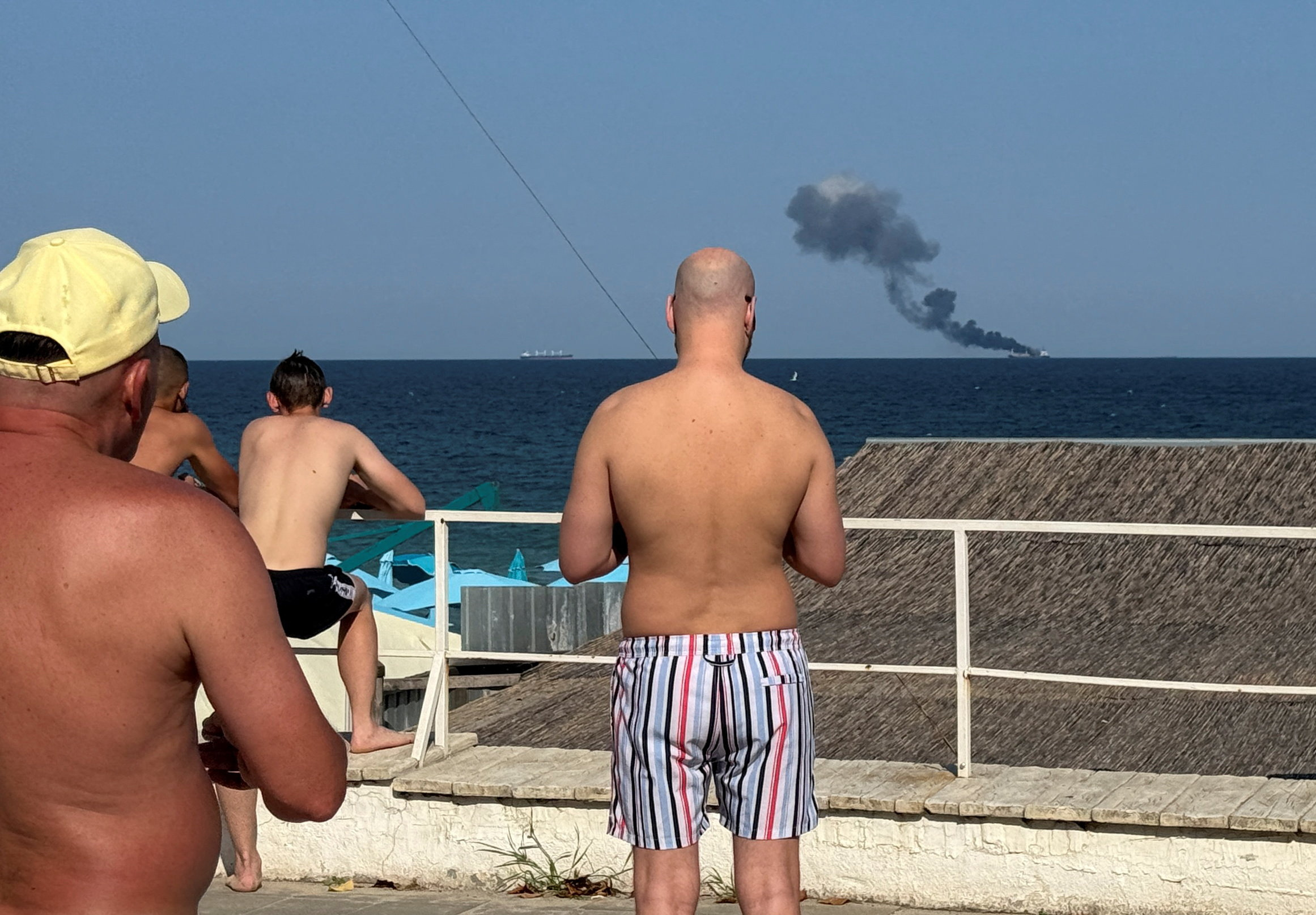
Ukraine targeted Moscow and the surrounding region with more than 400 drones overnight, while a Russian missile strike killed 10 people aboard a corn-carrying vessel near the Ukrainian port of Odesa, officials said on Monday, marking a sharp escalation in attacks far beyond the war’s front lines.
Moscow Mayor Sergei Sobyanin said more than 400 “enemy drones” were launched at the Moscow region between 8:30 pm on Sunday and 5 am on Monday. Most were intercepted by air-defence systems at long range, he said, including 85 destroyed while approaching the Russian capital.
The Russian Defence Ministry said its forces had shot down 381 Ukrainian drones over Russian regions, the Black Sea and the Sea of Azov overnight.
At least 10 people were wounded in Moscow and the surrounding region, according to Russian officials. Moscow region Governor Andrei Vorobyov said seven people, including three Chinese nationals, were injured in an attack on Domodedovo, near one of the capital’s main airports.
Domodedovo Mayor Yevgeniya Khrustaleva said a fire broke out at a local industrial park and a residential building was struck.
Ukrainian President Volodymyr Zelenskiy said Kyiv’s forces had targeted logistics facilities and an oil depot in the Moscow region.
Wildberries, Russia’s largest online retailer, said it temporarily evacuated its logistics centre in the Podolsk district as a precaution before resuming normal operations.
Seven Wildberries warehouse workers were killed and dozens of people injured in waves of Ukrainian drone attacks on Saturday. A separate attack started a fire at an oil depot in the wider Moscow region. Ukraine has accused Wildberries of selling military supplies used in Russia’s war effort.
Farther south, near the Ukrainian border, one person was killed and four others injured when a drone struck a village in Russia’s Belgorod region, its governor said.
The overnight assault coincided with reports of a deadly Russian attack on commercial shipping near Odesa.
Ukraine said Russia struck the Golden Leo, a Guinea-Bissau-flagged vessel carrying corn, with three cruise missiles on Sunday. The attack caused a fire aboard the ship, which was crewed by Indian and Syrian nationals, the Ukrainian navy said on Telegram.
A Reuters witness in Odesa saw smoke billowing from a vessel off the coast and verified that it was the Golden Leo.
A search-and-rescue operation continued throughout the night. Nine crew members and a Ukrainian maritime pilot were killed, while eight of the vessel’s 17 crew members were rescued, Ukraine’s seaports authority said.
The Golden Leo is owned by Mumbai-based Ocean Grace Shipping Ltd, according to LSEG data. Its manager, Friends Shipping Co SA, did not immediately respond to an emailed request for comment. Moscow made no immediate public comment on the strike.
The attack was the deadliest incident in a weeks-long resurgence of violence in the Black Sea, where Russia and Ukraine have increasingly targeted shipping, ports and energy infrastructure.
Russia’s Defence Ministry said its forces also struck fuel reservoirs at the port of Odesa overnight, Interfax reported. Russian attacks have killed 28 people in the Odesa region so far this month, according to the regional governor.
The Black Sea became a major flashpoint after Russia launched its full-scale invasion of Ukraine in 2022. Commercial shipping subsequently recovered under arrangements intended to facilitate grain exports and limit global food-price shocks, but renewed attacks are again disrupting the crucial trade route.
Ukrainian forces have targeted Russian energy infrastructure and oil tankers, while Russia has intensified its attacks on Ukrainian deepwater ports and cargo vessels.
Both countries are major grain exporters. Ukraine has accounted in recent seasons for about 6% of global wheat exports and 11% of corn exports, but Russian missile and drone attacks have eliminated about a third of its Black Sea grain-export capacity, according to traders and analysts.
Ukrainian attacks have meanwhile forced Russia, the world’s largest grain exporter, to restrict shipping through the Sea of Azov, a route responsible for about a quarter of its grain exports, sources have told Reuters.





Click here to change your cookie preferences