
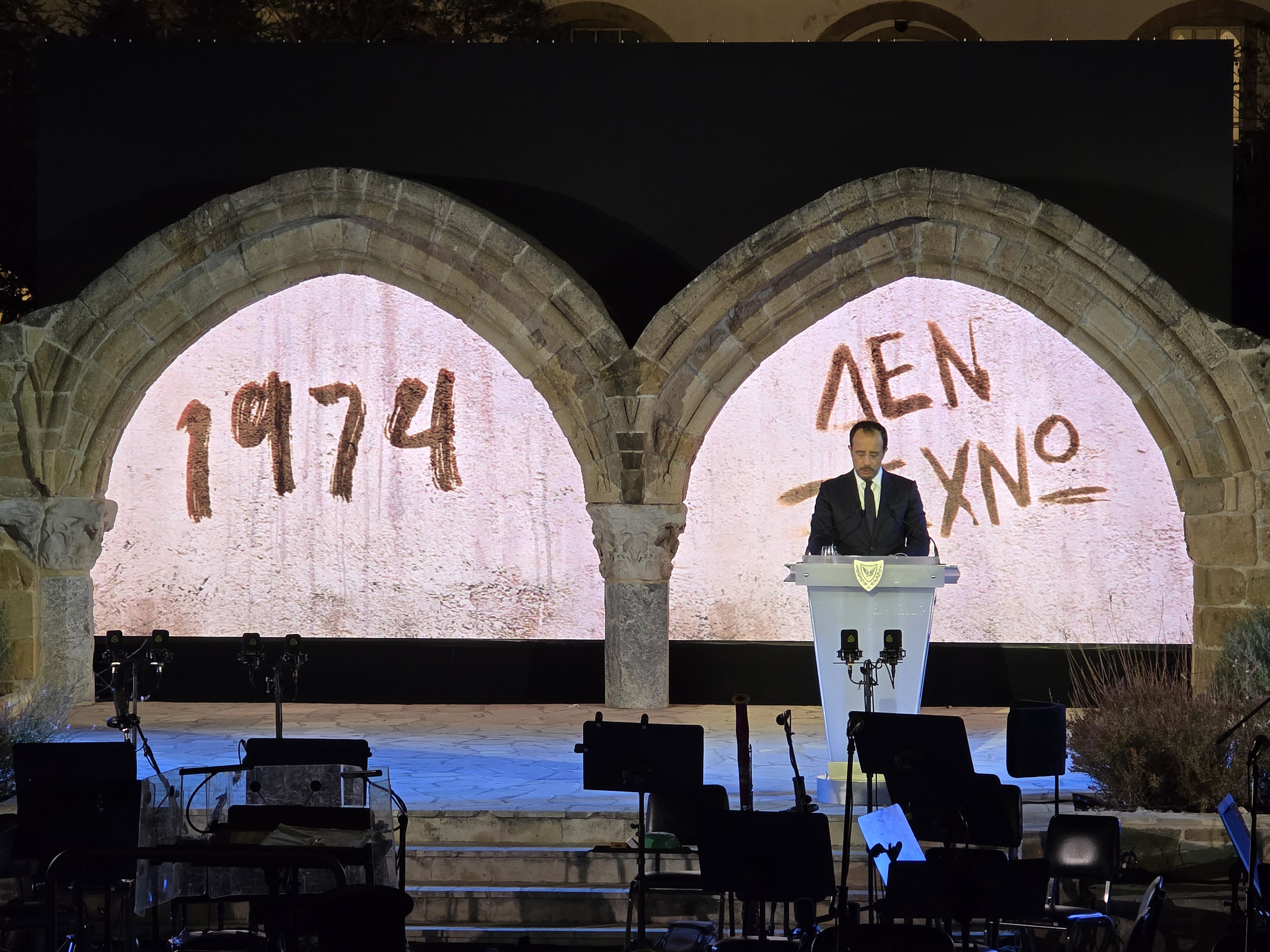
President Nikos Christodoulides stressed he would “not become the president of partition” and that the continuation of the Republic of Cyprus was an “absolute red line”.
Speaking on Monday evening at an event at the presidential palace to mark the coup d’état and the Turkish invasion, on July 15 and 20, 1974, respectively, Christodoulides said a two-state solution or a disguised confederation was not up for discussion.
Christodoulides also said that, although reaching a solution of the Cyprus problem was his “life mission”, he would never sign an agreement that was not functional and sustainable, and would not stand the test of time.
The president referred to the events of 1974 and the consequences, saying that during its “barbaric rampage” through Cyprus, Turkey committed one of the greatest crimes in postwar European history, wreaking destruction and suffering, with thousands of dead, displaced and missing.
He added that “justice cannot be derived from illegality.”
Christodoulides said that since he was elected, initiatives have been undertaken towards a solution, which must be within the UN framework and based on the acquis communautaire.
Despite the global turmoil caused by the wars in Ukraine and the Middle East, it has been possible to rekindle international interest in the Cyprus issue following the seven-year stalemate that began in 2017, he added.
He also referred to the UN Secretary-General’s upcoming visit to Cyprus from July 27 to 29 and the appointment of European Commission executive vice-president Raffaele Fitto as special envoy for the Cyprus issue.
“At this critical juncture, it has become clear to everyone that progress in EU-Turkey relations is directly linked to substantive progress on the Cyprus issue. And this development is the result of the strategy we have charted and are implementing,” he said.
Christodoulides said a settlement beneficial to all parties concerned could be achieved, provided that Ankara abandoned anachronistic notions that were incompatible with the current era, particularly in a European state, such as Cyprus – a shared home for Greek Cypriots and Turkish Cypriots, “our common homeland”.
Addressing the refugees, the families of the fallen and the missing, the resistance fighters and the veterans of the 1974 war, Christodoulides said he drew strength from their resilience, their will to return and their longing for justice.
“As the first President of the Republic of Cyprus from the postwar generation, I address you all with reverence, fully aware of the historic responsibility I have undertaken to work towards handing down to our children a free homeland, greater than the one I inherited,” he said.
He also thanked the Greek people and Greece’s political leadership for their continuous and steadfast support in the effort to free Cyprus from occupation, making special mention of the Greeks who fought in Cyprus.
In conclusion, the president pointed out that the days ahead are full of challenges, which require the utmost seriousness, readiness and unity, and called on everyone to join forces.




Click here to change your cookie preferences