
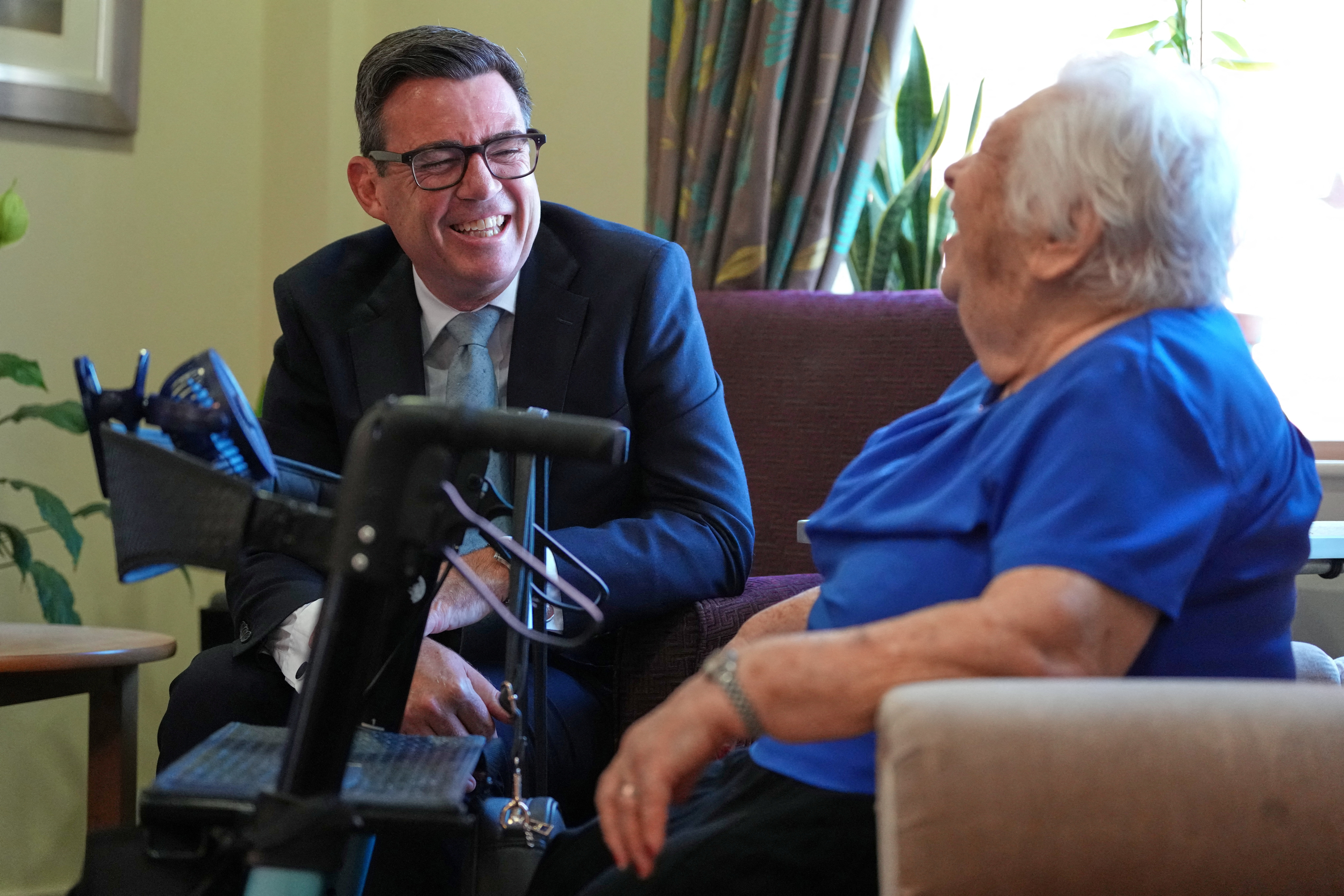
British Prime Minister Andy Burnham pledged on Wednesday to overhaul England’s adult social care system, saying he wanted to work with other parties to better fund a service where costs for users had become as unfair as those for U.S. healthcare.
Successive governments have failed to reform adult social care, for which families can pay hundreds of thousands of pounds, after previous proposals were defeated by opposition parties who dubbed them a “dementia tax” or “death tax”.
Burnham, who has seen a bounce in the governing Labour Party’s poll ratings since he became prime minister last week, cited the high-quality support given to his father, who has Alzheimer’s, as one reason why he was determined to fix the system and correct the “shameful” political record on care.
He said he had invited the leaders of the opposition Conservative and Liberal Democrat parties to discuss the issue and hoped that over time a national consensus would emerge, acknowledging that difficult decisions lay ahead.
POLITICAL, FISCAL RISKS
“I think social care in England is as unfair as American healthcare,” he told an audience at a care home in north London. “The vulnerable pay with everything and it can completely leave them with nothing.”
But Burnham’s focus on the system carries political risk, raising questions about whether he would need to hike taxes, impose a social care levy or favour an insurance model.
He first tried, and failed, to reform social care funding as health minister in 2010.
Unlike the National Health Service, which is free at the point of use, care homes are run by a range of providers, from large chains owned by international private equity groups to smaller family-owned businesses, charities and local government.
Depending on the level of medical need and location, residents pay about £1,400 ($1,900) a week privately, while local authorities are charged around £1,000 for similar care. How much the resident pays, and how much the state contributes, is determined by a person’s level of wealth.
Burnham said he believed more could be achieved with current funding levels if a national care service could be integrated into the health service, because at the moment the latter has to step in when the former cannot cope.
His ministers will develop an overarching care workforce plan, he added.
PROFITEERING, DANGEROUS COST-CUTTING FLAGGED
The former Greater Manchester mayor has argued that the state struggles because too often taxpayers’ money goes to services provided by private companies, limiting public control over quality.
On Wednesday, he said dysfunction in the care sector was symptomatic of that broader picture, where the government has to step in to pay for failure rather than invest in success.
He said profiteering in the care sector, aided by unnecessary and dangerous cost-cutting, was “fundamentally unacceptable”.
Private equity firms owned about one in eight for-profit care home beds in 2022.
The King’s Fund, a health think-tank, said English local authorities spent £34.5 billion on social care for disabled adults and older people in the 2024/25 financial year, up about 8% from the year before. Social care policy is devolved to the governments in Scotland, Wales and Northern Ireland.
According to Britain’s Institute for Fiscal Studies, around one in seven older people were likely to incur lifetime care costs of more than £100,000.





Click here to change your cookie preferences