
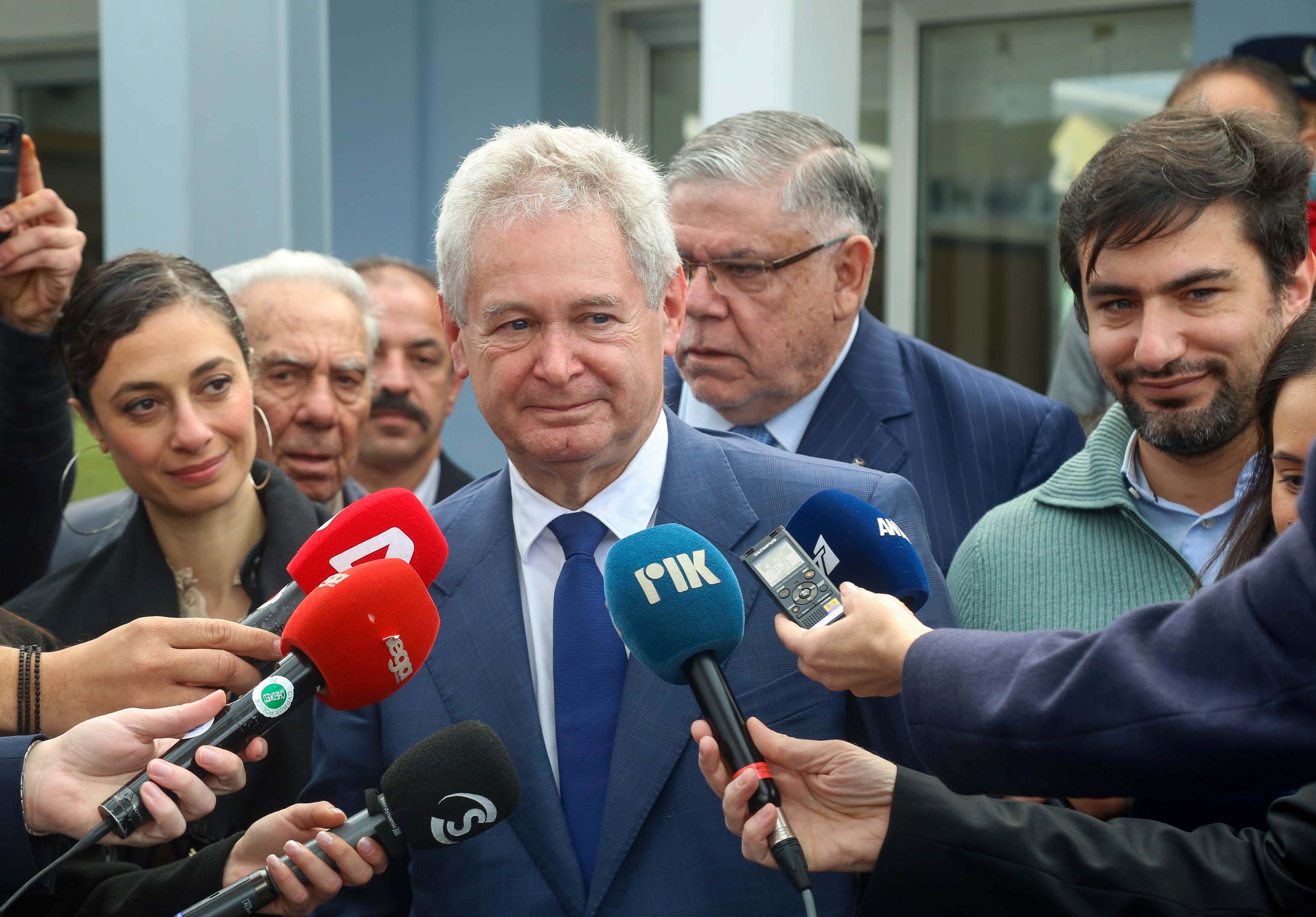
The Greek Cypriot side’s acceptance of a bicommunal federation following the 1974 Turkish invasion represented its “greatest concession” in pursuit of a Cyprus settlement, former Greek Cypriot chief negotiator Andreas Mavroyiannis has said, arguing that the compromise was always intended to secure progress on territory, security and the withdrawal of Turkish troops.
Speaking to the Cyprus News Agency, Mavroyiannis, who served as the Greek Cypriot chief negotiator from 2013 to 2022 and was also a member of the negotiating team under former presidents Glafcos Clerides and Tassos Papadopoulos, argued that the strategy of waiting for more favourable conditions -often referred to as the “long struggle” – has ultimately failed, with the passage of time only making a settlement more difficult as facts on the ground continue to change.
“We were always overcome by fear and a lack of boldness, and it usually took us time to understand developments and reach the point where we were ready to move forward,” he said.
Despite the “trauma” of the invasion and occupation, he said, the Greek Cypriot side made what he described as an exceptionally significant concession by accepting the principle of federalism.
That process began with the 1977 Makarios-Denktash high-level agreement, under which the Greek Cypriot side accepted the concept of a bicommunal federation. By the end of the 1980s, negotiations had evolved towards the concept of a bizonal, bicommunal federation.
“This was the greatest concession made by the Greek Cypriot side,” he said.
“But it was made on the understanding that in return we expected the withdrawal of Turkish troops, territorial readjustments, the return of refugees, a settlement of the property issue and so on.”
“What happened to all those things?” he asked.
According to Mavroyiannis, negotiations focused for decades on governance while leaving security guarantees and the withdrawal of Turkish troops largely untouched until the Geneva and Crans-Montana talks in 2017.
“For the first time since 1974 we discussed the entire package,” he said, arguing that only a comprehensive agreement addressing the principal concerns of both communities could produce a viable settlement.
“For Greek Cypriots, the key concerns are territory, property, guarantees and troops,” he said.
“For Turkish Cypriots, the main concern is effective participation in governance and ensuring that, as the smaller community, their rights are protected within a future settlement.”
Looking back at the 1978 American-British-Canadian peace initiative, Mavroyiannis said neither side demonstrated genuine willingness to negotiate and acknowledged that the proposal may have been premature.
Even so, he argued that rejecting it outright was a mistake.
“A proposal should always be negotiated,” he said. “Simply saying ‘no’ from the beginning is not particularly constructive.”
Recalling a quote by former US president John F Kennedy, he added that “you should never negotiate out of fear, but you should never fear to negotiate.”
Instead, he argued, the rejection of the proposal reinforced the concept of the “long struggle”.
He stressed that Archbishop Makarios’ original concept did not mean refusing negotiations or believing there was no urgency, but rather recognising that no agreement should exceed the limits of what the Greek Cypriot side could reasonably accept.
“The basic objective in 1977 was to make concessions on governance in order to secure gains on guarantees, troops, territory and property,” he said.
“Today that has been completely forgotten. We speak about a bizonal, bicommunal federation, but forget that this was our greatest concession in order to safeguard everything else.”
Responding to suggestions that the 1978 initiative should have been rejected because it was linked to efforts by the US to lift its arms embargo on Turkey, Mavroyiannis acknowledged that this had indeed been one of the motivations.
“But was that a reason to reject it?” he asked.
“As a result of the rejection, despite the ten-point agreement that followed the next year, the embargo was eventually lifted anyway, and we gained absolutely nothing.”
He distinguished between the Cuellar guidelines and the Ghali set of ideas, arguing that neither constituted a complete settlement proposal but rather negotiating frameworks.
According to Mavroyiannis, only two comprehensive settlement frameworks have existed: the Annan plan and the package negotiated up to Crans-Montana in 2017.
Although he was one of the principal negotiators under Papadopoulos, he said he personally opposed the Annan plan because it was the product of international arbitration rather than free negotiations.
“A settlement plan produced through arbitration is, by definition, not a good plan,” he said. “It is not something freely negotiated between the parties. A third party decides for you.”
He argued that the negotiations culminating at Crans-Montana were fundamentally different because they emerged from direct negotiations between the two sides while also building on useful elements of the Annan plan, later convergences and Cyprus’ accession to the European Union.
“Because Cyprus had become an EU member, we moved towards something which I personally consider much better than the Annan plan,” he said.
Nevertheless, that effort ultimately collapsed at Crans-Montana.
Mavroyiannis rejected widely-offered assertions that the talks failed because of hesitation by the Greek Cypriot side.
“The reason we failed was that, at the last moment, the Turkish side did not accept two of the six points proposed by the UN secretary-general,” he said, referring to guarantees and the withdrawal of Turkish troops.
According to Mavroyiannis, then Turkish foreign minister Mevlut Cavusoglu rejected those elements, insisting that while troop numbers could be drastically reduced, the remaining military contingent should stay permanently.
He acknowledged that Crans-Montana represented a lost opportunity but rejected claims that the Greek Cypriot side was responsible for its collapse.
“An opportunity was certainly lost,” he said. “But it is one thing to say an opportunity was lost and quite another to say it was lost because of us.”
Turning to the concept of the “long struggle”, Mavroyiannis said the strategy had failed to produce better conditions for a settlement.
“Not only has the idea not been vindicated, but we have moved into a much more difficult situation because the facts on the ground continue to deteriorate,” he said.
He nevertheless described Cyprus’ accession to the European Union in 2004 as a unique opportunity, saying it helped produce a significantly stronger negotiating framework by 2017 than had existed during the Annan process.
“Because Cyprus had joined the EU, what was on the table in 2017 was much better than what existed in 2004,” he said. “So, while people often say that every year is worse than the last, 2017 was the exception.”
Looking ahead, Mavroyiannis said future negotiations should preserve the progress already achieved rather than start again from the beginning.
“We must not lose the six-point framework put forward by UN Secretary-General Antonio Guterres,” he said.




Click here to change your cookie preferences