
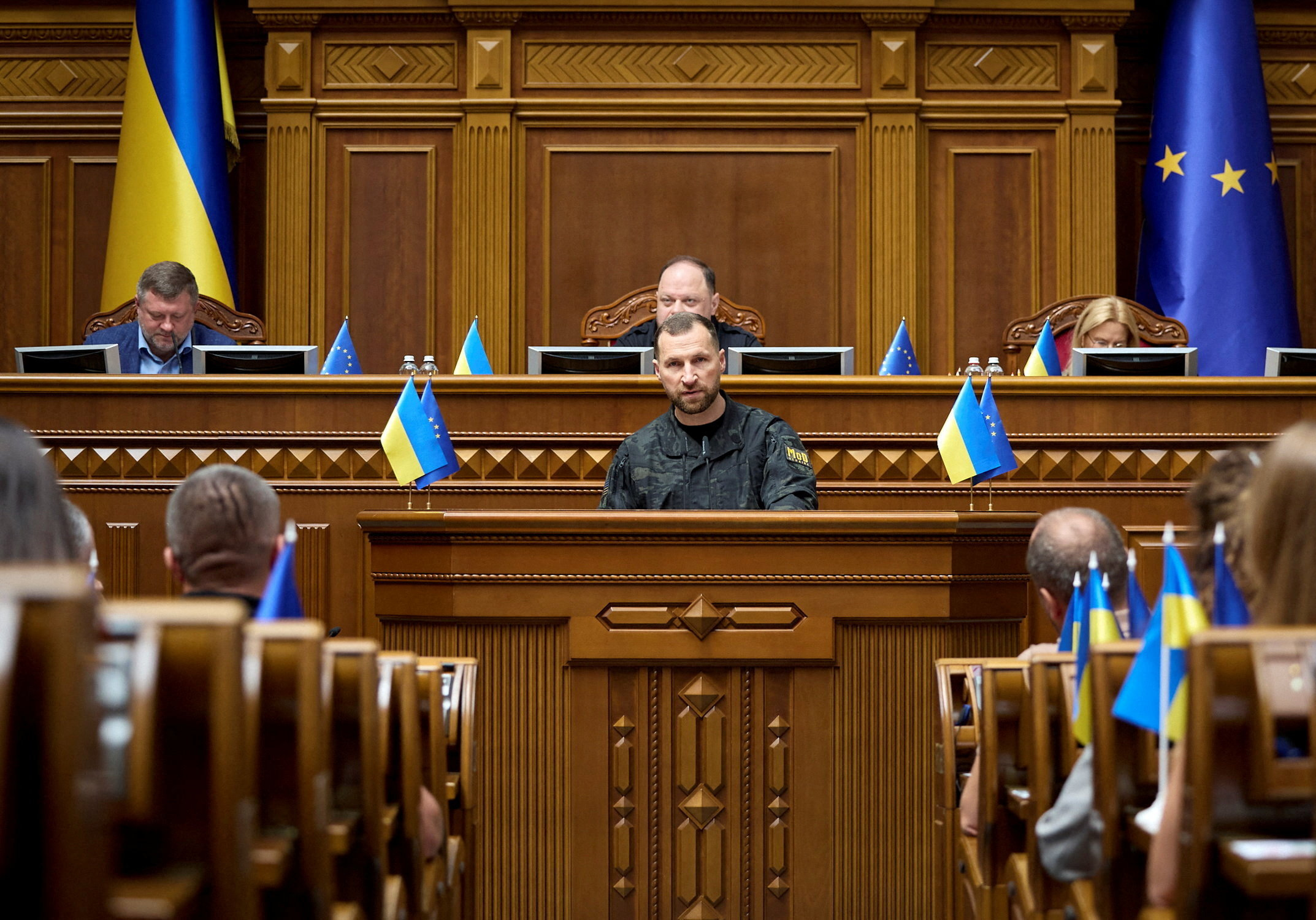
Ukrainian lawmakers appointed Yevhenii Khmara as the country’s new defence minister on Wednesday, hours after his predecessor, Mykhailo Fedorov, called for elections during wartime, delivering a fresh political challenge to President Volodymyr Zelenskiy.
Khmara, a former senior special forces operative who briefly served as acting head of Ukraine’s SBU security service, takes charge of the defence ministry amid political turmoil following Fedorov’s removal in July.
Fedorov’s dismissal prompted thousands of people to protest in Kyiv in rare wartime demonstrations, with critics arguing that the decision was poorly communicated at a critical stage of the war with Russia.
In a statement on Tuesday, Fedorov said Ukraine faced a crisis of governance and argued that its democratic process “cannot be held hostage by Russia”. He called for a “legal, safe and realistic mechanism” to allow elections despite the continuing war.
Wartime elections are currently prohibited under Ukrainian law. An August 5 poll by the Kyiv International Institute of Sociology found that 57% of Ukrainians believe elections should only be held after the war, citing the presence of hundreds of thousands of troops on the front line and continuing Russian missile and drone attacks.
Zelenskiy has not directly responded to Fedorov’s call. His communications adviser Dmytro Lytvyn said Russia’s daily attacks provided “the exhaustive answer to this question”.
Fedorov’s intervention has fuelled speculation over his political ambitions. One recent poll suggested he could defeat Zelenskiy in a presidential run-off, although Fedorov has not said whether he intends to stand.
Political analyst Lesia Bidochko said there was currently no realistic mechanism for holding an election, given the millions of Ukrainians living abroad or displaced within the country and those serving in the military.
Khmara’s appointment also came as Ukrainian anti-corruption authorities announced charges against a deputy head of Zelenskiy’s office over an alleged $3 million money-laundering scheme.
The investigation concerns an alleged attempt to raise money for bail in a separate energy corruption case. The latest inquiry follows a major investigation launched last November into an alleged $100 million kickback scheme involving Ukraine’s state atomic energy agency.
Khmara now faces the task of overseeing Ukraine’s defence as Russian missile attacks intensify and fighting continues along the front line. His appointment follows two defence ministers who each remained in the post for less than six months.




Click here to change your cookie preferences