
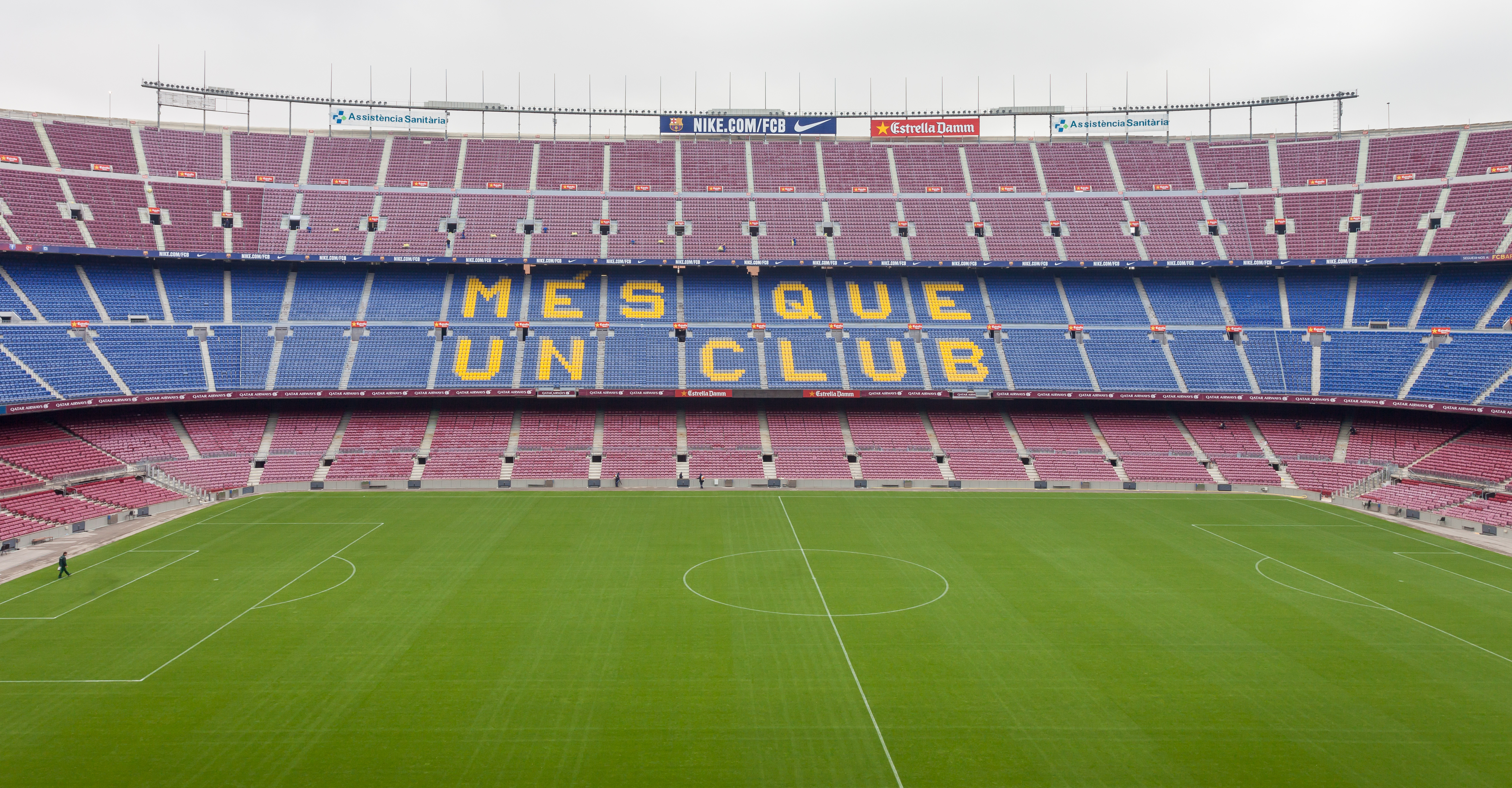
Cyprus Football Association chairman Haris Loizides wrote a letter to his Spanish counterpart Rafael Louzan, urging him to discourage footballing giant Barcelona from organising a children’s football camp in northern Cyprus, the CFA said on Tuesday.
“The CFA, as soon as it became aware of the announcement of the organisation of an FC Barcelona academy training camp in the occupied territories, took the appropriate actions, in consultation with Uefa,”, European football’s governing body, it said.
It added that Loizides had “requested the intervention” of Louzan, “so that the camp would not take place in the occupied territories, as such a thing is contrary to the current legal and regulatory framework”.
“As stated in the letter, FC Barcelona is requested to review the organisation and either move the camp to a suitable and legally compatible location in the free areas of the Republic of Cyprus or not hold it in Cyprus,” it said.
The camp, which is set to take place over the course of two weeks next month, was most likely not centrally organised by FC Barcelona itself, but by its affiliate academy in Istanbul, which is headed by Albert Medall.
FC Barcelona licences companies to run “Barcelona Academy” events, and in the case of the camp which is set to take place in Cyprus, official material has featured Medall, as well as northern Nicosia’s Near East University’s public relations officer Ozer Turan, given that the camp will be hosted at the university’s facilities.
This fact did not deter the CFA or first division club Nea Salamina from attempting to reach out to the club directly, with Nea Salamina writing to FC Barcelona directly, saying that it “has remained a refugee in its own homeland for more than half a century, far from the town [of Famagusta] and its historical home”.
“At the same time, we are addressing a club with an immense history and special symbolism. FC Barcelona knows from its own journey what identity, dignity, memory and resistance mean. It knows why ‘Mes que un club’ – ‘More than a club’ is not just a slogan, but a historical responsibility,” it said.
It added that “this is why we call on it to put into practice its own history and the values it has constantly championed”.
“We ask FC Barcelona to immediately reconsider its position and cancel the camp in the occupied areas of Cyprus, as well as to withdraw any reference which could be perceived as legitimising an unrecognised entity,” it said.
Despite this, it stressed that “Nea Salamina was and remains a club of peace, coexistence, and respect for all”, and that “our position is not directed against any community”.
“It is directed against the occupation, the violation of historical truth, and any action which may contribute to the normalisation of a situation which for us remains an open wound,” it said.
FC Barcelona has historically been closely connected to the Catalan identity, particularly during the time of the Spanish civil war and the dictatorship of Francisco Franco, which attempted to suppress the identity, language, and autonomy of the Catalan people in favour of Spain’s Castilian majority.
More recently, the club protested by holding a match behind closed doors in 2017 after violence broke out between demonstrators and police as Catalonia attempted to hold an independence referendum.
Around 15,000 people had taken to the streets of Barcelona on the day, with the police firing rubber bullets at the crowd.
The club had asked that the game be postponed, but after La Liga, the Spanish top-flight football league, ordered that it be played, and threatened the club with a points deduction should the match not go ahead.
While the club officially remained neutral on the matter of the referendum, it declared that it “condemns the events which have taken place in many parts of Catalonia today in order to prevent its citizens exercising their democratic right to free expression”.
Meanwhile, the club’s players took to the field wearing t-shirts in the colours of the Catalan flag, before changing into their traditional scarlet and blue ahead of kick-off.
In Cyprus, football in Cyprus has faced division for as long as the island’s political scene.
The CFA had initially been a bicommunal organisation, with Turkish Cypriot teams featuring in its competitions. Nicosia-based Turkish Cypriot club Cetinkaya even saw trophy-laden success in the early 1950s, going toe to toe with the likes of Apoel.
However, Turkish Cypriot teams were banned from playing at many Greek Cypriot-owned grounds in 1955, and thus set up their own association, the CTFA, with competitions separate from that of the CFA.
Previous efforts, including an agreement signed in 2013 which aimed to eventually re-amalgamate the two associations, have been made to bring the island’s two footballing communities together, but thus far have proven fruitless.
The CTFA remains a member of Conifa, an international football confederation of unrecognised countries and minority people groups, with the Turkish Cypriot representative team winning this year’s Conifa European football cup, beating Italian region Padania 6-1 in the final.



Click here to change your cookie preferences