
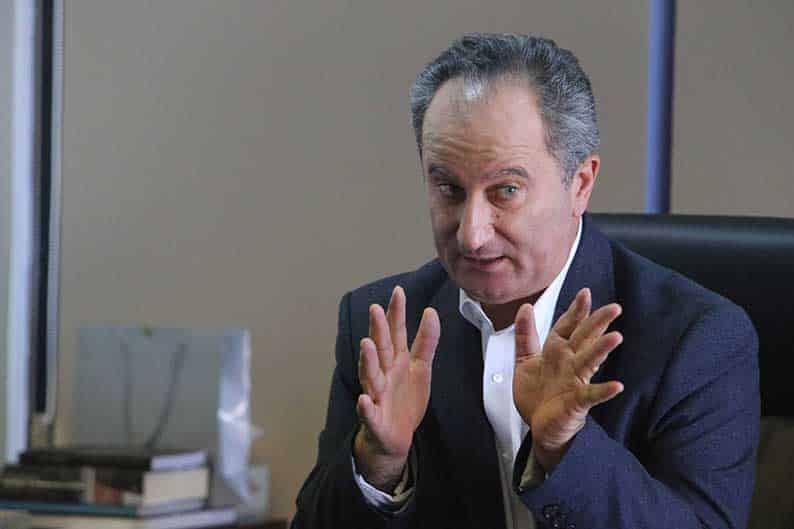
Increasing the productivity of sheep and goats and developing dedicated animal fattening units away from existing livestock farms should be among the priorities for rebuilding Cyprus’ livestock sector, head of a special scientific committee Stavros Malas has said.
Malas, who heads the Special Scientific Committee for the Reconstruction of Livestock Farming, submitted a report to President Nikos Christodoulides on Thursday.
Speaking to the Cyprus News Agency (CNA), he said the government was satisfied with most of the issues and findings highlighted by the committee.
The report focused on two main areas, the first concerning how farms affected by foot-and-mouth disease should resume operations while minimising the risk of a similar outbreak in the future.
Malas said 84 of the 121 affected farms were located in livestock farming zones where units had been established next to one another, significantly increasing the risk of transmission.
“The livestock farming areas made the problem much worse,” he said.
The committee has proposed measures for farmers who choose to resume operations, with particular emphasis on reducing congestion in livestock farming areas. Malas noted that not all affected farmers were expected to restart their businesses and said restructuring would be necessary where appropriate.
The second part of the report sets out broader proposals for reorganising the sector, including a more balanced development of milk and meat production.
On dairy farming, Malas said milk production underpins the halloumi industry but warned that future challenges extend beyond the cheese’s protected designation of origin (PDO) status.
European traders are expected to impose requirements relating to biosecurity, animal welfare and environmental standards, he said.
“Difficult decisions are coming for the halloumi trade,” Malas warned.
The meat production chain, meanwhile, has not been properly developed, according to Malas, resulting in what he described as a “huge shadow economy with the north”, involving the movement and trade of animals for meat consumption.
“We have not ensured proper conditions for fattening animals so that they achieve maximum yield,” he said.
Sheep and goat farming requires the greatest support to improve animal productivity, while cattle farming needs improvements in animal welfare, biosecurity and productivity, he added.
“We need to increase productivity per animal, so that we can produce milk with fewer animals,” Malas said.
Reports on Friday put the estimated cost of the committee’s proposals at €610 million, although Malas neither confirmed nor denied the figure.
He said the measures would require national expenditure, while noting that the European Commission’s new funding package begins in 2028 and that funds could be secured through the Common Agricultural Policy.
Malas also expressed the personal view that Cyprus could potentially discuss ad hoc funding with the European Commission because of the island’s particular circumstances, including the Republic’s inability to exercise effective control over part of its territory, which he said makes livestock farming more vulnerable to risks.
Asked which measures should be treated as the most urgent, Malas said subsidies should immediately be introduced to develop animal fattening units in areas away from existing farms.
Animals could then be transferred from production farms to dedicated fattening units, easing congestion in livestock areas and putting the meat trade on a more organised footing.
Malas said shortcomings in the meat trade had been the cause of the foot-and-mouth outbreak. The proposed changes, he added, would also help stabilise sheep and goat prices and generate greater revenues for cattle farmers.
A second priority is the introduction from next year of a programme aimed at the productive replacement of livestock, using modern breeding techniques and genetic analysis.
Malas said importing more productive animals from abroad was not the solution, as only limited numbers could be brought into Cyprus and would therefore be unlikely to make a significant difference.
Instead, he said, breeding nuclei of local or imported breeds should be established at farms unaffected by foot-and-mouth disease, which could then provide animals to meet the needs of the domestic market.
Malas said in Thursday’s announcement that the committee’s findings and recommendations would be presented publicly in the coming period.
Meanwhile, government spokesman Konstantinos Letymbiotis said on Thursday that proposals for the restructuring of Cyprus’ livestock sector will be presented to stakeholders before being finalised and moved towards implementation.
“The aim is the restructuring of a vital sector in our country, the livestock sector,” he said, adding that the committee’s findings included specific proposals covering both the medium and long term.



Click here to change your cookie preferences