
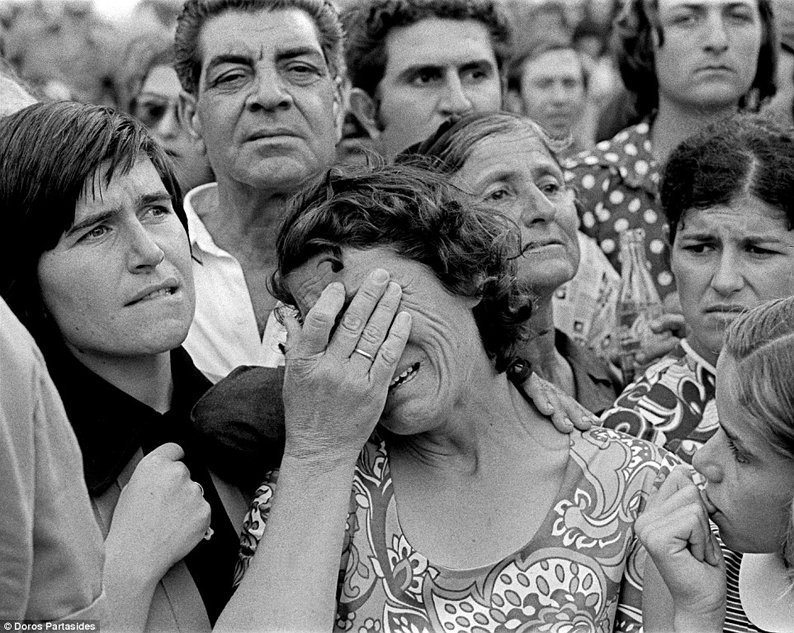
The Republic failed to properly investigate the disappearance of Loizos Hadjigeorgiou and his son Giorgos after the Turkish invasion of 1974 despite opportunities to examine people allegedly involved in their abduction, the family’s lawyer said on Tuesday.
Speaking to Alpha TV, lawyer Antonis Georgiou said the case should have been treated as a criminal matter as well as a case concerning the political circumstances of the Turkish invasion.
“The state failed to realise that, despite the political dimension and the difficulties that exist due to the invasion, this did not cease to be a purely criminal case,” he said.
Loizos and Giorgos Hadjigeorgiou were unarmed Greek Cypriot civilians from Strongylos in the Famagusta district.
They were abducted from the village on August 15, 1974, during the second phase of Operation Atilla.
Evidence before the Supreme Court indicated that they were allegedly taken by armed Turkish Cypriot villagers who were themselves citizens of the Republic.
The Supreme Court ruled last week that the state had failed to fulfil its obligation to investigate the disappearance and awarded the family €100,000 in compensation.
It found violations of Articles 2 and 3 of the European Convention on Human Rights, concerning the right to life and protection from inhuman or degrading treatment.
The court found that the circumstances distinguished the case from disappearances occurring as part of military operations and required a “targeted, specialised and intensive investigation” into possible criminal responsibility.
Georgiou said there had been opportunities to investigate individuals allegedly connected to the abduction after they entered the government-controlled areas.
One such person reportedly travelled to the free areas in the 1980s for medical treatment while suffering from cancer.
Another was reportedly seen in Pyla in 1990 selling dairy products. According to Georgiou, neither development resulted in any substantial investigative action.
He also referred to an incident in 2003 when one alleged suspect was taken into custody following protests.
The person was subsequently released, he said, and the family received no adequate information about what had happened.
Georgiou said correspondence was then sent to the attorney general but, according to the family, no response was received.
In 2016, the family was informed by the missing persons service that there was no registry or file concerning the specific incident.
“We had to come to 2016 and have the state testify to provide this information,” Georgiou said.
The Supreme Court also rejected the argument that the state’s investigative obligation depended on the discovery of the men’s remains.
It found that the Commission on Missing Persons (CMP) could not substitute for a criminal investigation, as its mandate concerns determining whether missing people are alive or dead and recovering and identifying remains where possible.
The court found that the families had endured decades of uncertainty and “constant anguish and mental suffering” over the fate of their relatives.
Georgiou said experienced investigators should now be appointed to review the available evidence and establish what had been investigated, what had not been examined and what further action could still be taken.
“In 2003 we know that at least one was alive, he may still be alive today,” he said.
He added that the Supreme Court decision had moral significance for the family but could not provide complete justice.
“With all due respect to the court that issued an exceptional decision for us, there is no court that can deliver real justice,” he said.
The family has discussed possible further legal action, while Georgiou said the absence of communication from the state or legal service since the Supreme Court decision remained a concern for the relatives.





Click here to change your cookie preferences