
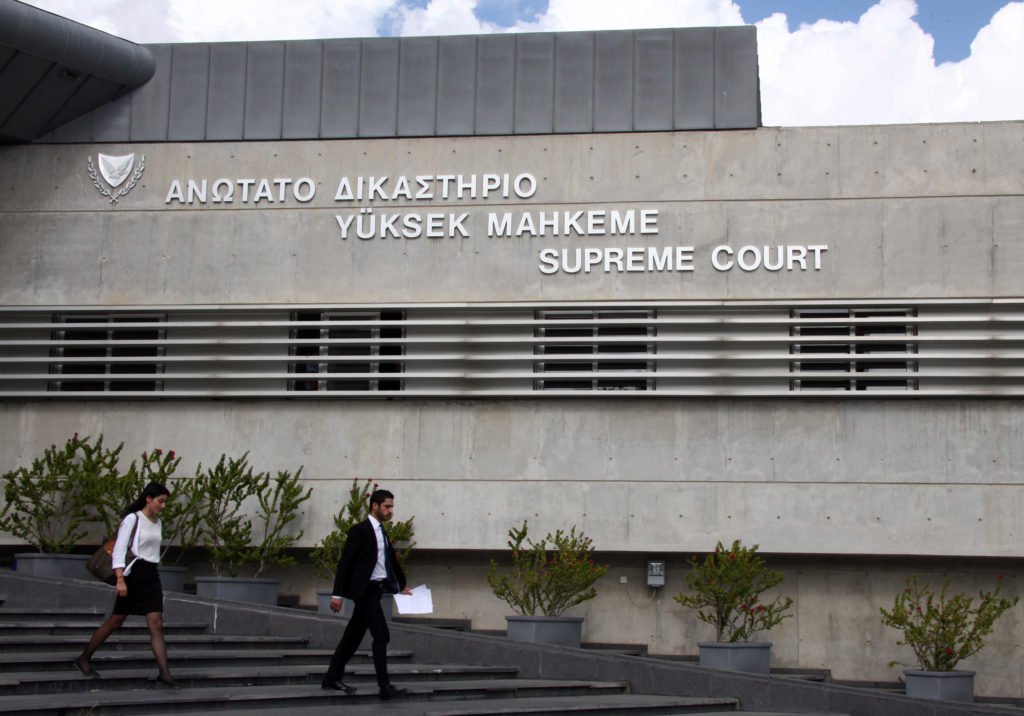
The Supreme Court ruling on the disappearance of two men from Strongylos could have implications for other 1974 missing persons cases where similar circumstances and evidence exist.
Speaking to the Cyprus News Agency, lawyer Achilleas Demetriades said the Supreme Court’s decision, which found violations of Articles 2 and 3 of the European Convention on Human Rights (ECtHR) in the case of Loizos Hadjigeorgiou and his son Giorgos, was significant as the two men were allegedly abducted by Turkish Cypriot residents of Strongylos, and not by Turkish soldiers.
“The important thing in this case was that the state was convicted because it did not fulfil its obligation to conduct an effective investigation under the circumstances,” he said.
The court found that the circumstances required a “targeted and intensive investigation” into possible criminal responsibility.
Demetriades said the case differed from the usual cases of individuals who disappeared in areas under Turkish occupation during the 1974 invasion as there was information that people allegedly involved in the abduction had subsequently entered the government-controlled areas.
He said the ruling could therefore provide a reference point in other cases, provided the facts were similar.
“In certain cases, there may be parallel responsibility,” Demetriades said.
“The court recognised that there may be parallel responsibility for violations, for ineffective treatment. The state is also to blame, as the Turkish Cypriots who were in involved were not examined.”
The ruling concerned Loizos Hadjigeorgiou and his son Giorgos, who disappeared from Strongylos on August 15, 1974, during the second phase of the Turkish invasion.
The Supreme Court awarded their family €100,000 after overturning a 2017 Nicosia district court decision which had rejected their case.
The court found that the case could not simply be treated as another disappearance connected to the hostilities of 1974.
It also rejected the argument that Cyprus’ obligation to investigate depended on the discovery of the men’s remains.
Demetriades said the state’s obligation remained active while a person’s fate was unknown.
“As long as there is no effective investigation and the fate of a person remains unknown, the authorities’ obligation does not expire with the passage of time.”
He said the issue should also be viewed as a humanitarian matter because families have a right to know what happened to their relatives.
Demetriades has proposed the creation of a ‘truth commission’ for missing persons as part of a transitional justice process.
“A truth commission for the missing persons would be what would help relatives learn what exactly happened to their loved ones and would also be a very good confidence building measure to begin solving the Cyprus problem,” he remarked.
According to the Committee on Missing Persons (CMP), its total list contains 2,002 people, including 1,510 Greek Cypriots and 492 Turkish Cypriots.
As of this month, the remains of 1,069 missing persons have been identified and returned to their families.
Demetriades said that “for those who were identified, we do not know the circumstances of their disappearance, because the CMP keeps its files closed,” he said.
He argued that a truth commission could allow relatives to receive information about cases that cannot be resolved through criminal proceedings.
“In exchange for information you give immunity to those who are otherwise murderers,” he said, referring to transitional justice processes used in other countries.
“In this way, society decides that it is more correct, more beneficial, it is in the public interest to tell the truth to the relatives, rather than insisting on legal proceedings to punish the guilty.”
Demetriades also raised Cyprus’ failure to ratify the United Nations Convention for the Protection of All Persons from Enforced Disappearance, which obliges states to criminalize the practice, even during times of war, and guarantees victims’ families the right to know the truth about a disappeared person’s fate.
He said Cyprus signed the convention on February 6, 2007, but had not ratified it.
“What is the reason that it does not grant this international protection to Cyprus?” he asked.





Click here to change your cookie preferences