
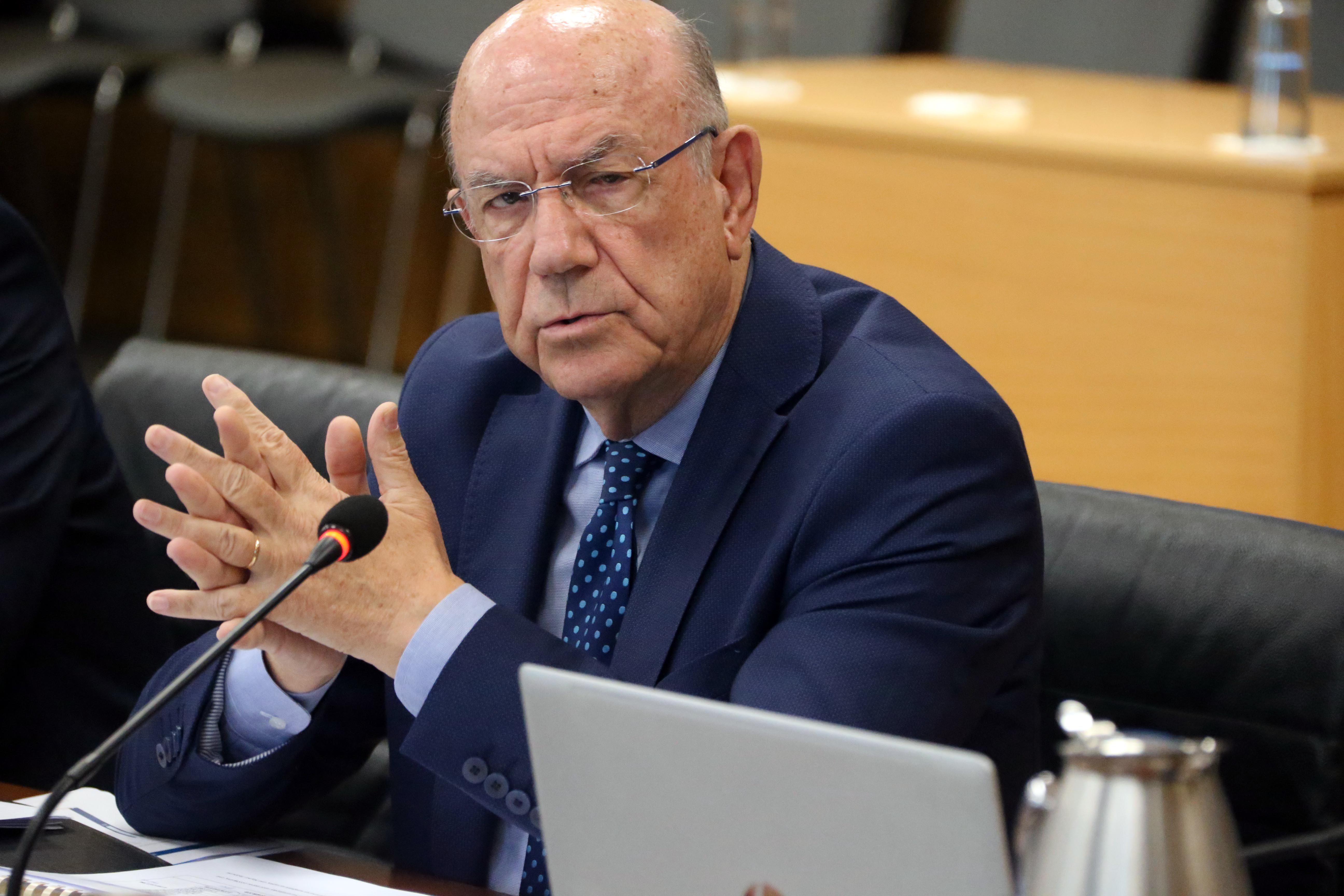
Cyprus’ cabinet approved the €11.1 billion state budget for 2027 on Wednesday, with Finance Minister Makis Keravnos forecasting continued economic growth, a larger fiscal surplus and further reductions in public debt.
Keravnos said the budget, which will be submitted to the House of Representatives for approval in December, was designed to support development while maintaining fiscal discipline.
The 2027 budget is approximately €470 million higher than the 2026 budget.
“Growth in 2027 is expected to be around 2.9 per cent,” Keravnos said, adding that there were encouraging indications that it could exceed 3 per cent.
Unemployment, meanwhile, is expected to remain at current levels associated with full employment and continue on a downward trend.
The government is forecasting a fiscal surplus equivalent to 2.8 per cent of GDP in 2027, up from 2.3 per cent in 2026.
The primary balance is expected to reach 4 per cent of GDP, compared with 3.6 per cent this year.
Keravnos said the medium-term outlook for the Cypriot economy remained positive, as recognised by international rating agencies and the European Commission, although geopolitical developments continued to create significant uncertainty.
Public debt is expected to fall to 46.6 per cent of GDP during 2027, from 49.9 per cent currently.
“Maintaining a surplus fiscal balance, continuing to contain public-sector employment, further reducing public debt over the medium term, promoting the green transition and digital transformation, creating sustainable growth in key sectors of the economy and maintaining a robust financial system are the objectives of the 2027 state budget and the medium-term fiscal framework,” Keravnos said.
The government also intends to place particular emphasis on higher defence spending in both the 2027 budget and the medium-term fiscal framework covering 2027-2029.
Development spending is expected to reach €1.1 billion next year, while capital expenditure is forecast to increase by 2.1 per cent compared with 2026.
Keravnos said the government was continuing efforts to contain the public-sector wage bill through policies implemented by the Finance Ministry.
“For the third consecutive year, we are succeeding in containing public-sector employment, with the 2027 budget providing for a reduction of 51 positions compared with the 2026 budget,” Keravnos stated.
He added that spending on public-sector employees and the state wage bill had fallen as a proportion of the budget from 28.2 per cent in 2025 to 27.2 per cent in 2026 and 26.1 per cent in 2027.
“The 2027 state budget and the 2027-2029 medium-term fiscal framework are tangible evidence, for another year, of the government’s policy for stable growth, fiscal responsibility and social progress,” Keravnos said.
“The ultimate and fundamental objective of the budget as a key tool of economic policy, as well as development economic policy, is to transfer the benefit to society, workers and our businesses, ensuring the continued resilience of our economy and the new generation,” he added.
Keravnos also announced that the cabinet had approved the budget of the National Solidarity Fund, which must now be submitted to parliament under the relevant procedure.
The fund’s draft 2026 budget provides for €28,725,209 in expenditure, which will be distributed to people who have been approved to receive support.
“The platform will open during the coming period, towards the end of September, and the details of those who have been approved will be submitted by those who have not yet done so, so that they can benefit from the amounts provided for in the fund’s budget,” Keravnos said.
He added that this would also cover people who had already received payments under a scheme approved in 2025 and continuing through 2026.
Asked whether the possible impact of the pension reform currently under discussion had been incorporated into the budget, Keravnos said it had been taken into account.
“A well-organised organisation and every government must function properly and plan correctly,” the minister stated.
“We apply the supplementary budget, and when savings arise, we immediately ensure that they are allocated through the supplementary budget,” he added.
He further mentioned that the government’s pension reform had not yet been completed and that the state currently paid around €360m towards existing pensions.
“The state will continue to pay these amounts and they have been budgeted for,” Keravnos said.
“The preparation of the budget has taken into account the possibility that there may be additional costs, including those arising from pension reform,” he added.
On the possible release of €25m for the electricity interconnection project following the issuance of a NAVTEX, Keravnos declined to comment directly on a statement made by the President of the Republic during a television interview.
“I cannot comment on the views of the President of the Republic,” he said.
“When the President of the Republic has stated something, it is understood that it is the position of the government,” Keravnos added.
Keravnos also described a meeting held on Wednesday over demands by hourly-paid workers as constructive.
“This is why we concluded that any action or strike should be postponed,” he said.
He stated hourly-paid workers had submitted a number of demands and that the government had shown considerable attention to their concerns, with significant concessions and benefits provided over the past three years.
“Most of the demands that have been submitted have been addressed positively,” Keravnos said.
He added that increases in pay remained outstanding and would be discussed with him the following week, after his planned trip to Ireland for the Eurogroup and ECOFIN meetings.
He mentioned that a subsequent meeting involving himself, the President and representatives of hourly-paid workers would seek to reach a final agreement.
On inflation, Keravnos said the government’s forecast was heavily dependent on energy prices, which could fluctuate significantly from day to day.
“The estimate is that it will be around 4 per cent,” he said.
“From there onwards, however, it is an estimate and we must closely monitor developments,” Keravnos added.
Keravnos also said government revenues were expected to increase by almost 3 per cent from 2026 to €17 billion as a result of the tax reform, while expenditure was forecast to rise by only 1.4 per cent.
He linked the difference between revenue and expenditure growth to the projected 2.8 per cent fiscal surplus.
“There is therefore an increase in revenue and an increase in expenditure whose rate is lower than that of revenue,” Keravnos stated.
“It is a first safety valve, but this lower rate of increase can also be explained through the factors mentioned above,” he concluded.



Click here to change your cookie preferences