
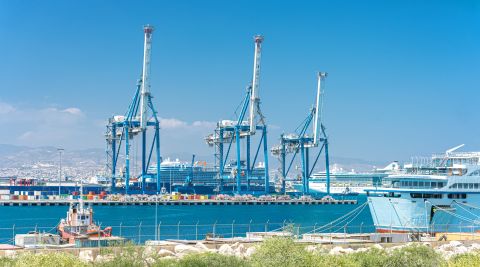
Plans to supply electricity to ships at Limassol port remain dependent on securing a connection to the national power grid and European funding, despite progress on technical studies, with key administrative procedures still outstanding.
The proposed cold ironing system, which would allow vessels to draw electricity from shore rather than running their engines while berthed, has yet to complete crucial steps towards implementation, according to information provided by Transport Minister Evi Tsolaki.
The minister confirmed that a request has been submitted for land to accommodate an electricity substation, but applications to connect the project to the transmission network have yet to be filed.
The development comes as MP Fotini Tsiridou has raised concerns over delays, warning that further setbacks could jeopardise the country’s ability to secure European financing.
Speaking to Entrepreneurial Limassol, a periodical published by the Limassol Chamber of Commerce and Industry (Evel), Tsiridou said she had observed some movement on the project, although she had not yet received an official response to the parliamentary question she submitted.
Nevertheless, she argued that the project should have progressed further by now, particularly as similar schemes in other European port cities have already benefited from EU funding.
She stressed that shore-side electricity would help reduce air pollution and noise generated by ships’ engines during their stay at the port, while improving conditions in the surrounding urban area.
“Our port should not be disconnected from the rest of the city,” she said, describing the installation of shore-side electricity infrastructure as both a necessity and a European obligation.
At the same time, she expressed concern that the delays could affect either the level of European funding available or Cyprus’ ability to obtain financial support.
According to Tsiridou, technical, economic and environmental studies have already progressed, while the Electricity Authority of Cyprus (EAC), Cyprus ports authority (CPA), port operators and participating companies support the project’s implementation.
However, she said the completion of the necessary applications and administrative procedures remained unclear, adding that she would await the ministry’s formal response before assessing whether sufficient progress had been made.
For her part, Tsolaki said work was being undertaken on several fronts, particularly regarding the completion of studies under the EU-backed DecarbonLim programme.
The initiative brings together the CPA, Frederick University, Eurogate Container Terminal Limassol, DP World Limassol, EAC, the Cyprus Transmission System Operator and Limassol municipality.
Its purpose is to prepare the preliminary technical assessment and feasibility study required to advance the installation of shore-side electricity infrastructure at the port.
According to the minister, the studies are now at an advanced stage, while the ministry has requested regular updates from the CPA on their expected completion.
However, the connection to the electricity transmission system remains a separate challenge.
Tsolaki explained that the ministry has already submitted a request to the Department of Lands and Surveys for the allocation of a plot where the necessary electricity substation would be constructed.
Once the land has been allocated, applications will be submitted to the Cyprus Transmission System Operator, allowing the grid connection process to proceed.
As a result, despite progress on the preparatory work, the project has not yet completed a key stage required to secure its electricity supply.
The outstanding procedures also raise questions over financing, particularly as Cyprus seeks to take advantage of available European funds.
Tsolaki said the studies being undertaken through DecarbonLim would form the basis of an application for construction funding.
She also confirmed that a competitive European funding call is currently open, with the ministry intending to submit an application within the required timeframe.
“The ministry’s objective is the timely completion of the project within the framework of the European Regulation,” she said.
However, no specific dates were provided for the allocation of land, the submission of grid connection applications or the completion of financing arrangements.
The project has been under development for some time. In July 2025, the ports authority signed a contract with DBA S.p.A. for a comprehensive study covering the technical, economic and environmental requirements of the planned system.
The study was intended to establish the groundwork for the installation, including any upgrades required to existing port infrastructure.
More than a year later, however, the project remains in its preparatory and administrative stages, with the grid connection and construction financing arrangements still unresolved.
The proposed system would allow compatible vessels to switch off their auxiliary engines while berthed, helping to cut emissions and reduce noise around one of Cyprus’ principal commercial ports.
For now, no confirmed construction timetable has been announced, leaving the completion of the studies, allocation of land, submission of grid connection applications and securing of European funding as the project’s immediate priorities.





Click here to change your cookie preferences