
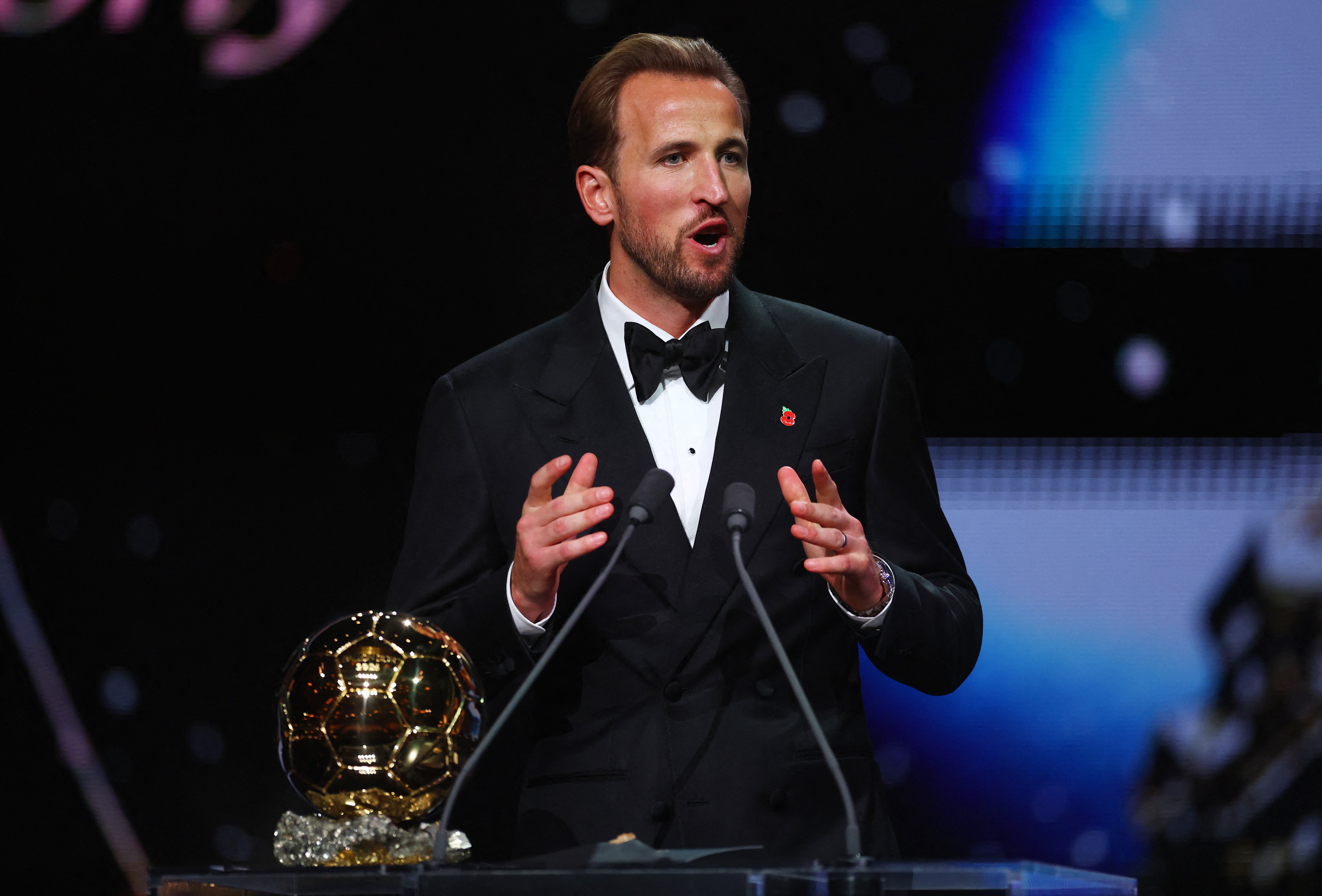
England captain scores 73 goals for club and country as Alexia Putellas claims third women's award
Harry Kane completed his long quest for football’s highest individual honour on Monday, with the Bayern Munich and England striker winning the Ballon d’Or after a record-breaking season that cemented his status as one of the game’s greatest goalscorers.
Kane is the first Englishman to win the prestigious award in 25 years, after Michael Owen won it in 2001.
“Wow, wow, wow!” Kane said after taking the stage. “I am almost speechless. Being here in London has made it extra special. Made it a good omen for me tonight. Thank you to everyone who voted for me. I can imagine it was tough this year.
“Some world-class players in the room tonight. Congratulations to all the winners and nominees tonight and impressive showing determination and hard work can really achieve.”
Spain midfielder Alexia Putellas won the Ballon d’Or Feminin for the third time.
Kane’s record-breaking season
Kane’s move to Bayern in 2023 brought the team trophies that had long eluded him. In 2025-26, he coupled that success with goalscoring numbers that made him the leading Ballon d’Or candidate.
The England captain produced his most prolific campaign, scoring 61 goals in 51 games for Bayern across all competitions as the German side completed a domestic league and cup double.
By the end of the season, Kane had established himself as Europe’s leading goalscorer.
His influence stretched far beyond club football.
He scored six goals at the World Cup and led England to the semi-finals, combining his clinical finishing with the leadership and composure that have defined his international career.
From Tottenham struggles to Ballon d’Or glory
The award represents the culmination of a remarkable journey. Few players have experienced a career arc quite like Kane’s, and he thanked all of his career coaches in his emotional speech, plus Tottenham Hotspur and his wife Kate.
Once struggling to establish himself at Spurs as a youngster, being sent out on numerous loans, he developed into one of the most complete centre forwards of his generation, capable of scoring every type of goal while also functioning as a playmaker.
“It’s about the journey,” Kane said. “Anything is possible, work hard when nobody is watching.
List of Ballon d’Or winners
1956 – Stanley Matthews (England)
1957 – Alfredo Di Stefano (Spain)
1958 – Raymond Kopa (France)
1959 – Alfredo Di Stefano (Spain)
1960 – Luis Suarez (Spain)
1961 – Omar Sivori (Italy)
1962 – Josef Masopust (Czechoslovakia)
1963 – Lev Yashin (Soviet Union)
1964 – Denis Law (Scotland)
1965 – Eusebio (Portugal)
1966 – Bobby Charlton (England)
1967 – Florian Albert (Hungary)
1968 – George Best (Northern Ireland)
1969 – Gianni Rivera (Italy)
1970 – Gerd Mueller (West Germany)
1971 – Johan Cruyff (Netherlands)
1972 – Franz Beckenbauer (West Germany)
1973 – Johan Cruyff (Netherlands)
1974 – Johan Cruyff (Netherlands)
1975 – Oleg Blokhin (Soviet Union)
1976 – Franz Beckenbauer (West Germany)
1977 – Allan Simonsen (Denmark)
1978 – Kevin Keegan (England)
1979 – Kevin Keegan (England)
1980 – Karl-Heinz Rummenigge (West Germany)
1981 – Karl-Heinz Rummenigge (West Germany)
1982 – Paolo Rossi (Italy)
1983 – Michel Platini (France)
1984 – Michel Platini (France)
1985 – Michel Platini (France)
1986 – Igor Belanov (Soviet Union)
1987 – Ruud Gullit (Netherlands)
1988 – Marco van Basten (Netherlands)
1989 – Marco van Basten (Netherlands)
1990 – Lothar Matthaus (Germany)
1991 – Jean-Pierre Papin (France)
1992 – Marco van Basten (Netherlands)
1993 – Roberto Baggio (Italy)
1994 – Hristo Stoichkov (Bulgaria)
1995 – George Weah (Liberia)
1996 – Matthias Sammer (Germany)
1997 – Ronaldo (Brazil)
1998 – Zinedine Zidane (France)
1999 – Rivaldo (Brazil)
2000 – Luis Figo (Portugal)
2001 – Michael Owen (England)
2002 – Ronaldo (Brazil)
2003 – Pavel Nedved (Czech Republic)
2004 – Andriy Shevchenko (Ukraine) 2005 – Ronaldinho (Brazil)
2006 – Fabio Cannavaro (Italy)
2007 – Kaka (Brazil)
2008 – Cristiano Ronaldo (Portugal)
2009 – Lionel Messi (Argentina)
2010 – Lionel Messi (Argentina)
* 2011 – Lionel Messi (Argentina)
* 2012 – Lionel Messi (Argentina)
* 2013 – Cristiano Ronaldo (Portugal)
* 2014 – Cristiano Ronaldo (Portugal)
* 2015 – Lionel Messi (Argentina)
* 2016 – Cristiano Ronaldo (Portugal)
2017 – Cristiano Ronaldo (Portugal)
2018 – Luka Modric (Croatia)
2019 – Lionel Messi (Argentina)
2020 – Award Cancelled (COVID-19 pandemic)
2021 – Lionel Messi (Argentina)
2022 – Karim Benzema (France)
2023 – Lionel Messi (Argentina)
2024 – Rodri (Spain)
2025 – Ousmane Dembele (France)
2026 – Harry Kane (England)
“For any young boy or girl wanting to achieve their dreams, anything is possible. I wasn’t the kid who went straight to the top. I had to experience the downs. I had to find my way to be the very best right now.”
The Ballon d’Or has often rewarded players whose success was built on flair and spectacle, but Kane’s triumph is a tribute to consistency, intelligence and productivity on an exceptional scale.
Week after week, he delivered. Match after match, he decided contests. There were no prolonged slumps and few quiet nights.
His numbers were almost impossible to ignore.
Kane finished the campaign with 73 goals for club and country, a total rarely seen in the modern era. More importantly, those goals arrived in moments of genuine significance, helping Bayern collect trophies and driving England deep into the biggest tournament in the sport.
Kane beats Mbappe and Yamal to top prize
The competition for this year’s award was fierce. Kylian Mbappe broke World Cup scoring records. Lamine Yamal helped Spain to World Cup glory. Yet voters ultimately chose Kane, whose excellence lasted the entire season.
Mbappe finished second, followed by Lamine, Rodri and Lionel Messi.
At 33, Kane has finally claimed the game’s highest individual honour, adding a Ballon d’Or to a legacy that already places him among football’s greatest strikers as England’s all-time leading marksman and their record World Cup scorer.
Putellas claims third women’s Ballon d’Or
Putellas was presented with the women’s award after winning the treble with Barcelona in the 2025-26 campaign, in addition to the Spanish Super Cup. She moved to Women’s Super League side London City Lionesses in July after 14 years at Barca.
Spain and Barcelona players won the young talent awards, Lamine picking up his third trophy and Vicky Lopez taking home the women’s award for the second successive year.
Spain coach Luis de la Fuente was named men’s coach of the year, while Barcelona’s Pere Romeu won the women’s coaching award.
The men’s goalkeeper award went to Unai Simon of Spain and Athletic Bilbao, while Cata Coll of Spain and Barcelona won the women’s award.
Paris St Germain won the men’s club of the year award, while Barcelona picked up the women’s honours. Kane won the men’s striker of the year prize, while Charlyn Corral was named top women’s striker.
Arsenal and England winger Bukayo Saka was presented with the Socrates Award for humanitarian work.


Click here to change your cookie preferences