
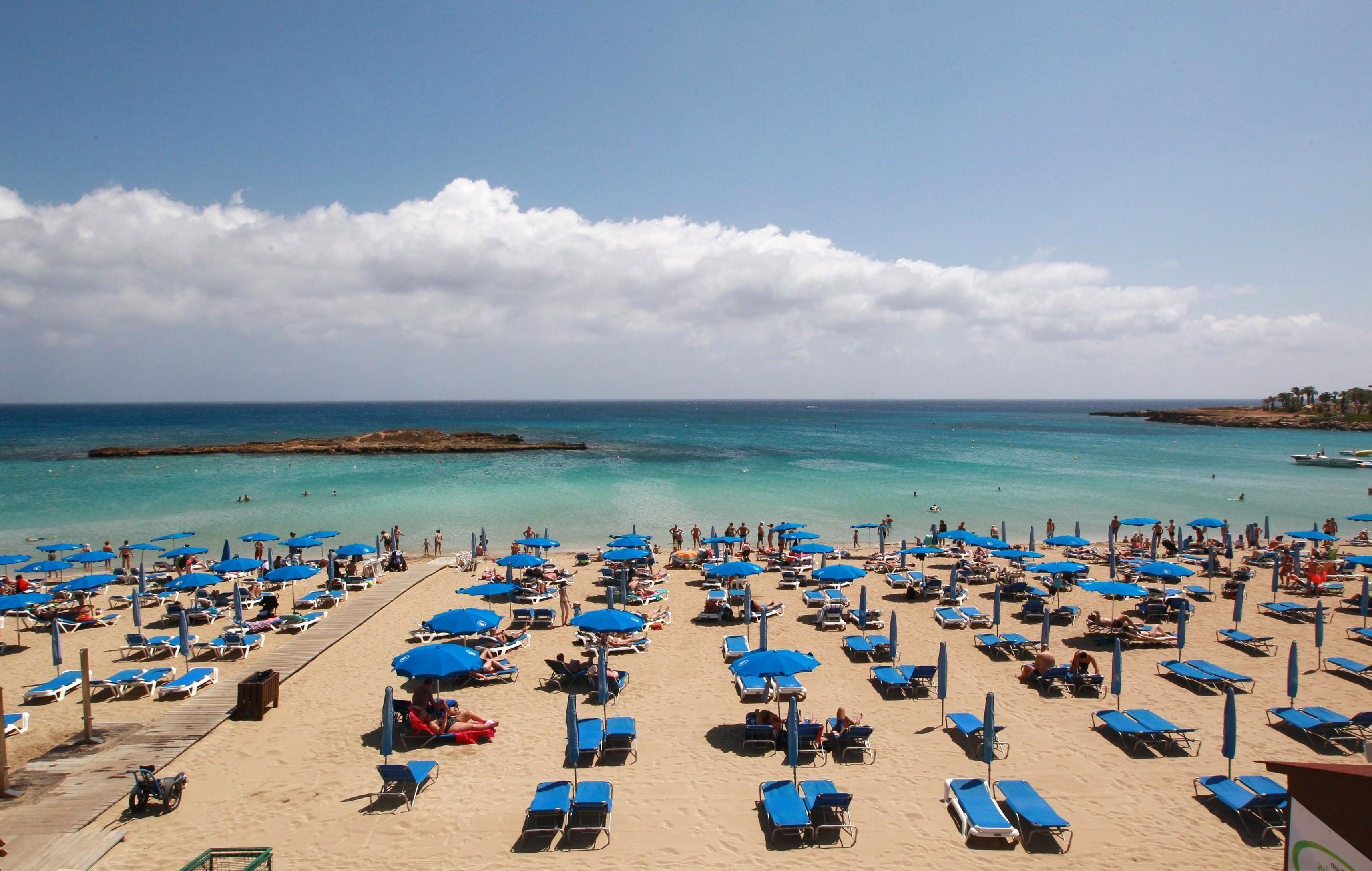
Fig Tree Bay is one of Cyprus’s best-known beaches and the main attraction of Protaras, on the island’s southeastern coast. With its sheltered, shallow waters, fine sand and small rocky island just offshore, it has earned a reputation as one of the Mediterranean’s most appealing family beaches.
Named after a fig tree associated with the bay, this Blue Flag beach regularly features in lists of Europe’s best beaches. Its clear water, easy access and proximity to restaurants and hotels make it particularly convenient for visitors.
There is, however, one important drawback: Fig Tree Bay gets extremely busy in July and August. Finding parking or a sunbed after mid-morning can be difficult, particularly at weekends. For more information on parking please check here.
Here is what to know before visiting, from parking and facilities to the best time to swim and how the beach compares with Nissi Beach and Konnos Bay.
Where is Fig Tree Bay and how to get there?
Fig Tree Bay is in central Protaras, in the Paralimni-Deryneia municipality, on the eastern coast of Cyprus.
It is within easy walking distance of the main Protaras tourist strip, where most of the area’s restaurants, shops and hotels are concentrated.
Approximate distances are:
- Ayia Napa: 12–14km, around 15–20 minutes by car.
- Paralimni: 8–10km, around 15 minutes.
- Larnaca International Airport: 65–70km, approximately 40–50 minutes by car.
- Central Protaras: A few minutes’ walk from much of the main resort area.
Driving is straightforward, with road signs directing visitors towards Protaras and Fig Tree Bay. The beach is accessible via the roads leading down from the main tourist strip.
Public buses operated by OSEA connect Protaras with Ayia Napa and Paralimni. Route 101 runs from Ayia Napa towards Paralimni, while route 102 operates in the opposite direction, from Paralimni towards Ayia Napa. Both serve the Protara–Fig Tree Bay stop.
Check the direction and the nearest Protaras stop before travelling, as routes and timetables can change.
Visitors staying in central Protaras generally do not need a car to reach the beach.
There is also a coastal pedestrian route through parts of Protaras, with sea views and access to neighbouring coves. Walking towards Konnos Bay is possible, although it is a considerably longer outing involving roads and paths rather than one uninterrupted seafront promenade.
For visitors arriving by air, see our Larnaca airport coverage for travel and transport information.
Parking at Fig Tree Bay
Parking is one of the main practical difficulties at Fig Tree Bay during the summer.
There are public parking areas and privately operated parking spaces around the roads leading down to the beach, including the vicinity of the main beach access points. Some spaces may be free, while others charge a fee.
Availability and charging arrangements can change, so drivers should check signs rather than assume a particular parking area is free.
In July and August, the most convenient spaces can fill early, especially on Saturdays, Sundays and public holidays.
Arriving before 9am is a sensible strategy if you want to park close to the beach and secure a good position on the sand.
If the nearest parking areas are full, look for legal parking farther back towards central Protaras and walk down. Visitors staying within the resort may find walking or taking the bus much less frustrating than driving.
Avoid parking on pavements, obstructing access roads or blocking entrances. Parking restrictions are enforced, particularly during the busy season.
What is Fig Tree Bay beach actually like?
Fig Tree Bay is a relatively compact, gently curving sandy beach, roughly 500 metres long, rather than a vast stretch of open coastline.
The sand is fine and light-coloured, with a broad central swimming area and relatively sheltered water.
One of the beach’s biggest advantages is its gradual entry into the sea. The water remains comparatively shallow close to shore, making it popular with families and less confident swimmers.
Conditions are generally calm during settled summer weather, although wind, waves and currents can vary.
The central section is the easiest place to enter the water. Towards the edges of the bay, particularly around the rocky sections and the offshore islet, swimmers will encounter more stones and submerged rocks.
Water shoes are not essential for the main sandy area but can be useful for anyone exploring the rocky parts.
The small island offshore
Perhaps Fig Tree Bay’s most recognisable feature is the small rocky islet approximately 100 metres offshore.
It gives the bay its distinctive appearance and attracts confident swimmers and snorkellers.
Although the water between the beach and the island may look shallow from the shore, visitors should not assume they can walk all the way across. Depth varies, and swimming may be necessary.
The rocks around the island can also be slippery and sharp. Children and inexperienced swimmers should not attempt the crossing without appropriate supervision and an assessment of conditions.
The islet is best approached in calm weather, with attention to other swimmers and water sports activity.
Lifeguards and accessibility
Fig Tree Bay has Blue Flag status and is an organised beach with seasonal lifeguard supervision.
Lifeguard operating dates and hours vary according to the season. Visitors should check the information displayed at the beach, particularly in spring and autumn when services may be reduced.
The beach has developed access routes and facilities intended to improve accessibility. However, the availability of specialised equipment, including beach wheelchairs or assisted sea access, should be confirmed locally before travelling.
Visitors with mobility difficulties may also wish to check the most convenient drop-off and beach access points, as some approaches involve slopes or steps.
Facilities and prices at Fig Tree Bay
Fig Tree Bay is a fully organised tourist beach during the main holiday season.
Facilities typically include sunbeds, umbrellas, toilets, changing areas, showers, nearby refreshments and seasonal lifeguard services.
The standard regulated charge commonly applied at organised Cyprus beaches is €2.50 per sunbed and €2.50 per umbrella, although visitors should check the current municipal price list.
That means a typical arrangement of two sunbeds and one umbrella costs €7.50 for the day.
There is no requirement to rent a sunbed. Visitors can bring their own towels and use the public beach, provided they respect designated areas and beach regulations.
Refreshments are available from beach kiosks, cafés and nearby restaurants. Prices vary considerably depending on whether you buy a drink from a kiosk or sit down at a beachfront establishment.
Some showers or other services may involve an additional charge.
In peak summer, the front rows of sunbeds are particularly popular. Arriving early provides a better choice, but visitors should not assume that leaving belongings unattended reserves a place indefinitely.
Water sports and things to do at Fig Tree Bay
Swimming and relaxing on the beach are the main attractions, but Fig Tree Bay also offers access to several water-based activities.
Depending on the season and operators, visitors may find pedalos, paddleboards, parasailing and other motorised or non-motorised water sports.
Snorkelling is especially rewarding around the rocky margins of the bay and the offshore islet, where fish are more likely to gather than over the open sandy bottom.
Boat excursions operate from the wider Protaras and Ayia Napa area, including trips towards Cape Greco, the sea caves and the turquoise waters often marketed as the Blue Lagoon.
These excursions do not necessarily depart directly from Fig Tree Bay, so check the departure point when booking.
For visitors wanting a change of scenery, Cape Greco National Forest Park offers coastal viewpoints, walking trails and dramatic limestone formations.
The sea caves near Cape Greco are another popular attraction, although visitors should avoid jumping from cliffs or entering caves when sea conditions are unsafe.
Can you see turtles at Fig Tree Bay?
Sea turtles are occasionally spotted swimming in the waters around Protaras, including near Fig Tree Bay.
However, sightings are unpredictable, and visitors should not expect to encounter turtles every time they swim or snorkel.
Fig Tree Bay is not generally promoted as one of Cyprus’s principal turtle nesting beaches.
For visitors specifically interested in sea turtle conservation, Lara Bay on the Akamas peninsula in western Cyprus is much better known for its protected nesting areas.
If you encounter a turtle while swimming, maintain a respectful distance, avoid touching or feeding it, and never chase it for photographs.
Best time to visit Fig Tree Bay
The best months for many visitors are May, June, September and early October, when conditions are generally warm but the beach is usually less crowded than during the height of summer.
May and June offer increasing sunshine and pleasantly warm daytime temperatures, although the sea can still feel cool early in the season.
September is particularly attractive because the sea retains much of its summer warmth, while the number of visitors generally begins to decline after the school holidays.
October can also be excellent for swimming, especially during settled weather, although rain and wind become more likely as the month progresses.
For more seasonal advice, see our guides to Cyprus in September and Cyprus in October.
What about July and August?
July and August bring the hottest weather, the warmest sea and the largest crowds.
On busy days, the central sandy section can feel packed, with rows of sunbeds occupying much of the available space.
The best time to visit is early morning, ideally before 9am, when the beach is quieter and the light is particularly attractive.
Late afternoon is another option, although parking and sunbed availability can remain difficult.
Is Fig Tree Bay worth visiting in winter?
Yes, particularly for walking, photography and enjoying the coastline without the summer crowds.
The beach itself remains accessible, but organised services such as sunbed rentals, water sports and lifeguard supervision are seasonal.
Some nearby cafés and restaurants remain open in winter, while others close or reduce their operating hours.
Swimming is possible for those comfortable with cooler water, but winter conditions are not comparable to the sheltered, warm-water experience of summer.
Where to eat near Fig Tree Bay
One of the advantages of Fig Tree Bay is that visitors are not isolated from the resort’s restaurants and cafés.
Several established options are within walking distance or a short drive.
Opening hours, menus and seasonal availability should be checked before visiting, particularly outside the main summer months.
Fig Tree Bay vs Nissi Beach vs Konnos Bay
Three of the best-known beaches in southeastern Cyprus are Fig Tree Bay, Nissi Beach and Konnos Bay.
All three are attractive, but they offer noticeably different experiences.
| Fig Tree Bay | Nissi Beach | Konnos Bay | |
|---|---|---|---|
| Sand | Fine, light-coloured sand | Fine white sand | Fine sand in a smaller cove |
| Water depth | Gradual, shallow entry | Very shallow in places | Sheltered, with depth increasing farther out |
| Crowds | Very busy in peak summer | Extremely busy in peak summer | Busy, with limited space |
| Parking | Limited near the beach at peak times | Parking areas nearby, often busy | Particularly limited and can be difficult |
| Family-friendly | Excellent | Very good, especially shallow areas | Good, but access can be less convenient |
| Party atmosphere | Low to moderate | High in peak season | Low |
Which beach should you choose?
Fig Tree Bay is arguably the best all-round choice for families and visitors staying in Protaras. It combines easy swimming, organised facilities and nearby restaurants.
Nissi Beach, in Ayia Napa, is famous for its striking white sand, shallow water and lively atmosphere. It is especially popular with younger visitors and those seeking beach music and entertainment.
Konnos Bay, between Protaras and Cape Greco, is smaller and more scenic, enclosed by wooded slopes. Its setting is beautiful, but access and parking can be more difficult, particularly for families carrying beach equipment.
Visitors staying in southeastern Cyprus for several days may find it worthwhile to experience all three.
Frequently asked questions about Fig Tree Bay
Is Fig Tree Bay nice?
Yes. Fig Tree Bay is widely regarded as one of Cyprus’s most attractive organised beaches, particularly for its clean-looking water, fine sand and sheltered swimming conditions. Its main disadvantage is overcrowding during peak summer.
Is Fig Tree Bay free?
Yes. Access to the public beach and swimming in the sea are free. You pay only for optional services such as sunbeds, umbrellas, water sports and certain facilities.
Is Fig Tree Bay good for children?
Yes. The sandy entry and relatively shallow nearshore water make it particularly popular with families. Children still require close supervision, especially near rocky areas, the offshore island and water sports zones.
How far is Protaras from Fig Tree Bay?
Fig Tree Bay is in Protaras itself. It is only a short walk from the main tourist strip and many central hotels.
How far is Fig Tree Bay from Ayia Napa?
Approximately 12–14km by road, usually around 15–20 minutes by car, depending on the starting point and traffic.
How far is Larnaca airport from Fig Tree Bay?
Approximately 65–70km, with a typical driving time of 50–60 minutes in normal traffic.
Can you swim to the island at Fig Tree Bay?
Confident swimmers can reach the small island in suitable conditions, but the water is not uniformly shallow and the surrounding rocks require care. It should not be treated as a safe walk across the sea.
Is Fig Tree Bay open in winter?
The public beach remains accessible throughout the year, but lifeguards, sunbeds, water sports and other organised services are generally seasonal.
Is Fig Tree Bay worth visiting?
Fig Tree Bay deserves its reputation as one of Cyprus’s standout beaches, particularly for families, swimmers and visitors who want an attractive beach within easy reach of restaurants and resort facilities.
It is not the place to seek solitude in the middle of August. Parking can be frustrating, sunbeds fill quickly and the beach can feel crowded.
But visit early in the morning or during May, June, September or October, and it becomes much easier to appreciate why Fig Tree Bay remains one of the island’s most popular coastal destinations.
For more information on planning a holiday, read our Cyprus travel guide.




Click here to change your cookie preferences