
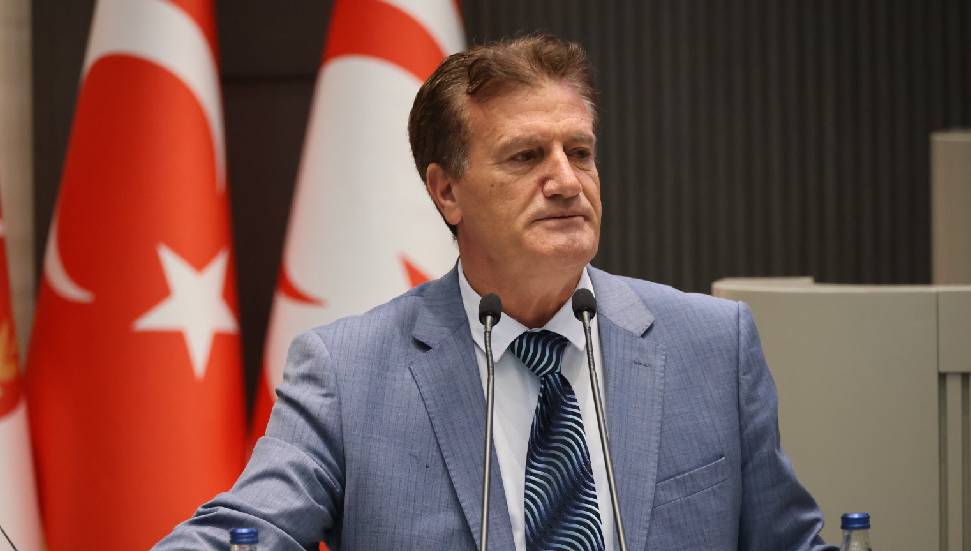
The north will face “serious energy and water problems” next year, its ‘transport minister’ Erhan Arikli said on Monday as discussions in the Turkish Cypriot legislature over next year’s ‘state’ budget began.
He said that with the budget proposed by his own ruling coalition “it will not be possible to implement the projects we desire”.
However, he said, “to this end, we are constantly visiting Ankara and discussing the support Ankara will provide for the budget”, because “we have no other authority to which we can turn”.
Turkish Vice President Cevdet Yilmaz will return to Cyprus next month to discuss a new financial protocol between the north and Turkey.
“Whether there will be early elections in 2026 or not, we must continue to make trips to Ankara throughout 2026 to leave a positive legacy,” he said.
It was at this point which he said the north will “face serious energy and water problems in 2026”.
“With whom will we discuss these issues? We will have to constantly go back and forth … We are also experiencing difficulties in tourism and education, which are significant sources of income,” he said.
To remedy this, he said, efforts to promote the north as an “information technology island” should be boosted, while measures should also be taken to address “difficulties in attracting students from Turkey”.
Arikli’s comments come at the end of what has been a troublesome year for the north’s energy sector, with a particular lowlight coming in August when an explosion at a substation near the village of Nikitas, around a mile southwest of Morphou, took the north’s entire electricity grid offline for almost a day.
Sporadic power cuts continued for days afterwards, while the ‘health ministry’ was forced later in the year to deny that there had been a chlorine gas leak at the Teknecik power station in Kyrenia after four people who worked at the power station were hospitalised.
Turkish Cypriot electricity workers’ trade union El-Sen leader subsequently described the fuel being used to power the generators at Teknecik as “pirate fuel”.
Elsewhere, the north’s electricity authority Kib-Tek remains locked into a procurement deal it signed with Turkish private energy company Aksa, which bound it to purchase the energy produced at the Kalecik power plant near the village of Gastria, which is owned and operated by Aksa, until 2038, and to pay for it in US dollars.
Tugcu described the contract as a “betrayal” when it was signed, and the feeling of unfairness in some quarters was heightened when Cyprus Turkish Chamber of Mechanical Engineers chairman Ayer Yarkiner claimed last year that Aksa’s profits in Cyprus had exceeded $1 billion (€924 million at the time) since 2000.
Aksa is also the company chosen by the north’s ruling coalition and the Turkish government to construct an undersea electricity cable which would connect the north to Turkey’s electricity grid, though developments on this front have been few and far between.
In terms of water, things are on the surface simpler for the north, with a pipeline bringing water to the island’s northern third from Turkey having been completed in 2015.
However, water consumption in the north has been rising rapidly in recent years, and ‘agriculture minister’ Huseyin Cavus said in August that the amount of water being consumed in the north is already reaching levels not expected until 2043.



Click here to change your cookie preferences