
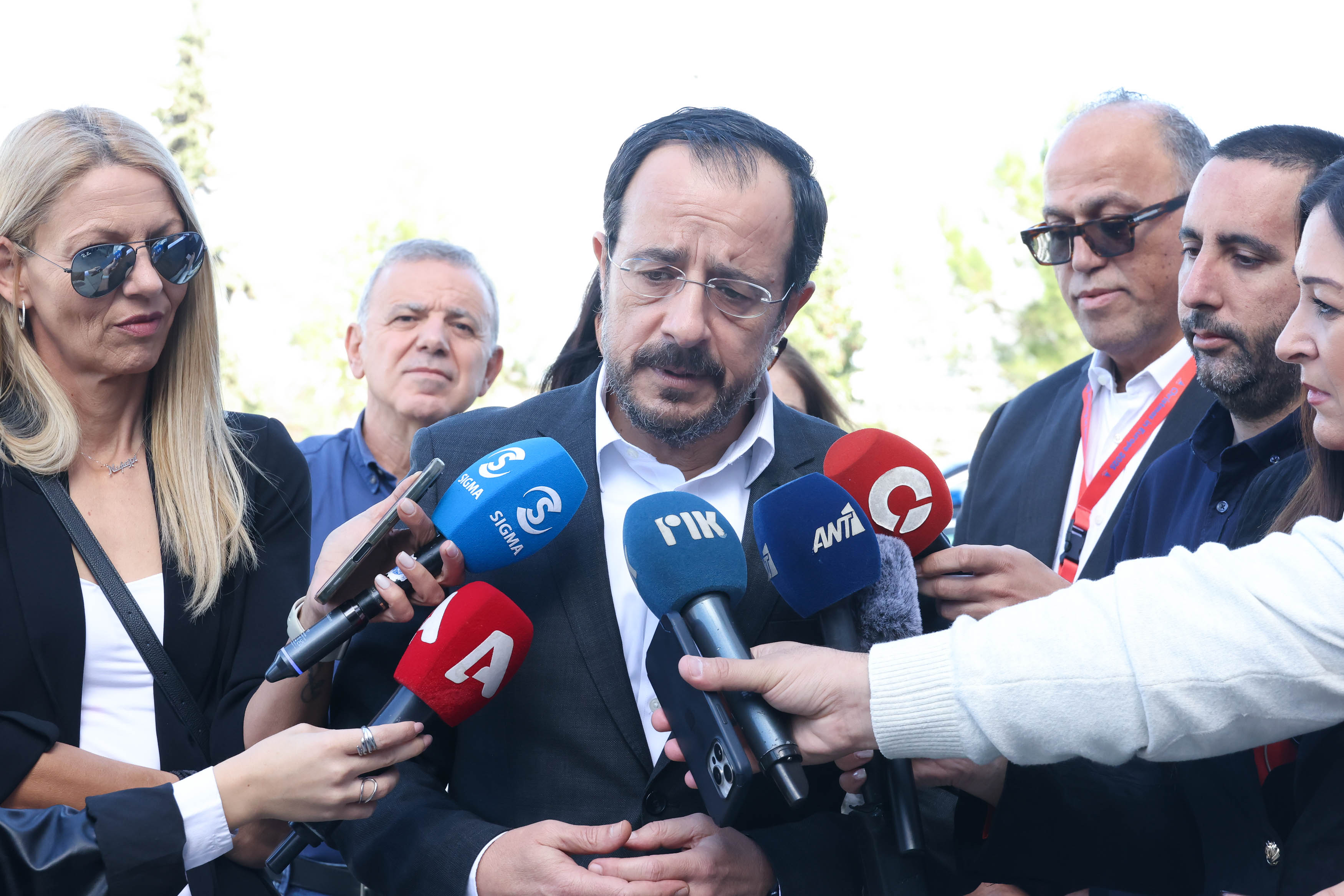
President Nikos Christodoulides spoke on Monday at the annual general assembly of the chamber of commerce and industry (Keve), emphasising the government’s economic and international policy agenda.
He highlighted measures aimed at boosting business competitiveness, promoting investment, and enhancing Cyprus’ role within the European Union.
Addressing business leaders and members of the cabinet, the president said the government will continue its current economic path through responsible fiscal policy and ongoing reforms.
He stressed that the first requirement for a competitive Cyprus is the international orientation of its businesses.
The president referred to the recently reached agreement on the automatic cost-of-living adjustment (CoLA), concluded on November 13, 2025 and effective from January 1, 2026.
He said the deal ends a long-standing issue affecting tens of thousands of workers, ensures income stability, and creates a predictable labour cost environment for companies.
Christodoulides described it as an example of successful cooperation between social partners and the state. He added that similar issues, including the minimum wage and foreign worker policies, could be resolved through constructive dialogue with unions.
He also noted Cyprus’ upcoming Presidency of the Council of the European Union in three weeks. During this period, he said, the country will prioritise enhancing EU competitiveness and supporting trade and innovation, both for Europe and Cyprus.
Christodoulides explained that Cyprus will seek to complete major EU trade agreements, accelerate negotiations with Mexico and Southeast Asian countries, strengthen trade cooperation with the UK post-Brexit, and maintain predictable dialogue with the United States to reduce the risk of unilateral tariffs.
He said Cyprus will also work to finalise free trade agreements with India and the United Arab Emirates, while continuing talks with Thailand, the Philippines, and Malaysia.
Christodoulides highlighted the importance of the EU-Canada agreement and said Cyprus will work to implement it fully.
He also cited strengthened diplomatic ties with the US, UK, and India, noting the Indian prime minister’s visit in June 2025 as a milestone for bilateral relations and investment opportunities in pharmaceuticals, defence, and technology.
He added that Cyprus’ participation in the India, Middle East, Europe trade corridor through the island brings clear geopolitical and economic benefits.
Domestically, the President said reforms aim to modernise the state and simplify bureaucracy.
He described measures to streamline construction permitting, with faster approval times for residential and small-scale projects, and announced plans to create a national business development organisation to improve financing access for Cypriot companies, particularly small and medium-sized enterprises. Christodoulides said the
Cyprus equity fund has already made initial investments in start-ups and innovative businesses, while ministry of commerce grant schemes have distributed over €360 million to support enterprises.
He stated that the planned privatisation of the Cyprus stock exchange is intended to attract capital, strengthen corporate governance, and improve market infrastructure.
On the national economy, the president said Cyprus has recorded strong growth, a low debt-to-GDP ratio, low inflation, and a surplus fiscal balance.
He described the government’s political orientation as grounded in social liberalism, with policies promoting equality, social solidarity, and a favourable environment for business and investment.
He concluded by acknowledging the role of social partners and the business community as essential contributors to Cyprus’ economic development and international positioning, emphasising a shared vision of growth and prosperity.





Click here to change your cookie preferences