
The Cypriot representation to the United Nations has submitted a letter to the security council decrying what it describes “violations” of Cyprus’ airspace and territorial waters by Turkey.
The letter was distributed to the security council’s members, and stated that in July and August, 328 violations of the island’s airspace and 16 violations of its territorial waters by Turkey were recorded.
Of those airspace violations, it said, 93 were carried out by Turkish unmanned military aircraft and a further 56 were carried out by “armed military fighter aircraft”.
It added that these reported actions constitute “yet another clear violation of the sovereignty, independence, and territorial integrity of Cyprus”, and a reflection of “Turkey’s usual blatant disregard for the UN charter and for international law”.
Additionally, it spoke of “illegal use of closed ports and airports” on the island, in reference to the Turkish Cypriots’ continued operation of Ercan (Tymbou) airport and the ports of Famagusta and Kyrenia for commercial purposes.
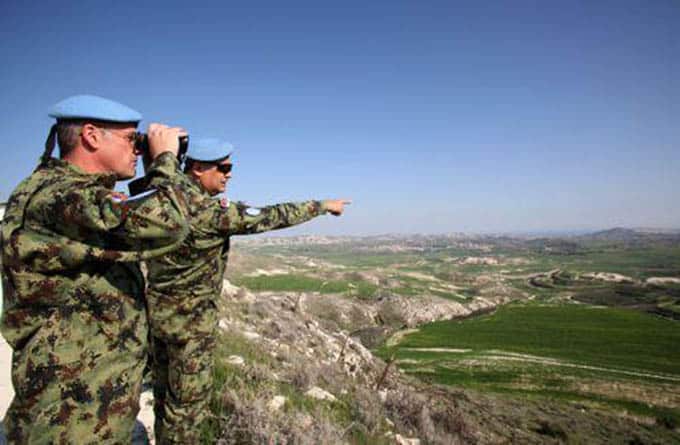
It then said there are “almost daily entries into the buffer zone” made by Turkey, and a “strengthening of the military infrastructure in the occupied areas”, and that these acts are evidence of Turkey’s “persistent aggressive behaviour on the island”.
This, it added, “undermines the sense of security of all Cypriots and efforts to resume negotiations”.
It at this point stressed that “despite” what was outlined in the letter, the Greek Cypriot side is “absolutely committed” to working closely with UN envoy Maria Angela Holguin and Secretary-General Antonio Guterres “to create the necessary conditions for the resumption of talks” to solve the Cyprus problem.
Such talks, it added, must be geared towards a solution on the basis of a “bicommunal, bizonal federation with political equality”.
In his most recent report on the state of the UN’s peacekeeping force in Cyprus (Unficyp), penned in July, Guterres had written that “military violations on both sides” were recorded “with concerning frequency” along the island’s buffer zone.
Even so, he wrote, this frequency was “somewhat lower than the previous period”, though he did stress that “the worrying long-term trends of the eroding integrity of the buffer zone and continued indifference towards the UN’s mandated authority persisted on both sides”.
There was also positive news over the matter of buffer zone violations, with Guterres writing that “a decrease in the occurrence of moves forward and overmanning violations” had been recorded in the first half of the year.
He also wrote that “a particular source of tensions in the buffer zone” during the first half of this year had “come from a small number of Greek Cypriot civilians who persisted in unauthorised activities, flouting Unficyp’s mandate to preserve the integrity of the buffer zone”.
“These activities were often exacerbated by incidents of misinformation and disinformation regarding the role of Unficyp,” he wrote.
He also referred to the matter of the barbed wire which had been placed by the Greek Cypriot side along the buffer zone in 2021, causing persistent protests from the UN.
In total, he wrote, “nearly 12 of the 14 kilometres” of the wire “remains in place”.
More recently, civilian aircraft taking off from Ercan (Tymbou) airport flew over southern Nicosia during Storm Byron last week as they attempted to avoid the worst of the weather before turning northwards and flying towards Turkey.





Click here to change your cookie preferences